Representative Laurence Massillon Keitt
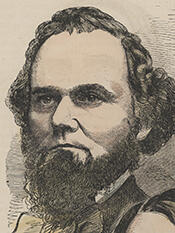
Here you will find contact information for Representative Laurence Massillon Keitt, including email address, phone number, and mailing address.
| Name | Laurence Massillon Keitt |
| Position | Representative |
| State | South Carolina |
| District | 3 |
| Party | Democratic |
| Status | Former Representative |
| Term Start | December 5, 1853 |
| Term End | March 3, 1861 |
| Terms Served | 4 |
| Born | October 4, 1824 |
| Gender | Male |
| Bioguide ID | K000054 |
About Representative Laurence Massillon Keitt
Laurence Massillon Keitt (October 4, 1824 – June 2, 1864) was an American planter, lawyer, politician, and soldier from South Carolina who became one of the most prominent pro-secession “Fire-Eaters” in the decade preceding the American Civil War. He was born in Orangeburg District, South Carolina, where he was raised in the plantation society that shaped his staunchly pro-slavery and states’ rights views. Emerging from this milieu, he would later articulate the ideological position of many Southern radicals, declaring in 1860 that “The anti-slavery party contends that slavery is wrong in itself, and the government is a consolidated national democracy. We of the South contend that slavery is right, and that this is a confederate republic of sovereign states.”
Keitt received his early education in South Carolina and pursued higher studies at the South Carolina College (now the University of South Carolina) in Columbia, where he graduated in the mid-1840s. After completing his collegiate education, he studied law, was admitted to the bar, and commenced practice in Orangeburg. Alongside his legal work, he became a planter, owning and managing enslaved labor, which further entrenched his commitment to the defense of slavery as a social and economic system. His legal training, plantation interests, and oratorical skill combined to propel him into public life as a spokesman for the most extreme wing of Southern Democratic politics.
Keitt’s political career began in the South Carolina state legislature, where he served in the General Assembly and quickly aligned himself with the radical pro-slavery faction advocating for Southern rights and, increasingly, for secession. A member of the Democratic Party, he was elected to the United States House of Representatives as a Democrat from South Carolina and first entered Congress in 1853. He served as a Representative from South Carolina in the United States Congress from 1853 to 1861, contributing to the legislative process during four terms in office. During this period, he was repeatedly identified as a leading Fire-Eater—one of the Southern politicians who adamantly urged the secession of the slaveholding states from the Union and resisted measures of compromise and reconciliation in the mounting sectional crisis.
Keitt’s service in Congress occurred during a significant and increasingly volatile period in American history, as debates over slavery, territorial expansion, and federal authority intensified. As a member of the House of Representatives, he participated in the democratic process and represented the interests of his South Carolina constituents, consistently advocating for the protection and expansion of slavery and for a strict construction of states’ rights. His rhetoric and conduct in Congress reflected the hardening sectional lines of the 1850s, and he became nationally known not only for his speeches but also for his readiness to resort to physical confrontation in defense of Southern honor and institutions.
Keitt is particularly notable for his involvement in two separate acts of legislative violence in the congressional chambers. In 1856, he played a central role in the notorious attack on Republican Senator Charles Sumner of Massachusetts by his fellow South Carolina Representative Preston Brooks. During Brooks’s caning of Sumner on the Senate floor, Keitt stood nearby, brandishing a pistol and cane to prevent other senators from coming to Sumner’s aid, thereby ensuring that the assault continued uninterrupted. Two years later, on February 5, 1858, Keitt again drew national attention when he initiated a massive brawl on the House floor during a tense late-night debate. Offended that Pennsylvania Congressman Galusha A. Grow, a Republican (and later Speaker of the House), had stepped over to the Democratic side of the chamber, Keitt dismissively ordered him to sit down, calling him a “black Republican puppy.” Grow retorted that “No negro-driver shall crack his whip over me.” Enraged, Keitt went for Grow’s throat, shouting that he would “choke [him] for that.” The confrontation escalated into a melee involving approximately fifty representatives, which ended only when a missed punch from Representative Cadwallader Washburn of Wisconsin dislodged the hairpiece of Representative William Barksdale of Mississippi; Barksdale, in his embarrassment, accidentally replaced the wig backward, provoking spontaneous laughter from both sides and bringing the brawl to an end.
As the secession crisis deepened at the close of the 1850s, Keitt emerged as an outspoken advocate for immediate separation from the Union. His public statements and congressional speeches helped frame secession as both a constitutional remedy and a moral imperative for the slaveholding South. After South Carolina seceded from the Union in December 1860, Keitt left the U.S. Congress in 1861 and continued his political work in the nascent Confederate government. He served as a deputy and delegate to the Provisional Confederate States Congress from 1861 to 1862, participating in the formation of the Confederate government and supporting policies designed to sustain the new Confederacy and safeguard slavery.
Following his service in the Provisional Confederate Congress, Keitt turned from legislative to military service as the Civil War intensified. He entered the Confederate States Army and rose to the rank of colonel, commanding troops in the field. Remaining committed to the Confederate cause, he served until he was mortally wounded during the Battle of Cold Harbor in Virginia, one of the war’s bloodiest engagements, in early June 1864. Laurence Massillon Keitt died on June 2, 1864, succumbing to the wounds he received in that battle. His career, marked by fervent pro-slavery advocacy, legislative militancy, and eventual military service, made him a prominent and controversial figure in the sectional conflict that culminated in the American Civil War.