Representative Lawrence Brooks Hays
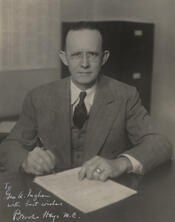
Here you will find contact information for Representative Lawrence Brooks Hays, including email address, phone number, and mailing address.
| Name | Lawrence Brooks Hays |
| Position | Representative |
| State | Arkansas |
| District | 5 |
| Party | Democratic |
| Status | Former Representative |
| Term Start | January 6, 1943 |
| Term End | January 3, 1959 |
| Terms Served | 8 |
| Born | August 9, 1898 |
| Gender | Male |
| Bioguide ID | H000405 |
About Representative Lawrence Brooks Hays
Lawrence Brooks Hays (August 9, 1898 – October 11, 1981) was an American lawyer, Baptist lay leader, and Democratic politician who served eight terms as a member of the United States House of Representatives from Arkansas from 1943 to 1959. Over the course of his career he held a series of influential legal, administrative, religious, and academic positions, including service as president of the Southern Baptist Convention and as a senior official in the administrations of Presidents John F. Kennedy and Lyndon B. Johnson.
Hays was born in London, Pope County, Arkansas, on August 9, 1898, and grew up in nearby Russellville, where he attended the public schools. In 1918 he served in the United States Army during World War I. After leaving the service, he enrolled at the University of Arkansas at Fayetteville, receiving his degree in 1919. He then moved to Washington, D.C., to study law at George Washington University, where he became a member of the Sigma Chi fraternity and earned his law degree in 1922. Admitted to the bar that same year, Hays returned to Russellville and opened a private law practice, establishing the professional base from which he would enter public life.
Hays’s early career was rooted in Arkansas state government and Democratic Party politics. From 1925 to 1927 he served as assistant attorney general of Arkansas. He twice sought higher office, running unsuccessfully for the Democratic gubernatorial nomination in 1928 and again in 1930. As the New Deal era began, he became increasingly involved in national Democratic affairs, serving as a Democratic National Committeeman for Arkansas from 1932 to 1939. In 1934 he was appointed a labor compliance officer for the National Recovery Administration in Arkansas, and in 1935 he became assistant to the administrator of resettlement. From 1936 to 1942 he held administrative and legal positions in the Farm Security Administration, work that deepened his engagement with federal efforts to address rural poverty and agricultural reform.
In 1942 Hays ran for the United States House of Representatives and was elected as a Democrat to the Seventy-eighth Congress, taking office on January 3, 1943. He was re-elected seven times, serving continuously until January 3, 1959. During these eight terms, he represented Arkansas in the House of Representatives through World War II, the early Cold War, and the beginnings of the modern civil rights era, participating in the legislative process and representing the interests of his constituents. He became known nationally for his interest in the intersection of religion and public life. In 1953 he sponsored House Resolution 60 to create within the United States Capitol “a place of retreat as an encouragement to prayer,” a measure that paralleled other mid‑century religious initiatives such as the establishment of the National Day of Prayer (1952), the addition of the words “under God” to the Pledge of Allegiance (1954), and the adoption of “In God We Trust” on U.S. currency (1955). Hays also worked closely with International Christian Leadership, later known as The Family, which sponsored the Presidential Prayer Breakfast (later the National Prayer Breakfast) beginning in 1953. Journalist Drew Pearson of The Washington Post described him in 1954 as “one of the foremost experts in psychological warfare against communism,” reflecting Hays’s use of his evangelical connections to help build a Christian conservative consensus in favor of the aggressive anti-communist internationalism that The Family termed “Militant Liberty,” an approach supported by internationalist Republicans and conservative Democrats.
Hays’s final years in Congress were dominated by the political and social upheaval surrounding school desegregation in Arkansas. During the Little Rock Integration Crisis of 1957, when President Dwight D. Eisenhower sent federal troops to enforce the integration of Central High School in Little Rock, most Arkansas politicians opposed federal intervention. Hays, who had signed the 1956 Southern Manifesto opposing the Supreme Court’s desegregation rulings and was not an integrationist, nonetheless attempted to mediate between the federal government and Arkansas Governor Orval Faubus in an effort to resolve the standoff. His perceived moderation angered segregationists, who rallied behind Amis Guthridge, an attorney for several segregationist groups, in the Democratic primary. Backed by the White Citizens’ Council and running on a pro‑segregation platform, Guthridge challenged Hays, but Hays prevailed by a three‑to‑two margin. With only a week remaining before the November 1958 general election, however, Dale Alford, a member of the Little Rock school board, launched a last‑minute write‑in campaign against him. Supported by allies of Faubus, Alford defeated Hays in a major upset by just over 1,200 votes (51 to 49 percent), one of only three successful write‑in campaigns for Congress in the twentieth century.
During his last term in Congress, Hays was elected president of the Southern Baptist Convention for the 1957–1958 term. Nominated by J. D. Grey, longtime pastor of the First Baptist Church of New Orleans, he used the position to advance his longstanding interest in religious and civic affairs. In that capacity he traveled with the Reverend Dr. Clarence Cranford, his pastor at Calvary Baptist Church in Washington, D.C., and then president of the American Baptist Convention, to Moscow on a joint peace mission, reflecting his belief in using religious channels to ease Cold War tensions. He also served on the board of directors of the National Conference on Citizenship in 1960, further underscoring his commitment to civic engagement and public service beyond elective office.
After leaving Congress in 1959, Hays continued in federal service and public life. From 1959 to 1961 he served on the board of directors of the Tennessee Valley Authority. In the Kennedy administration he was appointed Assistant Secretary of State for Congressional Relations in 1961, acting as a key liaison between the Department of State and Capitol Hill. Later that year he moved to the White House as Special Assistant to the President of the United States, a post he held from late 1961 until February 1964, continuing in that role into the early months of the Johnson administration. In 1966 he sought to return to elective office in Arkansas, running for the Democratic gubernatorial nomination in a crowded field of eight candidates following Governor Orval Faubus’s decision not to seek re‑election. Hays finished third, ahead of Dale Alford, who had defeated him in 1958, but behind Frank Holt and James D. “Justice Jim” Johnson. Johnson, a former Arkansas Supreme Court justice and avowed segregationist, secured the nomination but was defeated in the general election by Republican Winthrop Rockefeller.
In his later years Hays combined academic work with continued political involvement. He became a professor of political science at the Eagleton Institute of Politics at Rutgers University and served as a visiting professor of government at the University of Massachusetts Amherst. From 1968 to 1970 he was director of the Ecumenical Institute at Wake Forest University, reflecting his ongoing interest in the relationship between religion and public affairs. In 1970 he was elected co‑chairman of Former Members of Congress, Inc., and he later served as chairman of the Government Good Neighbor Council of North Carolina, an organization concerned with improving race relations and community affairs. In 1972 he again sought a seat in Congress, this time as the Democratic nominee for the Ninety‑third Congress from North Carolina, but he was defeated by the Republican incumbent, former Major League Baseball pitcher Wilmer “Vinegar Bend” Mizell.
With his active political and academic career concluded, Hays took up residence in Chevy Chase, Maryland. He remained there until his death on October 11, 1981. He was buried in Oakland Cemetery in Russellville, Arkansas, returning in death to the community where he had begun his legal and political career.