Representative Legrand Winfield Perce
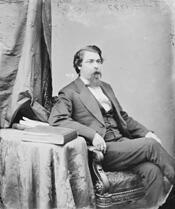
Here you will find contact information for Representative Legrand Winfield Perce, including email address, phone number, and mailing address.
| Name | Legrand Winfield Perce |
| Position | Representative |
| State | Mississippi |
| District | 5 |
| Party | Republican |
| Status | Former Representative |
| Term Start | March 4, 1869 |
| Term End | March 3, 1873 |
| Terms Served | 2 |
| Born | June 19, 1836 |
| Gender | Male |
| Bioguide ID | P000221 |
About Representative Legrand Winfield Perce
Legrand Winfield Perce (also spelled Le Grand Winfield Perce) (June 19, 1836 – March 16, 1911) was a Republican member of the United States House of Representatives from Mississippi who served two terms in Congress during the Reconstruction era, from 1869 to 1873. His congressional service took place at a significant moment in American history, as the nation grappled with the political, social, and economic consequences of the Civil War and the reintegration of the former Confederate states into the Union.
Perce was born on June 19, 1836, in Buffalo, Erie County, New York. He completed preparatory studies in his native state before pursuing higher education. He attended Genesee College in Lima, New York, an institution affiliated with the Methodist Episcopal Church that later became part of Syracuse University. Seeking a career in law, he enrolled at Albany Law School in Albany, New York, from which he graduated in 1857. That same year he was admitted to the bar and commenced the practice of law in Buffalo, beginning a professional path that would intertwine legal work, military service, and politics.
In 1859, Perce left Buffalo and traveled to St. Louis, Missouri, with the intention of making his home there. Confronted with the realities of slavery in Missouri, he concluded that, because of his strong anti-slavery views, he could not live in a slave state. He therefore abandoned his plan to settle in St. Louis and instead moved to Chicago, Illinois, a rapidly growing free-state city that was emerging as a commercial and political center in the Midwest. In Chicago he continued his legal career and aligned himself with the anti-slavery and Unionist sentiments that were gaining strength in the years immediately preceding the Civil War.
At the outbreak of the Civil War, Perce volunteered his services to Governor Richard Yates of Illinois. He served for four months on the staff of Union General Benjamin M. Prentiss at Cairo, Illinois, holding the rank of captain. In August 1861 he accepted an offer to join the Sixth Regiment, Michigan Volunteer Infantry, and was commissioned a second lieutenant. His military career advanced steadily: he was promoted to the rank of captain in June 1862, and in August 1863 he was appointed a captain in the United States Volunteers. For his service, he was brevetted lieutenant colonel and colonel in 1865, recognitions that reflected meritorious conduct during the war. His wartime experience and Union service would later shape his role in Reconstruction politics.
After the Civil War, Perce moved south and settled in Natchez, Adams County, Mississippi, a city that became an important center of Reconstruction activity. In June 1867 he was appointed register in bankruptcy, a federal position created under the Bankruptcy Act of 1867 to administer bankruptcy proceedings in the postwar economy. His legal training, Union military record, and Republican affiliation positioned him as part of the new political leadership in Mississippi during the period of federal oversight and reorganization of state governments.
Upon the readmission of Mississippi to representation in Congress, Perce was elected as a Republican to the Forty-first Congress. He took his seat on February 23, 1870, and was reelected to the Forty-second Congress, serving continuously until March 3, 1873. As a member of the House of Representatives, he participated in the legislative process at a time when Congress was addressing issues central to Reconstruction, including civil rights, education, labor, and the reintegration of the Southern states. During the Forty-second Congress he served as chairman of the Committee on Education and Labor, a position that placed him at the center of debates over national education policy and the conditions of the postwar workforce. Throughout his two terms, he represented the interests of his Mississippi constituents within the broader framework of Republican Reconstruction policies. He was not a candidate for reelection in 1872, thereby concluding his congressional career after two terms in office.
Following his departure from Congress, Perce returned to Illinois and resumed his legal and business pursuits in Chicago. He engaged in the practice of law and also became involved in the real estate business, reflecting the city’s rapid growth and expanding urban economy in the late nineteenth and early twentieth centuries. He continued to reside in Chicago for the remainder of his life. Legrand Winfield Perce died there on March 16, 1911. He was interred in Rosehill Cemetery in Chicago, a burial place for many of the city’s prominent political, military, and civic figures.