Senator Leland Stanford
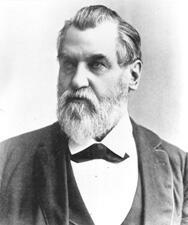
Here you will find contact information for Senator Leland Stanford, including email address, phone number, and mailing address.
| Name | Leland Stanford |
| Position | Senator |
| State | California |
| Party | Republican |
| Status | Former Representative |
| Term Start | December 7, 1885 |
| Term End | December 31, 1893 |
| Terms Served | 2 |
| Born | March 9, 1824 |
| Gender | Male |
| Bioguide ID | S000793 |
About Senator Leland Stanford
Amasa Leland Stanford (March 9, 1824 – June 21, 1893) was an American attorney, industrialist, philanthropist, and Republican Party politician from Watervliet, New York, who became one of the most influential—and controversial—figures in the economic and political development of the American West. Widely considered a robber baron for his role in the railroad industry, he served as the eighth governor of California from 1862 to 1863 and later represented California in the United States Senate from 1885 until his death in 1893. With his wife, Jane Elizabeth Lathrop Stanford, he founded Leland Stanford Junior University, named in memory of their only child.
Stanford was born in Watervliet (later part of Albany), New York, on March 9, 1824, into a family of farmers and small-scale entrepreneurs. He studied law in New York State and was admitted to the bar, beginning his professional life as an attorney. On September 30, 1850, he married Jane Elizabeth Lathrop in Albany, New York. She was the daughter of Dyer Lathrop, a merchant of that city, and Jane Anne (Shields) Lathrop. The couple did not have any children for 18 years; their only child, a son, Leland DeWitt Stanford (commonly known as Leland Stanford Jr.), was born in 1868 when his father was 44. Stanford was an active Freemason from 1850 to 1855, joining Prometheus Lodge No. 17 in Port Washington, Wisconsin, and, after moving west, he became a member of Michigan City Lodge No. 47 in Michigan Bluff, California. He was also a member of the Independent Order of Odd Fellows in California.
Drawn by the opportunities of the California Gold Rush, Stanford migrated to California in 1852. Rather than mining, he turned to commerce, becoming a successful merchant and wholesaler and building a substantial business empire. He settled in Sacramento, where he entered Republican politics and became a prominent figure in the emerging railroad industry. Stanford became an influential executive of the Central Pacific Railroad beginning in 1861, and later of the Southern Pacific railroads, holding major positions from 1861 to 1890. As head of the railroad company that built the western portion of the First Transcontinental Railroad from Sacramento eastward over the Sierra Nevada mountains into Nevada and Utah, he presided at the ceremonial driving of the “Last Spike” at Promontory, Utah, on May 10, 1869, and was given the honor of attempting to drive the final spike where the Central Pacific grade met that of the Union Pacific Railroad. He also played a significant role as a shareholder and executive in the early history of Pacific Life and Wells Fargo. Stanford moved with his family from Sacramento to San Francisco in 1874, where he assumed the presidency of the Occidental and Oriental Steamship Company, a steamship line to Japan and China associated with the Central Pacific.
Stanford’s political prominence rose in tandem with his business interests. A member of the Republican Party, he was elected the eighth governor of California and the state’s first Republican governor, serving from January 1862 to December 1863. His inauguration coincided with the Great Flood of 1862, and contemporary accounts held that he had to travel by boat to his own swearing-in. A large, slow-speaking man who read from prepared texts, he was often judged less polished than extemporaneous orators but impressed many listeners as sincere. During his gubernatorial tenure, Stanford cut the state’s debt in half and advocated for the conservation of forests. He also oversaw the establishment of California’s first state normal school in San Jose, which later became San Jose State University. Legislation passed during his time in office changed the gubernatorial term from two years to four years after his service. His record was also marked by outspoken support for restricting Chinese immigration; he argued that “the settlement among us of an inferior race is to be discouraged by every legitimate means,” language that reflected and reinforced anti-Chinese sentiment in the state. Although initially acclaimed by some for such views, he lost support when it became widely known that his Central Pacific Railroad was importing large numbers of Chinese workers to construct the railroad.
Stanford’s railroad empire continued to expand after his governorship. The Southern Pacific Company was organized in 1884 as a holding company for the Central Pacific–Southern Pacific system. Stanford was president of the Southern Pacific Company from 1885 until 1890, when he was forced out of that post, as well as the presidency of the Southern Pacific Railroad, by Collis P. Huntington, the company’s ranking vice president and a leading figure on the corporate directorate. This ouster was widely regarded as retaliation for Stanford’s election to the United States Senate in 1885 over Huntington’s ally, former Senator Aaron A. Sargent. In 1890, Stanford was elected chairman of the Southern Pacific Railroad’s executive committee, and he retained that position, along with the presidency of the Central Pacific Railroad, until his death. During these years he wielded tremendous power in the Western United States, leaving a lasting impact on California’s economy, politics, and landscape.
Stanford’s interests extended beyond railroads and politics into agriculture, animal breeding, and early motion studies. He owned the 17,800‑acre Gridley tract in Butte County and, in Santa Clara County, founded his Palo Alto Stock Farm. There he bred Standardbred horses to be raced as trotters, including his chief sire Electioneer (sired by Hambletonian) and notable offspring such as Arion, Sunol, Palo Alto, and Chimes (out of his best-known dam, Beautiful Bells), as well as Thoroughbreds for flat racing. In 1872, he commissioned photographer Eadweard Muybridge to conduct scientific studies of equine gaits at the Agricultural Park racetrack in Sacramento, later continuing the work at the Palo Alto Stock Farm. Stanford sought to determine whether a horse at a trot or gallop ever had all four feet off the ground simultaneously. The resulting photographic sequences culminated in the proto-film “Sallie Gardner at a Gallop” (1878), a landmark in the development of motion pictures. As the Palo Alto Stock Farm was later developed into the Stanford University campus, the institution acquired the enduring nickname “The Farm.”
In national politics, Stanford’s most prominent role came as a United States Senator from California. A Republican, he was elected to the Senate in 1885 and served from March 4, 1885, until his death on June 21, 1893, completing two terms in office. His service in Congress occurred during a significant period in American history marked by rapid industrialization, agrarian unrest, and debates over monetary policy and labor. As a member of the Senate, Stanford participated in the legislative process and represented the interests of his California constituents while simultaneously serving as president and director of the Central Pacific Railroad. He served for four years as chairman of the U.S. Senate Committee on Public Buildings and Grounds and also sat on the Naval Affairs Committee. Influenced by ideas later associated with the People’s Party, he authored several bills, including proposals to foster the creation of worker-owned cooperatives and to allow the issuance of currency backed by land value rather than solely by gold. None of these measures advanced out of committee, but they reflected his interest in alternative economic arrangements and employee ownership—ideas he had contemplated for more than 30 years and which he also discussed in relation to Stanford University. While in Washington, D.C., he maintained a residence on Farragut Square, near the home of Baron Karl von Struve, the Russian minister to the United States.
The death of the Stanfords’ only child profoundly reshaped their legacy. Leland Stanford Jr. died of typhoid fever in Florence, Italy, in 1884 at the age of 15 while traveling in Europe with his parents. In his memory, Leland and Jane Stanford founded Leland Stanford Junior University. The university was established by the Endowment Act of the California Assembly and Senate on March 9, 1885, and by a Grant of Endowment signed by Leland and Jane Stanford at the first meeting of the board of trustees on November 14, 1885. The Stanfords donated approximately $40 million—equivalent to about $1.4 billion in modern terms—to develop the institution, originally intended with a strong emphasis on agricultural and practical studies. Opening exercises were held on October 1, 1891. The first student admitted to Encina Hall that day was Herbert Hoover, who would later become the 31st president of the United States. The Stanford family’s wealth in the late nineteenth century has been estimated at around $50 million (roughly $1.89 billion in contemporary value). Stanford’s long-standing interest in employee ownership and cooperative principles influenced his vision for the university’s governance and its relationship to faculty and staff, and he elaborated these ideas in public statements and in his senatorial proposals.
The Stanfords maintained several notable residences. They retained ownership of their mansion in Sacramento, where their son was born in 1868; this home later became the Leland Stanford Mansion State Historic Park and is used for California state social occasions. Their grand residence on San Francisco’s Nob Hill was destroyed in the 1906 San Francisco earthquake; the site is now occupied by the Stanford Court Hotel. The family residence at the Palo Alto Stock Farm later became a convalescent home for children in 1919, a forerunner of the Lucile Packard Children’s Hospital, and was demolished in 1965. Stanford’s prominence in the railroad industry was commemorated in the naming of locomotives such as the Gov. Stanford, a 4‑4‑0 locomotive built in 1863 by the Norris Locomotive Works in Philadelphia and brought to San Francisco by sailing vessel, now preserved at the California State Railroad Museum in Sacramento, and El Gobernador, a massive 4‑10‑0 locomotive built in the Central Pacific shops in Sacramento in 1884, which proved disappointing as a freight hauler and was scrapped in July 1894. In the Sierra Nevada, Mount Stanford in California’s John Muir Wilderness—located in Pioneer Basin near other peaks named for railroad magnates, including Mount Huntington, Mount Hopkins, and Mount Crocker—bears his name.
Long afflicted with locomotor ataxia, a degenerative neurological condition, Stanford died of heart failure at his home in Palo Alto, California, on June 21, 1893, at the age of 69, while still serving in the United States Senate and presiding over the Central Pacific Railroad. He was interred in the family mausoleum on the Stanford University campus. His widow, Jane Stanford, continued to guide the university until her own death in 1905, after being poisoned with strychnine under circumstances that have remained controversial. Stanford’s life and career—spanning law, commerce, railroads, politics, and higher education—left a complex legacy of immense economic development, enduring educational philanthropy, and lasting debate over the methods and ethics of Gilded Age industrialists.