Representative Lemuel Phillips Padgett
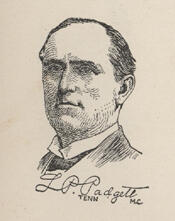
Here you will find contact information for Representative Lemuel Phillips Padgett, including email address, phone number, and mailing address.
| Name | Lemuel Phillips Padgett |
| Position | Representative |
| State | Tennessee |
| District | 7 |
| Party | Democratic |
| Status | Former Representative |
| Term Start | December 2, 1901 |
| Term End | March 3, 1923 |
| Terms Served | 11 |
| Born | November 28, 1855 |
| Gender | Male |
| Bioguide ID | P000012 |
About Representative Lemuel Phillips Padgett
Lemuel Phillips Padgett (November 28, 1855 – August 2, 1922) was an American politician and lawyer who represented Tennessee’s 7th congressional district in the United States House of Representatives from 1901 until his death in 1922. A member of the Democratic Party, he served eleven consecutive terms in Congress and played a significant role in national legislative affairs during the early twentieth century, particularly in the area of naval policy.
Padgett was born on November 28, 1855, in Columbia, Maury County, Tennessee, the son of John B. Padgett and Rebecca Ophelia (Phillips) Padgett. He was educated in the private schools of Maury County, where he received his early instruction. Seeking higher education, he enrolled at Erskine College in Due West, South Carolina, a Presbyterian institution, from which he graduated in 1876. Shortly after completing his college studies, he began reading law in September 1876 and was admitted to the bar in March 1877, marking the formal beginning of his legal career.
Following his admission to the bar, Padgett commenced the practice of law in Columbia, Tennessee, in January 1879. On November 11, 1880, he married Ida B. Latta, establishing his family life in the same community where he built his professional reputation. His legal practice and growing prominence in local affairs led naturally into political involvement. In 1884 he served as a Presidential Elector for Tennessee, reflecting his early engagement with national politics and the Democratic Party. Over the ensuing years he remained active in state and local political circles, gaining recognition as a capable attorney and party leader.
Padgett’s first major elective office came at the state level. He was elected to the Tennessee Senate, in which he served from 1899 to 1901. His tenure in the state legislature provided him with legislative experience and a broader platform within Tennessee politics. Building on this record, he successfully sought election to the United States House of Representatives as a Democrat from Tennessee’s 7th congressional district.
Elected to the Fifty-seventh Congress and to the ten succeeding Congresses, Padgett served in the U.S. House of Representatives from March 4, 1901, until his death on August 2, 1922. During more than two decades in the House, he represented the interests of his constituents while participating in the national legislative process during a period marked by rapid industrialization, Progressive Era reforms, and World War I. He was particularly influential in military and naval matters. From the Sixty-second through the Sixty-fifth Congresses, he served as chairman of the United States House Committee on Naval Affairs. In that role he oversaw legislation related to the development, expansion, and administration of the United States Navy at a time when sea power was increasingly central to American foreign and defense policy. Known as a thorough and studious man who took his responsibilities seriously, Padgett developed an extensive command of technical and strategic naval issues, becoming, in the estimation of contemporaries, a “walking encyclopedia” on naval affairs.
Padgett remained in office continuously, reflecting sustained support from his district and his party. His congressional service extended over eleven terms, encompassing major national events including the administrations of several presidents, the lead-up to and conduct of World War I, and the early postwar period. Throughout this time he contributed to the legislative process as a senior Democratic member of the House and as a key figure in shaping naval policy.
Lemuel Phillips Padgett died in Washington, D.C., on August 2, 1922, while still serving in Congress, placing him among the members of the United States Congress who died in office in the first half of the twentieth century. His body was returned to his native Tennessee, and he was interred at Rose Hill Cemetery in Columbia, Tennessee, thus concluding a public career that had remained closely tied to the community in which he was born and where he had first established himself as a lawyer and public servant.