Representative Leo Isacson
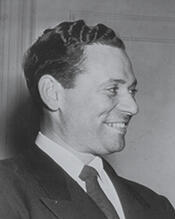
Here you will find contact information for Representative Leo Isacson, including email address, phone number, and mailing address.
| Name | Leo Isacson |
| Position | Representative |
| State | New York |
| District | 24 |
| Party | American Labor |
| Status | Former Representative |
| Term Start | January 3, 1947 |
| Term End | January 3, 1949 |
| Terms Served | 1 |
| Born | April 20, 1910 |
| Gender | Male |
| Bioguide ID | I000046 |
About Representative Leo Isacson
Leo Leous Isacson (April 20, 1910 – September 21, 1996) was a New York attorney and politician who served as a Representative from New York in the United States Congress from 1947 to 1949. A member of the American Labor Party, he won a closely watched 1948 special election to the United States House of Representatives from New York’s twenty-fourth district in the Bronx, in what contemporary observers, including The New York Times, described as “a test of Truman-[versus]-Wallace strength” in advance of the 1948 presidential election and a “test…of the third-party movement headed by Henry A. Wallace.” During his single term in Congress he contributed to the legislative process as one of the body’s most left-leaning members and represented the interests of his Bronx constituents at a moment of intense national debate over foreign policy, labor, and third-party politics.
Isacson was born on April 20, 1910, in Manhattan, New York City, New York, to a Jewish family. He grew up in New York City with two sisters, Ruth (later Thielle) and Regina (later Hymowitz). He attended the city’s public schools and proceeded to New York University, from which he graduated in 1931. He then enrolled in New York University School of Law, earning his law degree in 1933. His early life and education in New York’s public institutions helped shape his later identification with labor, tenant causes, and left-wing political movements that were particularly strong in the city’s working-class neighborhoods during the interwar and immediate postwar years.
Admitted to the bar in 1933 or 1934, Isacson commenced the practice of law in New York City. From the outset of his legal career he focused on labor and tenant cases, defending workers and renters in disputes that reflected the economic and social tensions of Depression-era and wartime New York. In 1936, at the founding of the American Labor Party (ALP), he became a member of the new organization, which sought to advance the cause of trade unions and provide an electoral vehicle for labor and left-liberal forces often dissatisfied with the major parties. His legal work on behalf of labor and tenants, combined with his early and active association with the ALP, positioned him as a prominent figure in New York’s labor-oriented political circles.
Isacson’s first major elective office came in 1944, when he was elected to represent the Bronx County 13th District in the New York State Assembly as the candidate of both the American Labor Party and the Republican Party. He served in the 165th New York State Legislature from 1945 to 1946. While serving in the Assembly, he ran in 1945 for Borough President of the Bronx, finishing second with 25 percent of the vote, an outcome that underscored his growing visibility but also the limits of third-party strength in citywide contests. He lost his bid for re-election to the Assembly in 1946. On January 6, 1947, the American Labor Party named Isacson its “legislative representative,” a role that reflected his standing within the party and his function as a liaison and advocate for its policy positions in legislative arenas.
Isacson’s national prominence stemmed from the special election held on February 17, 1948, to fill the vacancy in New York’s twenty-fourth congressional district created by the resignation of Representative Benjamin J. Rabin following Rabin’s election to the New York Supreme Court. The Democratic nominee in the race was Karl Propper, a former president of the Bronx Bar Association, who was backed by leading Democrats including Eleanor Roosevelt and New York City Mayor William O’Dwyer. Isacson, nominated by the American Labor Party, received strong public support from organized labor and from former Vice President Henry A. Wallace, who had broken with the Truman administration and was leading a new third-party presidential effort. The Greater New York CIO Council endorsed Isacson on January 24, 1948, and Wallace campaigned for him by radio on February 11 and in person on February 15. The campaign unfolded amid controversy over FBI inquiries into the political activities of “left wing” CIO locals under the Hatch Act of 1939. The Greater New York CIO Council charged that FBI agents were attempting to intimidate unions and curtail their political activity on behalf of Wallace and Isacson, while the more conservative Amalgamated Clothing Workers of America, which opposed Wallace, acknowledged FBI visits but reported receiving a “clean bill of health” and characterized the inquiries as routine. The CIO council telegraphed Attorney General Tom C. Clark to protest the investigations, arguing they were an attempt to harass unions in the exercise of their political rights.
The special election also became a focal point in the broader struggle over the emerging Progressive Party and Wallace’s presidential candidacy. Mayor O’Dwyer publicly urged Wallace to abandon his third-party effort and return to the Democratic Party, arguing that the 1948 election would be decided between Democrats and Republicans and describing the Democratic Party as “by its very nature the party of labor, of small business, small farmers and independents.” Wallace rejected this appeal and campaigned side by side with Isacson in the Bronx, while Liberal Party co-founder Adolf A. Berle denounced Wallace as a “front for an international intrigue” and accused him of seeking to “appease Russia.” Two days before the election, The New York Times noted that the contest would test the strength of the American Labor Party after the withdrawal of anti-Communist unions such as the Amalgamated Clothing Workers of America, which left Communists and other left-wing elements in control of the party’s organization. In a result widely described as a stunning upset, Isacson defeated Propper with 22,697 votes (55.8 percent) to Propper’s 12,598 votes (31 percent), while Dean Alfange of the Liberal Party received 3,840 votes and Republican Joseph A. De Nigris 1,482 votes. Saul Mills, secretary of the New York CIO Council, hailed the outcome as “the first test of labor’s independent political strength in the crucial 1948 elections.”
Isacson’s victory was interpreted nationally as a major boost to Wallace’s third-party movement and a warning sign for President Harry S. Truman’s prospects in New York and other industrial states. The Washington Post reported that Wallace had “jolted Democratic hopes of holding New York in November” and described the Bronx result as Wallace’s first electoral test since his break with the Democratic administration. The New York Times suggested that Isacson’s election indicated Wallace would draw a much larger vote than expected in 1948, potentially undermining Truman’s chances in New York and strengthening third-party candidates elsewhere, while also complicating the Republican nomination contest between Governor Thomas E. Dewey and Senator Robert A. Taft. Commentators also linked the election to the contentious issue of Palestine policy, with The Washington Post observing that “according to all seasoned political observers, it was the Palestine issue that gave the victory to Leo Isacson,” and warning of the political volatility of the question for a president seeking re-election in a state with a large Jewish electorate. In the days following the election, Wallace’s Progressive Party capitalized on the momentum, organizing a Michigan chapter on February 21, 1948, and gaining attention for its growing strength in states such as Michigan, Illinois, Pennsylvania, and California. At the same time, opponents of the Wallace movement used subsequent events—such as the New York City Council’s refusal on February 25, 1948, to seat Communist-backed candidate Simon W. Gerson—to argue that Communists were “largely responsible” for Isacson’s victory, a charge that some of Isacson’s labor supporters publicly denied.
In Congress, Isacson served from February 17, 1948, to January 3, 1949, completing the remainder of the term in the Eightieth Congress. His service in Congress occurred during a significant period in American history, marked by the early Cold War, debates over the Marshall Plan, the peacetime draft, and the shape of postwar American foreign and defense policy. As a member of the House of Representatives, he participated in the democratic process and represented the interests of his Bronx constituents while aligning with the left wing of American politics. By one quantitative measure of roll-call voting, he was later identified as the second most liberal person to serve in Congress between 1937 and 2002, surpassed only by William H. Meyer of Vermont. Reflecting his ideological commitments, he opposed the Marshall Plan and the establishment of a peacetime draft, and he was one of only three members of Congress to vote against legislation to increase the size of the United States Air Force. At the same time, he strongly advocated for immediate recognition of the State of Israel, consistent with his constituency’s concerns and his own views on the postwar international order. Some contemporary publications labeled him a socialist, underscoring the extent to which his positions diverged from the emerging Cold War consensus in both major parties.
Isacson’s tenure in the House was limited to a single term. Running in the general election of 1948, he was unable to hold the seat in the face of a national political climate that favored the major parties despite Wallace’s initial show of strength. He left Congress at the expiration of his term on January 3, 1949. In later years he continued his work as an attorney in New York City and remained associated with labor and progressive causes, though without again attaining national office. Leo Leous Isacson died on September 21, 1996, closing the life of a figure whose brief congressional career intersected with one of the most consequential third-party movements and ideological realignments in twentieth-century American politics.