Representative Leonard Ray Blanton
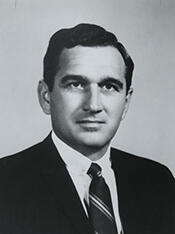
Here you will find contact information for Representative Leonard Ray Blanton, including email address, phone number, and mailing address.
| Name | Leonard Ray Blanton |
| Position | Representative |
| State | Tennessee |
| District | 7 |
| Party | Democratic |
| Status | Former Representative |
| Term Start | January 10, 1967 |
| Term End | January 3, 1973 |
| Terms Served | 3 |
| Born | April 10, 1930 |
| Gender | Male |
| Bioguide ID | B000548 |
About Representative Leonard Ray Blanton
Leonard Ray Blanton (April 10, 1930 – November 22, 1996) was an American businessman and Democratic politician who served three terms as a United States Representative from Tennessee from 1967 to 1973 and later as the 44th governor of Tennessee from 1975 to 1979. Over the course of his public career he played a notable role in state and national politics, contributing to the legislative process in Congress and pursuing government reforms and economic development as governor, even as his gubernatorial administration became synonymous with scandal involving the sale of pardons and liquor licenses. To date, Blanton is the last governor of Tennessee to have served only a single term in office; he was succeeded in the governorship by Lamar Alexander.
Blanton was born on April 10, 1930, in Hardin County, Tennessee, and was raised in a rural environment that shaped his early understanding of the economic and social concerns of his region. Before entering politics, he worked in business, gaining experience that would later inform his approach to economic development and industrial recruitment. His early life in western Tennessee, combined with his business background, helped establish his political base and his reputation as a practical, development-minded Democrat attuned to the needs of his constituents.
Blanton’s political career began in Tennessee state politics, where he first gained public office and built the network that would carry him to national prominence. As a member of the Democratic Party, he aligned himself with the dominant political organization in Tennessee during the mid‑20th century, positioning himself as a representative of working- and middle-class interests. His rise within the party reflected both his electoral appeal in his home region and his ability to navigate the shifting political landscape of the South during the civil rights era and the realignment of national party coalitions.
In 1966, Blanton was elected to the United States House of Representatives as a Democrat from Tennessee, beginning his service in the 90th Congress on January 3, 1967. He would serve three consecutive terms, remaining in the House until January 3, 1973. His tenure in Congress coincided with a significant period in American history marked by the Vietnam War, the civil rights movement, and far‑reaching debates over federal domestic programs. As a member of the House of Representatives, Leonard Ray Blanton participated in the democratic process and represented the interests of his Tennessee constituents, contributing to the legislative work of the chamber over the course of his three terms in office. During these years he supported measures aimed at economic development and infrastructure in his district, reflecting his continuing interest in improving opportunities in his home state.
After leaving Congress in 1973, Blanton turned his attention to statewide office and successfully sought the governorship of Tennessee. He was elected governor in 1974 and took office in January 1975 as the state’s 44th chief executive. As governor, he pursued a program that included government reforms and efforts to modernize state administration. He was particularly noted for his role in attracting foreign investment to Tennessee, helping to lay groundwork for the state’s later reputation as a destination for international manufacturing and industry. His administration worked to improve the state’s economic climate, and he sought to use his business experience and congressional background to promote growth and job creation.
Blanton’s governorship, however, became overshadowed by a series of scandals that emerged in the latter part of his term. Allegations surfaced that pardons and liquor licenses were being sold or otherwise corruptly distributed within his administration, prompting investigations that severely damaged his standing and legacy. The pardons scandal, and related controversies, drew national attention and contributed to a crisis of confidence in state government. The situation became so serious that state leaders moved to ensure a transition of power at the end of his term, and in January 1979 he left office after serving a single four‑year term. He was succeeded as governor by Lamar Alexander, who took office amid a climate of reform and reaction against the abuses associated with the Blanton years.
The story of the Blanton administration’s pardons scandal later became the subject of extensive journalistic and literary treatment. A portion of the scandal was chronicled in the book “Marie: A True Story” by Peter Maas, the author best known for “Serpico.” Maas’s work focused on Marie Ragghianti, a former chair of the Tennessee Board of Pardons and Paroles who challenged the corrupt practices she witnessed. The book was adapted into the 1985 motion picture “Marie,” starring Sissy Spacek in the title role of Marie Ragghianti. Attorney and future United States Senator Fred Thompson, who had served as Ragghianti’s lawyer during the investigations into the Blanton administration, launched his acting career in this film by portraying himself. The pardons scandal, as well as other aspects of the Blanton administration, were also detailed in the book “FBI Codename TENNPAR,” written by Hank Hillin, the Nashville-based FBI agent who led the federal investigation into corruption in Tennessee government during Blanton’s tenure.
In his later years, Blanton lived largely out of the public eye, his reputation permanently shaped by the contrast between his efforts at economic development and reform and the corruption scandals that engulfed his administration. He remained a figure of enduring interest in Tennessee political history, both for his role in bringing foreign investment to the state and for the ethical controversies that prompted significant changes in how state government conducted its business. Leonard Ray Blanton died on November 22, 1996, closing a career that had spanned local, congressional, and gubernatorial service during a transformative era in Tennessee and American politics.