Representative Leonidas Campbell Houk
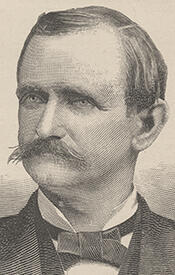
Here you will find contact information for Representative Leonidas Campbell Houk, including email address, phone number, and mailing address.
| Name | Leonidas Campbell Houk |
| Position | Representative |
| State | Tennessee |
| District | 2 |
| Party | Republican |
| Status | Former Representative |
| Term Start | March 18, 1879 |
| Term End | March 3, 1893 |
| Terms Served | 7 |
| Born | June 8, 1836 |
| Gender | Male |
| Bioguide ID | H000818 |
About Representative Leonidas Campbell Houk
Leonidas Campbell Houk (June 8, 1836 – May 25, 1891) was an American lawyer, Union Army officer, judge, and Republican politician who represented Tennessee’s 2nd congressional district in the United States House of Representatives. Serving from 1879 until his death in 1891, he was elected to seven consecutive terms and played a central role in entrenching Republican dominance in East Tennessee during the post–Civil War era. His long tenure in Congress, spanning a significant period in American political and economic development, made him one of the key Republican figures in his region in the late nineteenth century.
Houk was born near Boyds Creek in Sevier County, Tennessee. Orphaned at a young age and raised in modest circumstances, he received only limited formal schooling and worked from an early age to support himself. He learned the trade of cabinetmaking and carpentry and spent part of his youth working as a mechanic. Despite these constraints, he pursued self-education vigorously, reading law on his own initiative. His early life in the mountain region of East Tennessee, where Unionist sentiment was strong even before the Civil War, helped shape his political outlook and his later alignment with the Republican Party.
Largely self-trained as a lawyer, Houk was admitted to the bar in Tennessee and began practicing law in Knoxville. His legal practice developed alongside growing political involvement in the tumultuous years leading up to the Civil War. When the conflict began, Houk, reflecting the strong Unionist tradition of East Tennessee, supported the Union cause. He enlisted in the Union Army and, within a few months, rose to the rank of colonel. His wartime service enhanced his standing among Unionists in the region and provided a foundation for his subsequent public career.
After the Civil War, Houk resumed the practice of law and quickly moved into judicial service. From 1866 to 1869, he served as a state circuit court judge in Tennessee, presiding over a wide range of civil and criminal matters during the difficult Reconstruction period. His tenure on the bench coincided with efforts to reestablish civil authority and integrate formerly Confederate areas back into the Union’s legal and political framework. Following his judicial service, he returned full-time to private practice in Knoxville, where he continued to build his reputation as a capable lawyer and influential Republican leader in East Tennessee.
Houk’s congressional career began with his election as a Republican to the Forty-sixth Congress. He took his seat on March 4, 1879, representing Tennessee’s 2nd congressional district, and was subsequently reelected to the Forty-seventh, Forty-eighth, Forty-ninth, Fiftieth, and Fifty-first Congresses, and to the Fifty-second Congress as well. Between 1878 and 1891, he was elected to seven consecutive terms in the House of Representatives, serving continuously from 1879 until his death in 1891. During these years he participated actively in the legislative process, representing the interests of his East Tennessee constituents and helping to solidify the long-term Republican congressional dominance in that region that has persisted into the modern era.
As a member of the House of Representatives, Houk served during a period marked by debates over Reconstruction’s legacy, civil service reform, economic policy, veterans’ issues, and the evolving role of the federal government. He was known as a reliable Republican vote and a strong advocate for Union veterans, reflecting both his own military background and the priorities of his district. His influence extended beyond formal committee assignments, as he was regarded as a key organizer and political strategist for the Republican Party in East Tennessee, helping to maintain party unity and electoral strength in a predominantly Republican enclave within a largely Democratic state.
Leonidas Campbell Houk died in office in Knoxville, Tennessee, on May 25, 1891, while serving in the Fifty-second Congress. His death placed him among the members of the United States Congress who died in office in the nineteenth century. He was interred in Old Gray Cemetery in Knoxville. Houk’s legacy endures in the continued Republican strength of East Tennessee, a political pattern he helped to shape through his wartime loyalty to the Union, his postwar judicial service, and more than a decade of continuous representation in the United States House of Representatives.