Representative Leslie Larkin Byrne
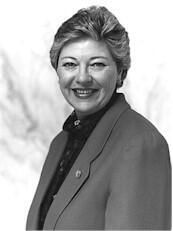
Here you will find contact information for Representative Leslie Larkin Byrne, including email address, phone number, and mailing address.
| Name | Leslie Larkin Byrne |
| Position | Representative |
| State | Virginia |
| District | 11 |
| Party | Democratic |
| Status | Former Representative |
| Term Start | January 5, 1993 |
| Term End | January 3, 1995 |
| Terms Served | 1 |
| Born | October 27, 1946 |
| Gender | Female |
| Bioguide ID | B001213 |
About Representative Leslie Larkin Byrne
Leslie Larkin Byrne (née Beck; born October 27, 1946) is an American politician and businesswoman who served as the U.S. representative for Virginia’s 11th congressional district from 1993 to 1995. A member of the Democratic Party, she became the first woman elected to the United States House of Representatives from the Commonwealth of Virginia when she won the newly created 11th district seat in 1992. Her single term in Congress coincided with a significant period in American political history, and she contributed actively to the legislative process while representing the interests of her Northern Virginia constituents.
Byrne was born in Salt Lake City, Utah, the daughter of Stephen and Shirley Beck, and she grew up in Salt Lake City. She attended the University of Utah and Mount Vernon College in Ohio, pursuing her education before embarking on a career that would combine business, community activism, and public service. In 1971, her family moved to Northern Virginia, a relocation that would shape the course of her political life. Settling in Fairfax County, she became involved in local civic affairs and community organizations, laying the groundwork for her later electoral career.
In Northern Virginia, Byrne quickly emerged as an active community leader. She participated in the Parent Teacher Association for her children’s schools, worked with the Fairfax Area League of Women Voters, and served on the Fairfax County Commission on Fair Campaign Practices. These roles deepened her engagement with public policy issues and local governance, particularly in areas related to education, fair elections, and civic participation. In 1985, she co-founded Quintech Associates, Inc., a human resources consulting firm, and served as its president. Her leadership at Quintech continued until her election to Congress in 1992, giving her experience in business management and workforce issues that would inform her later legislative priorities.
Byrne entered elective office in 1985, when she was elected to the Virginia House of Delegates after defeating two-term Republican incumbent Gwen Cody. She served in the House of Delegates for six years. During her tenure, she supported public–private partnerships for transportation infrastructure, including backing the Dulles Greenway project, a toll road intended to improve access between Loudoun County and the Washington Dulles International Airport area. Her work in the state legislature helped establish her reputation as a lawmaker attentive to transportation, growth, and quality-of-life issues in the rapidly developing Northern Virginia region.
Following the 1990 U.S. census, Virginia was awarded an additional seat in the U.S. House of Representatives, leading to the creation of the 11th congressional district in the suburbs of Washington, D.C. Byrne ran for this new seat in 1992, a year nationally dubbed the “Year of the Woman” because of the large number of women elected to Congress. Winning the race, she became the first woman ever elected to Congress from Virginia. She served in the 103rd Congress from January 3, 1993, to January 3, 1995, during which she was a member of the House Committee on Public Works and Transportation and the House Committee on Post Office and Civil Service. Her freshman Democratic colleagues elected her to the leadership position of freshman caucus whip, reflecting the confidence placed in her by other new members.
During her term in the House of Representatives, Byrne introduced and passed more legislation than any other freshman representative. Among her legislative achievements were two measures on childhood immunization that were enacted into law, underscoring her interest in public health and preventive care. She also played a role in securing federal funds for rail transportation improvements, including efforts to extend rail service from Tysons Corner to Washington Dulles International Airport, an early step in what would become a major regional transit initiative. Despite these accomplishments, she faced a difficult political environment in the 1994 midterm elections, a year marked by the “Republican Revolution.” In that election, Thomas M. Davis, then chairman of the Fairfax County Board of Supervisors, defeated her for re-election. His campaign argued that Byrne was too liberal for the swing district and criticized her voting record as being too supportive of President Bill Clinton.
After leaving Congress, Byrne remained active in Virginia and national politics. In 1996, she sought the Democratic nomination for the U.S. Senate to challenge incumbent Republican Senator John Warner. At the Virginia Democratic Convention that year, future Governor Mark Warner (no relation) won the nomination, receiving 1,889 delegates to Byrne’s 231; he went on to lose to Senator Warner in the general election. In 1998, Byrne joined the United States Information Agency, where she advised the director on the au pair program, adding federal administrative experience to her background in legislative service and business.
Byrne returned to elected office in 1999 when she won a closely contested race for the Senate of Virginia, defeating two-term Republican incumbent Jane Woods by a narrow margin (45.52 percent to 45.39 percent). During her term in the Virginia Senate, she continued to focus on issues related to growth and community standards. Among the legislation she sponsored was a measure to prohibit people from sleeping in rooms other than designated bedrooms, a response to local concerns about overcrowded housing, particularly involving students and low-income immigrants in residential neighborhoods. After one term, she chose not to seek re-election when redistricting placed her in the same district as another Democratic incumbent, and she left the Senate at the conclusion of her term.
Byrne remained a prominent figure in statewide politics into the 2000s. In 2005, she was the Democratic Party’s nominee for Lieutenant Governor of Virginia. In the general election held on November 8, 2005, she was defeated by Republican candidate Bill Bolling by a margin of approximately 1.2 percent. In 2008, she again sought to return to the U.S. House of Representatives by running for the Democratic nomination for Virginia’s 11th congressional district, the seat she had previously held. With incumbent Republican Thomas M. Davis choosing not to run for re-election, Byrne entered a multicandidate Democratic primary that included Gerald Connolly, then chairman of the Fairfax County Board of Supervisors. On June 10, 2008, Connolly defeated Byrne by a vote of 58 percent to 33 percent and later won the general election against Republican Keith Fimian.
Throughout her career, Leslie Larkin Byrne has combined business experience, community activism, and public service at both the state and federal levels. She is married to Larry Byrne, president of an international consulting firm. The couple has two grown children and three grandchildren, and she has remained associated with public affairs and civic life in Virginia beyond her years in elected office.