Representative Levi Warner
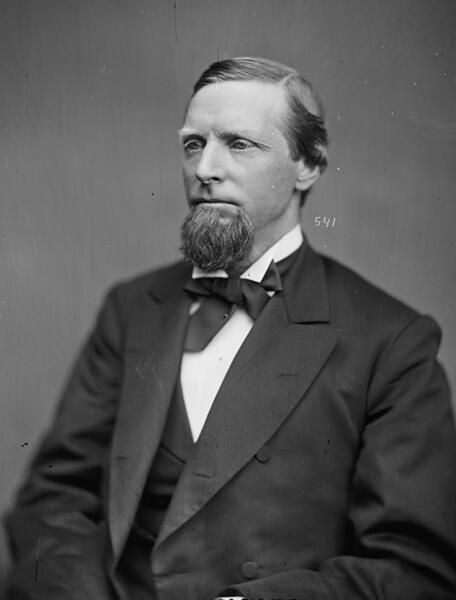
Here you will find contact information for Representative Levi Warner, including email address, phone number, and mailing address.
| Name | Levi Warner |
| Position | Representative |
| State | Connecticut |
| District | 4 |
| Party | Democratic |
| Status | Former Representative |
| Term Start | December 6, 1875 |
| Term End | March 3, 1879 |
| Terms Served | 2 |
| Born | October 10, 1831 |
| Gender | Male |
| Bioguide ID | W000155 |
About Representative Levi Warner
Levi Warner (October 10, 1831 – April 12, 1911) was a Democratic member of the United States House of Representatives from Connecticut’s 4th congressional district, serving in Congress from 1875 to 1879 and, more specifically, from December 4, 1876, to March 3, 1879. Over the course of two terms in office, he represented the interests of his constituents during a significant period in American history and contributed to the legislative process as a member of the House of Representatives.
Warner was born in Wethersfield, Connecticut, on October 10, 1831. He completed his preparatory studies in his native state before pursuing formal legal education. He attended the law department of Yale College and later studied at Dane Law School in Cambridge, Massachusetts, which was associated with Harvard University and was one of the leading centers of legal training in the country at the time. This education prepared him for a professional career in the law and public service. He was part of a politically active family; his brother, Samuel Larkin Warner, also served as a United States Representative from Connecticut.
After completing his legal studies, Warner was admitted to the bar in 1859. He commenced the practice of law in Fairfield County, Connecticut, and by 1858 had moved to Norwalk, Connecticut, where he continued to build his legal practice. His work as an attorney in Norwalk and the surrounding region established him as a prominent member of the local bar and provided the professional foundation for his later political career. Throughout this period, he remained aligned with the Democratic Party, which would become the vehicle for his entry into national politics.
Warner’s congressional service began in the context of post–Civil War Reconstruction and the political realignments of the 1870s. A member of the Democratic Party, he was elected as a Representative from Connecticut to the United States Congress and served two terms in office. He was elected to the Forty-fourth Congress to fill the vacancy caused by the resignation of William H. Barnum, a prominent Connecticut Democrat who left the House for the United States Senate. Warner took his seat on December 4, 1876, representing Connecticut’s 4th congressional district, and he was subsequently reelected to the Forty-fifth Congress.
During his tenure in the House of Representatives, which extended until March 3, 1879, Warner participated in the democratic process at a time of intense national debate over economic policy, federal-state relations, and the aftermath of Reconstruction. As a member of the House, he contributed to the legislative work of Congress and represented the interests of his Connecticut constituents, reflecting the priorities of the Democratic Party in a period marked by contested presidential elections and shifting party coalitions. Although he had successfully secured reelection once, he was not a candidate for renomination in 1878, bringing his congressional career to a close at the end of the Forty-fifth Congress.
Following his departure from Congress, Warner returned to Norwalk and resumed the practice of law. He continued his professional activities there, maintaining his standing in the legal community and remaining a figure of local prominence. His post-congressional years were spent in the same city that had long served as the center of his legal and civic life.
Levi Warner died in Norwalk, Connecticut, on April 12, 1911. He was interred in Riverside Cemetery in Norwalk. His life and career, which included service in two Congresses and a long tenure as a practicing attorney, reflected both the political traditions of his family and the broader currents of Connecticut and national politics in the late nineteenth century.