Representative Lewis Leonard Boyer
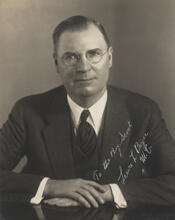
Here you will find contact information for Representative Lewis Leonard Boyer, including email address, phone number, and mailing address.
| Name | Lewis Leonard Boyer |
| Position | Representative |
| State | Illinois |
| District | 15 |
| Party | Democratic |
| Status | Former Representative |
| Term Start | January 5, 1937 |
| Term End | January 3, 1939 |
| Terms Served | 1 |
| Born | May 19, 1886 |
| Gender | Male |
| Bioguide ID | B000724 |
About Representative Lewis Leonard Boyer
Lewis Leonard Boyer (May 19, 1886 – March 12, 1944) was a Democratic U.S. Representative from Illinois who served one term in the Seventy-fifth Congress from 1937 to 1939. His congressional career took place during a significant period in American history, as the nation continued to grapple with the effects of the Great Depression and the implementation of New Deal policies. Over the course of his public life, Boyer combined experience as an educator, civil engineer, and local official with national legislative service, representing the interests of his Illinois constituents in the U.S. House of Representatives.
Boyer was born on a farm near Richfield Township, Adams County, Illinois, on May 19, 1886. He was raised in a rural environment and attended the local rural schools, receiving the basic education typical of small farming communities in the late nineteenth and early twentieth centuries. This early background in an agricultural setting informed his later understanding of the needs and concerns of rural residents in western Illinois, many of whom would become part of his political constituency.
After completing his schooling, Boyer began his professional life in education. From 1904 to 1915 he taught in the public schools of Douglas, Franklin, Pin Oak, and Liberty, Illinois. During this eleven-year period as a schoolteacher, he pursued further studies in civil engineering, preparing himself for a transition into technical and administrative work. His dual experience in the classroom and in technical study reflected a broader trend in early twentieth-century America, in which expanding infrastructure and public works created new opportunities for individuals with practical engineering skills.
In 1915 Boyer moved to Quincy, Illinois, the county seat of Adams County, where he embarked on a long career in public service at the local level. That same year he became county superintendent of highways of Adams County, Illinois, a position he held from March 1915 until December 1936. In this capacity he was responsible for the planning, construction, and maintenance of county roads and related infrastructure during a period of rapid growth in automobile use and public investment in transportation. His more than two decades as county superintendent of highways established him as a prominent local official and gave him extensive experience in public administration, budgeting, and the practical challenges of implementing government programs.
Boyer’s long tenure in county office provided the foundation for his entry into national politics. A member of the Democratic Party, he was elected to the U.S. House of Representatives as a Democrat from Illinois to the Seventy-fifth Congress, serving from January 3, 1937, to January 3, 1939. His term coincided with President Franklin D. Roosevelt’s second administration and the continuing development of New Deal legislation. As a Representative, Boyer participated in the legislative process and contributed to debates on national policy, while representing the interests of his Illinois constituents in Congress. His service in the House placed him among those lawmakers charged with responding to the economic and social challenges of the late 1930s.
In 1938 Boyer was an unsuccessful candidate for reelection to the Seventy-sixth Congress, bringing his congressional service to a close after a single term. He remained active in Democratic politics in Illinois, seeking to continue his public career at the state level. He ran unsuccessfully for the Illinois State Senate in 1940 and again in 1942, demonstrating his ongoing engagement with public affairs and his desire to return to elective office even after leaving Congress.
Lewis Leonard Boyer spent his later years in Quincy, Illinois. He died there on March 12, 1944. Following his death, he was interred in Xander Cemetery in Liberty, Illinois, returning to the community in Adams County where he had taught school and first established himself in public life. His career reflected the trajectory of a rural Illinois educator and engineer who rose to national office during a transformative era in American political and economic history.