Senator Lewis Baxter Schwellenbach
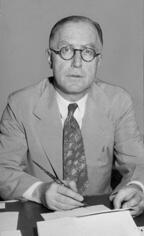
Here you will find contact information for Senator Lewis Baxter Schwellenbach, including email address, phone number, and mailing address.
| Name | Lewis Baxter Schwellenbach |
| Position | Senator |
| State | Washington |
| Party | Democratic |
| Status | Former Representative |
| Term Start | January 3, 1935 |
| Term End | December 16, 1940 |
| Terms Served | 1 |
| Born | September 20, 1894 |
| Gender | Male |
| Bioguide ID | S000160 |
About Senator Lewis Baxter Schwellenbach
Lewis Baxter Schwellenbach (September 20, 1894 – June 10, 1948) was a United States senator from Washington, a United States district judge of the United States District Court for the Eastern District of Washington, and the 5th United States Secretary of Labor. A member of the Democratic Party, he played a significant role in national affairs during the New Deal and post–World War II eras, contributing to the legislative process during one term in the United States Senate and later shaping federal labor policy in the Truman administration.
Schwellenbach was born on September 20, 1894, in Superior, Douglas County, Wisconsin. He moved with his family to Spokane, Washington, in his youth, where he attended public schools. After completing his early education, he worked for a period before pursuing higher studies, gaining familiarity with the economic and social conditions of the Pacific Northwest that would later inform his public service. His early life in a growing Western state exposed him to issues of labor, industry, and regional development that became central themes in his career.
Schwellenbach attended the University of Washington in Seattle, where he studied law. He received a Bachelor of Laws (LL.B.) degree from the University of Washington School of Law in 1917. Shortly after his graduation, he entered military service during World War I, serving in the United States Army. Following his discharge, he returned to Washington State and was admitted to the bar, beginning the practice of law in Seattle. In the 1920s and early 1930s, he established himself as a practicing attorney and became active in Democratic Party politics, gaining recognition as a capable lawyer and an advocate for progressive policies in line with the emerging New Deal coalition.
Building on his legal and political experience, Schwellenbach was elected as a Democrat to the United States Senate from Washington and served from January 3, 1935, to December 16, 1940, when he resigned. His service in Congress occurred during a significant period in American history, as the nation grappled with the Great Depression and the implementation of President Franklin D. Roosevelt’s New Deal. As a member of the Senate, Lewis Baxter Schwellenbach participated in the democratic process and represented the interests of his constituents in Washington State, supporting legislation aimed at economic recovery, social welfare, and labor protections. In 1938, he served as a delegate to the Inter-Parliamentary Union at The Hague, Netherlands, reflecting his engagement with international parliamentary dialogue on peace and cooperation. He was not a candidate for renomination in 1940, having been appointed to the federal bench.
On December 16, 1940, Schwellenbach resigned from the Senate to accept appointment as a United States district judge of the United States District Court for the Eastern District of Washington. In this judicial capacity, he presided over federal cases arising in a region undergoing rapid change due to defense production and wartime economic mobilization. His tenure on the bench was marked by the legal complexities of the World War II era, including issues related to federal regulation, labor, and wartime controls, and it further solidified his reputation as a careful and experienced interpreter of federal law.
Schwellenbach’s judicial service led to his selection for a key executive post in the immediate postwar period. He was appointed United States Secretary of Labor by President Harry S. Truman and served from July 1, 1945, until his death on June 10, 1948. As Secretary of Labor, he confronted the difficult transition from wartime to peacetime production. During Schwellenbach’s tenure as Secretary, fear of post-war unemployment brought the United States Congress to pass the Employment Act of 1946, which made promotion of maximum employment the nation’s top priority and established a framework for federal economic policy. He promoted the abolition of wartime wage and price controls as part of the broader demobilization of the wartime economy and worked to manage a major post-war wave of strikes as workers and employers adjusted to new economic conditions.
Schwellenbach’s term at the Department of Labor coincided with a shift in congressional attitudes toward organized labor. The Republican 80th United States Congress passed the Taft–Hartley Act, which significantly amended federal labor law and imposed new restrictions on unions, altering the balance of power in labor-management relations. During this period, staff cuts were made at the United States Department of Labor, and important structural changes occurred in the federal labor-relations apparatus. The U.S. Conciliation Service was removed from the Department of Labor and established as the independent Federal Mediation and Conciliation Service (FMCS), reflecting congressional efforts to reorganize labor dispute resolution. At the same time, the Department’s international work was institutionalized; the Office of International Labor Affairs (now the Bureau of International Labor Affairs) was established as a unit in the Office of the Secretary, expanding the department’s role in international labor standards and postwar reconstruction.
Lewis Baxter Schwellenbach died in office as Secretary of Labor at Walter Reed Army Medical Center in Washington, D.C., on June 10, 1948. He was interred in Washelli Cemetery in Seattle, Washington. His career, spanning service as a United States senator, a federal district judge, and a cabinet officer, reflected the central political and economic transformations of the United States from the Great Depression through the aftermath of World War II, and he left a legacy in both domestic labor policy and the institutional development of the Department of Labor.