Representative Lewis Steward
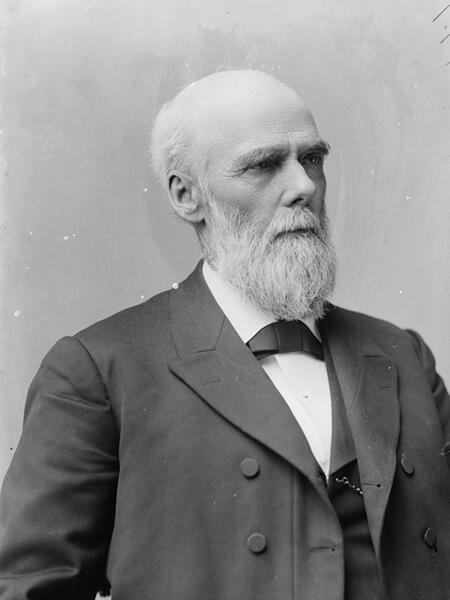
Here you will find contact information for Representative Lewis Steward, including email address, phone number, and mailing address.
| Name | Lewis Steward |
| Position | Representative |
| State | Illinois |
| District | 8 |
| Party | Democratic |
| Status | Former Representative |
| Term Start | December 7, 1891 |
| Term End | March 3, 1893 |
| Terms Served | 1 |
| Born | November 21, 1824 |
| Gender | Male |
| Bioguide ID | S000897 |
About Representative Lewis Steward
Lewis Steward (November 20, 1824 – August 27, 1896) was a U.S. Representative from Illinois, businessman, town founder, and philanthropist. A member of the Democratic Party, he served one term in the United States House of Representatives from 1891 to 1893, representing an Illinois district during a significant period in American political and economic development. Over the course of his career, he played a notable role in the growth of agricultural machinery manufacturing and in the development of the town of Plano, Illinois.
Steward settled in what would become Plano, Illinois, in the mid-nineteenth century and quickly became involved in local development and business. In 1853, recognizing the importance of rail transportation to the growth of the region, he persuaded surveyors from the Chicago, Burlington & Quincy Railroad to build a station near his homestead. After the station was established, he platted the surrounding territory, formally laying out and effectively founding the town of Plano. Ambitious and largely self-taught, Steward studied law in his spare time and was admitted to the bar in 1860, although he chose not to practice law professionally, instead devoting his energies to business and civic affairs.
Steward’s most significant business venture began in 1862, when brothers C. W. and W. W. Marsh approached him with an opportunity to invest in their experimental harvesting machine. Recognizing the potential of mechanized agriculture, Steward joined forces with the Marsh brothers to refine and perfect their prototype. By 1863, they had established the Plano Harvester Works under the name Marsh, Steward & Company. The firm sold 100 machines in its first year of operation, and by the mid-1870s it was producing approximately 10,000 machines annually, making it a major force in the agricultural equipment industry. In 1875, investor William Deering purchased the company and moved it to North Chicago, renaming it the Deering Harvester Company. This enterprise later became part of a landmark consolidation in 1902, when Deering Harvester merged with the McCormick Harvesting Machine Company and others to form International Harvester, one of the most important agricultural machinery manufacturers of the era. Steward’s early role as co-founder of Marsh, Steward & Company thus placed him at the origins of a company that would have a lasting impact on American agriculture.
Despite the sale of the company, Steward chose to remain in Plano rather than follow the business to North Chicago. He continued to expand his business interests locally. He had established a tannery in 1864, and in 1876 he purchased a boot and shoe factory that used leather produced by this tannery, further integrating his enterprises. By 1877, his various ventures had made him a wealthy man, with an estimated worth of more than $250,000, a substantial fortune for the time. That same year, he entered statewide politics as the Democratic Party’s candidate for Governor of Illinois. Although he was defeated in the 1876 gubernatorial election, he lost by a margin of only about 5,000 votes, a significantly closer result than other recent Democratic candidates in the state, and his performance demonstrated the party’s growing competitiveness in Illinois.
In the 1880s, Steward increasingly turned his attention from private enterprise to philanthropy and civic improvement in Plano. He donated land to local churches and contributed to their construction, reflecting his commitment to the religious and social life of the community. He established a park and built an opera house, providing cultural and recreational amenities for the town’s residents. He also sponsored an annual excursion for local boys and girls to attend the circus, an event that became a cherished tradition. Demonstrating his interest in public infrastructure, Steward financed the construction of a water system for Plano and later sold it to the town in 1888, helping to modernize local services and improve public health and safety.
Steward’s prominence in business and local affairs led naturally to a role in national politics. A Democrat, he was elected in 1890 to the United States House of Representatives and served in the Fifty-second Congress from 1891 to 1893. During his single term in office, he represented the interests of his Illinois constituents and participated in the legislative process at a time when the nation was grappling with issues of industrialization, agricultural policy, and monetary reform. His service in Congress occurred during a significant period in American history, and as a member of the House of Representatives he contributed to the democratic process and the formulation of national policy. After his term ended, he sought to return to Congress, running unsuccessfully for the same office in 1892 and again in 1894.
In his later years, Steward remained in Plano, continuing to be identified with the town he had helped to found and develop. He died there on August 27, 1896, at the age of 71. His legacy in Plano endured not only through the institutions and improvements he had sponsored but also through his residence; the house he built in 1854 was recognized for its historical significance and was listed on the National Register of Historic Places on November 28, 2003. Through his combined roles as entrepreneur, town builder, philanthropist, and public servant, Lewis Steward left a lasting imprint on both his local community and the broader economic and political life of Illinois.