Representative Lincoln Davis
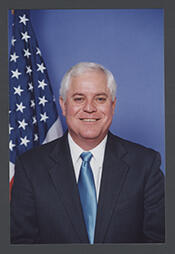
Here you will find contact information for Representative Lincoln Davis, including email address, phone number, and mailing address.
| Name | Lincoln Davis |
| Position | Representative |
| State | Tennessee |
| District | 4 |
| Party | Democratic |
| Status | Former Representative |
| Term Start | January 7, 2003 |
| Term End | January 3, 2011 |
| Terms Served | 4 |
| Born | September 13, 1943 |
| Gender | Male |
| Bioguide ID | D000599 |
About Representative Lincoln Davis
Lincoln Edward Davis (born September 13, 1943) is an American politician and businessman who represented Tennessee’s 4th congressional district in the United States House of Representatives from January 3, 2003, to January 3, 2011. A member of the Democratic Party, he served four terms in Congress during a significant period in American history, participating in the legislative process and representing the interests of a largely rural constituency. Before his service in the U.S. House of Representatives, Davis was a long-serving member of the Tennessee General Assembly from 1980 to 2002, and he later became a member of the ReFormers Caucus of Issue One, a bipartisan group of former elected officials focused on political reform.
Davis has spent most of his life in Fentress County, Tennessee, a predominantly rural county in the state’s coal-mining region. He grew up in this environment and maintained close ties to the area throughout his career. He graduated from Tennessee Technological University (Tennessee Tech) in 1966 with a degree in agriculture, a field of study that reflected the economic and cultural character of his home region. Davis later settled in the rural Fentress County community of Pall Mall, where he established his home and business interests. He owns Diversified Construction Co., a construction firm that builds homes, apartments, and offices, and that provided him with a professional background in small business and development. Davis married Lynda, an elementary school teacher who later retired from the profession, and together they have three daughters—Larissa, Lynn, and Libby—and five grandchildren.
Davis began his political career at the local level in 1978, when he was elected mayor of Byrdstown, Tennessee. Midway through his term as mayor, he successfully ran for a seat in the Tennessee House of Representatives, where he served two terms representing the 38th district from 1980 until 1984. In the state legislature, he quickly developed a reputation for focusing on issues affecting working families, public employees, and vulnerable populations. In 1984, he gave up his House seat to seek the Democratic nomination for the U.S. House of Representatives in Tennessee’s 6th congressional district after Representative Al Gore vacated the seat to run successfully for the United States Senate. Davis narrowly lost that primary to state Democratic Party chairman Bart Gordon, marking the first of several close congressional nomination contests in his early career.
After returning to private life and remaining active in regional politics, Davis again sought a seat in Congress in 1994, this time in Tennessee’s 4th congressional district. He ran for the Democratic nomination after Representative Jim Cooper left the seat to pursue an ultimately unsuccessful campaign for the U.S. Senate seat being vacated by Al Gore. Davis again lost narrowly, this time to Jeff Whorley, a former assistant to Cooper; Whorley went on to lose the general election to Republican Van Hilleary. Davis returned to state-level office in 1996 when he was elected to the Tennessee State Senate, representing the 12th district. He served two terms in the State Senate from 1996 to 2002. During his combined service in the Tennessee General Assembly—both in the House and Senate—Davis supported pay raises for state employees and teachers, advocated for long-term care for senior citizens, promoted character education in schools, and championed new domestic violence legislation. He initiated and fought for a bill requiring counseling and a 12-hour holding period for domestic violence offenders, reflecting his emphasis on public safety and family protection.
Midway through his second term in the State Senate, in 2002, Davis again sought federal office when four-term Republican incumbent Van Hilleary vacated Tennessee’s 4th congressional district seat to run unsuccessfully for governor. This time Davis narrowly won the Democratic primary against a self-financed opponent, Fran Marcum of Tullahoma, who spent nearly $2 million on the race. In the general election, he faced Republican Janice Bowling, a Tullahoma alderman and Hilleary’s district director. Davis won a hard-fought contest, defeating Bowling by a margin of 52 percent to 47 percent. He was reelected in 2004 in a rematch with Bowling, increasing his margin to 55 percent to 44 percent. In 2006, despite the 4th district’s reputation as a competitive seat that was not considered safe for either major party, Davis benefited from the advantages of incumbency in a geographically sprawling district that stretched across two time zones and five television markets, making it difficult for challengers to mount effective campaigns. He faced nominal opposition and defeated Republican Kenneth Martin by a decisive margin of 67.5 percent to 32.5 percent.
During his four terms in the U.S. House of Representatives, from 2003 to 2011, Davis served on the influential Committee on Appropriations, where he sat on the Subcommittee on Agriculture, Rural Development, Food and Drug Administration, and Related Agencies, and the Subcommittee on Energy and Water Development. He also served on the Committee on Science and Technology, including the Subcommittee on Energy and Environment and the Subcommittee on Investigations and Oversight. His committee assignments reflected both his agricultural background and his district’s interests in rural development, energy, and infrastructure. Davis was active in several caucuses, including the Caucus to Control Methamphetamine and the Congressional Rural Caucus, and he was a member of the Blue Dog Coalition, a group of fiscally conservative Democrats. In Congress, he focused attention on issues such as funding for abandoned coal mines in Tennessee, long-term care for senior citizens, and domestic violence prevention, continuing themes from his state legislative career.
Ideologically, Davis was considered a conservative Democrat, a profile typical of many Democrats representing rural Southern districts. He opposed abortion and gun control, positions that aligned with much of his constituency. During his first run for Congress, he famously vowed not to allow his Republican opponents to “outgun me, outpray me or outfamily me,” a phrase that underscored his cultural and social alignment with his district. At the same time, he took several high-profile positions that distinguished him within his party. He opposed the proposed Federal Marriage Amendment, which would have defined marriage in the U.S. Constitution, and he was known for his opposition to bailing out Wall Street and to cap-and-trade legislation aimed at regulating carbon emissions. In April 2009, he voted against the Matthew Shepard and James Byrd Jr. Hate Crimes Prevention Act. Davis did not endorse a presidential candidate prior to the 2008 Democratic National Convention; in his district, Hillary Clinton won the Democratic primary by a significant margin, and in the general election Republican nominee John McCain carried the district over Barack Obama by 29 percentage points. In the November 2008 general election, Davis defeated Republican Monty Lankford, a hospital equipment company owner, and following that victory he was appointed to the House Appropriations Committee and the Energy and Water Development Subcommittee, further enhancing his influence over federal spending priorities affecting his district.
Davis was mentioned as a possible candidate for Governor of Tennessee in the 2010 election cycle. In January 2009, however, he announced that he would not seek the governorship and would instead run for reelection to his House seat. In the 2010 congressional race, he faced Republican physician Scott DesJarlais, along with several independent candidates—Paul H. Curtis, James Gray, Richard S. Johnson, and Gerald York. In a year that proved difficult for many Democratic incumbents, DesJarlais defeated Davis with 57.1 percent of the vote to Davis’s 38.6 percent. The result represented the third-largest margin of defeat for a Democratic incumbent in the 2010 election cycle, the first time an incumbent had been unseated in Tennessee’s 4th district since its creation in 1983, and the first time since 1974 that an incumbent congressman in Tennessee lost a general election.
Following his departure from Congress in January 2011, Davis returned to private life in Fentress County while remaining engaged in public affairs. He became a member of the ReFormers Caucus of Issue One, joining other former elected officials in advocating for reforms to reduce the influence of money in politics and strengthen democratic institutions. In the wake of Tennessee’s enactment of a strict voter identification law in 2011, Davis drew national attention in March 2012 when he was denied the right to vote in Fentress County on Super Tuesday. Although he had voted in the county for about fifteen years, he had been purged from the rolls of registered voters, an incident he cited as evidence of the law’s potential to disenfranchise long-time citizens. Davis continues to reside in Pall Mall, Tennessee, where he maintains his ties to the community and region that shaped his long career in public service.