Representative Lindsay Carter Warren
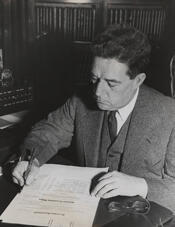
Here you will find contact information for Representative Lindsay Carter Warren, including email address, phone number, and mailing address.
| Name | Lindsay Carter Warren |
| Position | Representative |
| State | North Carolina |
| District | 1 |
| Party | Democratic |
| Status | Former Representative |
| Term Start | December 7, 1925 |
| Term End | January 3, 1941 |
| Terms Served | 8 |
| Born | December 16, 1889 |
| Gender | Male |
| Bioguide ID | W000166 |
About Representative Lindsay Carter Warren
Lindsay Carter Warren (December 16, 1889 – December 28, 1976) was a Democratic politician who served as a U.S. Representative from North Carolina between 1925 and 1940 and as the third Comptroller General of the United States from 1940 to 1954. A member of the Democratic Party, he represented his constituents in the House of Representatives for eight terms during a significant period in American history, and later became a central figure in federal fiscal oversight.
Warren was born in Washington, Beaufort County, North Carolina, the son of prominent lawyer Charles F. Warren and the grandson of politician Edward J. Warren. He was educated at Bingham School in Asheville from 1903 to 1906. He attended the University of North Carolina at Chapel Hill from 1906 to 1908 and returned there from 1911 to 1912 to study law. In 1912 he was admitted to the bar and began practicing law in his hometown of Washington, establishing the professional base from which his political career would grow.
Also in 1912, Warren was named county attorney for Beaufort County, North Carolina, and was elected chairman of the executive committee for the Beaufort County Democratic Party, positions he held continuously until 1925. He entered state politics as a member of the North Carolina Senate, to which he was elected in 1917 and again in 1919. During his second term he served as president pro tempore of the Senate in 1919 and 1920 and chaired the special legislative commission on workmen’s compensation acts, reflecting his early engagement with labor and social legislation. In 1920, he played a controversial role in the debate over women’s suffrage by successfully preventing a Senate vote on ratification of the Nineteenth Amendment, although the amendment became effective nationwide when Tennessee ratified it the following day.
Warren continued his state legislative service when he was elected to the North Carolina House of Representatives for a single term in 1923. Building on his growing reputation in state politics and party leadership, he was elected in 1924 to the 69th United States Congress. He was re-elected seven times, serving in the U.S. House of Representatives from March 4, 1925, until November 1, 1940, when he resigned to accept a federal appointment. His service in Congress thus spanned eight terms and encompassed the late 1920s, the Great Depression, and the early New Deal era. During the 72nd through the 76th Congresses he served as chairman of the House Committee on Accounts, overseeing administrative and financial matters of the House. He was also active in national and state party affairs, serving as a delegate to the Democratic National Conventions in 1932 and 1940 and chairing the North Carolina Democratic Convention in 1930 and 1934.
Warren’s congressional tenure coincided with a transformative period in American political and economic life, and he participated in the legislative process as the federal government expanded its role in response to economic crisis and impending global conflict. In 1940, he left Congress to become Comptroller General of the United States and head of the General Accounting Office (GAO), after having previously declined President Franklin D. Roosevelt’s offers of the post in 1936 and 1938. He assumed the office in 1940 and served for almost fourteen years, until May 1, 1954. As Comptroller General, Warren led GAO through World War II and the early Cold War, overseeing a substantial increase in the agency’s workforce and undertaking extensive reorganization to strengthen federal auditing and fiscal accountability. He worked closely with the Senate Special Committee to Investigate the National Defense Program, commonly known as the Truman Committee, to combat waste and corruption in wartime contracting, including efforts to outlaw kickbacks by subcontractors to defense contractors.
After concluding his service as Comptroller General, Warren returned to state politics. He was elected again to the North Carolina House of Representatives and served two additional terms, in 1959 and 1961, resuming his role as a legislator in his home state late in his career. His family’s involvement in public life continued through his son, Lindsay Warren Jr., who followed him into the legal profession and also served in the North Carolina legislature.
Lindsay Carter Warren died on December 28, 1976, in his hometown of Washington, North Carolina. His legacy in the state is commemorated by the 2.8‑mile Lindsay C. Warren Bridge, one of the longest bridges in North Carolina, constructed in 1960 over the Alligator River and named in his honor. In addition, the M/V Lindsay Warren, a 112‑foot, 25‑car ferry built in 1970 for the North Carolina Department of Transportation Ferry Division to operate across Hatteras Inlet between Hatteras and Ocracoke Islands on the Outer Banks, was named for him; the vessel was later taken out of state service, sold, and renamed Marissa Mae Nicole, and now operates on Mobile Bay.