Representative Linn Boyd
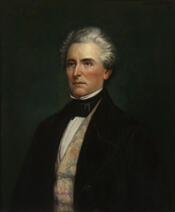
Here you will find contact information for Representative Linn Boyd, including email address, phone number, and mailing address.
| Name | Linn Boyd |
| Position | Representative |
| State | Kentucky |
| District | 1 |
| Party | Democratic |
| Status | Former Representative |
| Term Start | December 7, 1835 |
| Term End | March 3, 1855 |
| Terms Served | 9 |
| Born | November 22, 1800 |
| Gender | Male |
| Bioguide ID | B000719 |
About Representative Linn Boyd
Linn Boyd (also spelled “Lynn”) (November 22, 1800 – December 17, 1859) was a prominent American politician of the 1840s and 1850s, a long-serving Representative from Kentucky, and Speaker of the United States House of Representatives from 1851 to 1855. A member of the Democratic Party for most of his national career, he served in Congress during a significant period in American history, participating in major legislative debates over territorial expansion and sectional compromise. Boyd County, Kentucky, was later named in his honor.
Boyd was born on November 22, 1800, in Nashville, Tennessee, to the wife of Abraham Boyd, a part-time delegate in Kentucky politics. During his youth, he was raised in what became Trigg County, Kentucky, where he received a limited formal education. Despite the modest extent of his schooling, he developed sufficient learning and political acumen to enter public life at an early age. In 1832, he married Alice C. Bennett, a native of Trigg County. After her death, he married again in 1850, taking as his second wife Anna L. Dixon, a widow from Pennsylvania.
In 1826, Boyd moved to Calloway County, Kentucky, where he engaged in farming. His political career began soon thereafter. In 1827 he was elected as Calloway County’s delegate to the Kentucky House of Representatives, and in 1828–1829 he served in that body alongside his father, Abraham Boyd, who represented neighboring Trigg County. In 1831, Boyd returned to Trigg County, and its voters again elected him to the Kentucky House of Representatives, reinforcing his standing as a rising Democratic politician in the Jacksonian era.
Boyd first sought national office in 1833, when he ran unsuccessfully for a seat in the United States House of Representatives. He was elected two years later, winning a seat as a Jacksonian from Kentucky and serving in the Twenty-fourth Congress from 1835 to 1837. His initial tenure was cut short when a Whig landslide, fueled in part by the economic dislocations of the Panic of 1837, cost him his seat. After this setback, Kentucky voters in the First Congressional District returned him to the House in 1839. From 1839 through 1855 he served continuously as a Democratic Representative, completing what contemporary accounts describe as nine terms in Congress and what later tallies record as seven terms in the House between 1839 and 1855. Throughout this period he was a strong supporter of President Andrew Jackson’s political principles and a loyal member of the Democratic Party.
During his long congressional service, Boyd played a notable role in several of the most consequential legislative struggles of his time. He was instrumental in maneuvering the annexation of Texas through Congress during the administration of President John Tyler in 1845, aligning himself with the expansionist wing of the Democratic Party. He later became a key figure in securing passage of the Compromise of 1850, a complex legislative package chiefly associated with Senator Henry Clay. Boyd’s skill in shepherding the compromise measures through the House greatly enhanced his national reputation and contributed directly to his election as Speaker of the House in 1851. He held the speakership from 1851 to 1855, presiding over the House during a period of intensifying sectional tension. While in Congress, he impressed colleagues such as Representative Charles S. Benton, who later named his son, the future inventor and businessman Linn Boyd Benton, in Boyd’s honor. During this period he also declined a Democratic nomination for Governor of Kentucky in 1848, after which Lazarus W. Powell became the party’s candidate. In 1852, while still an influential national figure, Boyd moved his residence to Paducah, Kentucky.
After leaving the House of Representatives in 1855, Boyd remained a significant figure in Democratic politics. At the 1856 Democratic National Convention he was mentioned as a potential candidate for Vice President of the United States, though he was never formally nominated; the vice-presidential nomination ultimately went to another Kentuckian, John C. Breckinridge. Boyd’s political career reached its final stage in 1859, when Kentucky voters elected him the sixteenth Lieutenant Governor of Kentucky. He assumed that office in 1859, but his tenure was brief, as he died less than four months after taking office. His early death later acquired added historical significance with the onset of the Civil War. Governor Beriah Magoffin, a supporter of slavery, secession, and states’ rights, became increasingly distrusted by the Unionist majority in the Kentucky General Assembly, which frequently overrode his vetoes. By August 1862, Magoffin was prepared to resign, but because Boyd had died in 1859, the next in line for the governorship was the Speaker of the Senate, John F. Fisk, whom Magoffin considered unacceptable. A political arrangement followed in which Fisk resigned as Speaker and was replaced by James F. Robinson; Magoffin then resigned, Robinson became governor, and Fisk was restored as Speaker of the Senate. Boyd’s absence thus indirectly shaped the course of Kentucky’s leadership during the Civil War.
Linn Boyd died in Paducah, Kentucky, on December 17, 1859. He was buried in Oak Grove Cemetery in Paducah. In 1852 he had built a spacious brick residence there known as “Oaklands,” which no longer survives except in the name of a local street. His long service in the United States House of Representatives from 1835 to 1837 and from 1839 to 1855, his leadership as Speaker of the House from 1851 to 1855, and his brief tenure as Lieutenant Governor of Kentucky secured his place as one of the more influential Kentucky Democrats of the mid-nineteenth century.