Representative Lois Capps
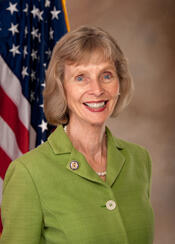
Here you will find contact information for Representative Lois Capps, including email address, phone number, and mailing address.
| Name | Lois Capps |
| Position | Representative |
| State | California |
| District | 24 |
| Party | Democratic |
| Status | Former Representative |
| Term Start | March 10, 1998 |
| Term End | January 3, 2017 |
| Terms Served | 10 |
| Born | January 10, 1938 |
| Gender | Female |
| Bioguide ID | C001036 |
About Representative Lois Capps
Lois Ragnhild Capps (née Grimsrud; born January 10, 1938) is an American politician and former educator and nurse who served as a U.S. Representative from California from 1998 to 2017. A member of the Democratic Party, she represented a coastal Central Coast district that was numbered the 22nd Congressional District from 1998 to 2003, the 23rd from 2003 to 2013, and the 24th from 2013 to 2017. Over 10 terms in office, she contributed to the legislative process during a significant period in American history, representing the interests of constituents in a district that included all of Santa Barbara and San Luis Obispo Counties and a portion of Ventura County.
Capps was born in Ladysmith, Wisconsin, the daughter of Solveig Magdalene (née Gullixson) and the Rev. Jurgen Milton Grimsrud, a Lutheran minister. Both sides of her family were of Norwegian descent, and her upbringing in a clergy household shaped her later interest in public service and social justice. She attended Pacific Lutheran University, where she earned a bachelor’s degree in nursing, preparing for a career in health care that would later inform much of her legislative work. In 1960, while pursuing graduate studies, she married Walter Capps, then a divinity student who would later become a prominent religious studies professor at the University of California, Santa Barbara (UCSB). The couple eventually had three children.
In 1964, Capps completed a Master of Arts in Religion at Yale Divinity School, deepening her academic grounding in ethics and theology. That same year, she and her husband moved to Santa Barbara, California, where she has lived since 1964. While raising their family, she pursued additional education and professional work in the community. She later earned a Master of Arts in education from UCSB in 1990, reflecting her growing engagement with educational issues. For approximately 20 years, Capps worked as a nurse and health advocate in the Santa Barbara public schools, where she focused on student health and wellness, and she also taught early childhood education part-time at Santa Barbara City College.
Capps’s path to Congress was closely intertwined with that of her husband. Walter Capps was elected to the U.S. House of Representatives in 1996 in a rematch of his 1994 race against Republican Andrea Seastrand, representing what was then California’s 22nd Congressional District. His victory marked a rare Democratic breakthrough in a district that had been held by Republicans almost continuously since the 1940s. However, he died of a heart attack on October 28, 1997, only nine months into his term. Following his death, Lois Capps entered the special election to fill the vacancy and won the seat by defeating Republican Tom Bordonaro on March 10, 1998. She was sworn into the 105th Congress on March 17, 1998, and later that year defended her seat against Bordonaro in the general election, commencing her first full term in office.
During her early congressional campaigns, Capps consolidated Democratic control in a historically Republican district. In 2000, she retained the 22nd District seat by defeating Republican Mike Stoker with 53 percent of the vote, becoming the first Democrat to hold that district for more than one term in over 50 years. The district—known as the 11th from its formation in 1943 until 1953, the 13th from 1953 to 1975, and the 19th from 1975 to 1993—had been held by Republicans from 1947 until Walter Capps was sworn in in 1997. After the 2000 census, her district was renumbered as the 23rd and made somewhat safer for Democrats, and she was reelected without serious opposition in 2002, 2004, 2006, 2008, and 2010. Following the 2010 census, the district was renumbered as the 24th, and redistricting added more Republican-leaning inland areas of Santa Barbara County. The Cook Political Report’s House editor David Wasserman predicted a more difficult race, and local Republicans targeted Capps as one of their top prospects in California. In 2012 she defeated former Lieutenant Governor Abel Maldonado with 54.8 percent of the vote. In 2014, she faced Republican Chris Mitchum—an actor, screenwriter, businessman, and son of film star Robert Mitchum—in what became the closest race of her congressional career; she ultimately prevailed by a 3.8 percent margin. In April 2015, Capps announced that she would not seek reelection in 2016, concluding nearly two decades of service in the House of Representatives.
Throughout her congressional tenure, Capps served on the influential House Committee on Energy and Commerce, where she was a member of the Subcommittee on Energy and Power, the Subcommittee on Environment and Economy, and the Subcommittee on Health. Earlier in her service she also sat on the Energy and Air Quality Subcommittee and the Health Subcommittee. Drawing on her background in nursing and school health, she became a leading advocate on health policy, environmental protection, and coastal issues. She supported the Obama administration’s economic stimulus measures and the Patient Protection and Affordable Care Act, and she was strongly critical of the Stupak–Pitts Amendment, which restricted taxpayer funding of abortions except in cases of rape, incest, or threat to the mother’s life. She had earlier sponsored the alternative Capps Amendment, which was defeated and replaced by the Stupak language. In 2013, she introduced the National Pediatric Research Network Act, which sought to authorize the National Institutes of Health to support, fund, and coordinate data from research on rare pediatric diseases.
Capps also played a prominent role in environmental and coastal policy. In 2004, the House passed her legislation prohibiting a “comprehensive inventory” of oil and gas resources beneath the outer continental shelf, reflecting her long-standing opposition to expanded offshore drilling. She was a vocal opponent of drilling for oil in the Los Padres National Forest and off the coast of California. In the 113th Congress she introduced H.R. 3008, a bill to provide for the conveyance of a small parcel of National Forest System land in Los Padres National Forest to the White Lotus Foundation, a yoga training organization, in exchange for a parcel of its land, enabling improved access to the foundation’s site. On foreign policy, she generally aligned with the Democratic caucus, though in 2012 she was recorded as the only member of the House to vote “no” on House Resolution 556, which condemned the government of Iran for persecuting pastor Youcef Nadarkhani on a charge of apostasy; her office later stated that she strongly supported the resolution and had cast the vote in error. In 2011, she voted for the National Defense Authorization Act for Fiscal Year 2012, which contained a controversial provision allowing the government and military to detain American citizens and others without trial indefinitely.
Within the House, Capps was associated with the New Democrat Coalition and was widely regarded as a “solid liberal” in her voting record and policy positions. She was repeatedly recognized for her collegial style; in The Washingtonian magazine’s 2006 “Best and Worst of Congress” survey of congressional staffers, she was named the nicest member of Congress. She founded the Congressional Nursing Caucus and the School Health and Safety Caucus, reflecting her professional background, and co-founded or co-chaired numerous issue caucuses, including the Congressional Caucus on Women’s Issues, the National Marine Sanctuary Caucus, the Congressional Coastal Caucus, the Biomedical Research Caucus, the House Cancer Caucus, the Congressional Heart and Stroke Coalition, and the Congressional Caucus on Infant Health and Safety. She was also a member of the Veterinary Medicine Caucus, among other groups, and was active in efforts to promote women’s representation and leadership in the House of Representatives.
In her personal life, Capps experienced both prominence and tragedy. Her husband, Walter, died suddenly in 1997, shortly after beginning his own congressional service, and their eldest daughter died in 2000. Her daughter Laura Capps later became active in public affairs and married Bill Burton, a political consultant who served as Deputy White House Press Secretary in the Obama administration. After leaving Congress in January 2017, Lois Capps remained a resident of Santa Barbara and continued to be associated with public service, health advocacy, and environmental and coastal protection issues that had defined much of her professional and congressional career.