Representative Lorenzo Crounse
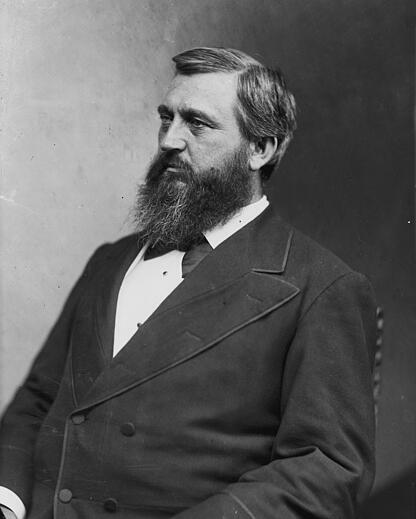
Here you will find contact information for Representative Lorenzo Crounse, including email address, phone number, and mailing address.
| Name | Lorenzo Crounse |
| Position | Representative |
| State | Nebraska |
| District | 1 |
| Party | Republican |
| Status | Former Representative |
| Term Start | December 1, 1873 |
| Term End | March 3, 1877 |
| Terms Served | 2 |
| Born | January 27, 1834 |
| Gender | Male |
| Bioguide ID | C000935 |
About Representative Lorenzo Crounse
Lorenzo Crounse (January 27, 1834 – May 13, 1909) was a Nebraska Republican politician, jurist, and legislator who served as a Representative from Nebraska in the United States Congress from 1873 to 1877 and later as the eighth Governor of Nebraska. He was born in Sharon, Schoharie County, New York, where he spent his early years before pursuing higher education and a legal career that would eventually lead him westward and into public life on the Great Plains.
Crounse attended the New York Conference Seminary in Charlotteville, New York, receiving the education that prepared him for both teaching and the study of law. While working as a schoolteacher, he read law and, in 1857, was admitted to the bar. Establishing a law practice at Fort Plain, New York, he began his professional life as an attorney. In 1860 he married Mary E. Griffiths (1836–1882), and the couple had four children, forming a family that would accompany and support him through his subsequent moves and public responsibilities.
With the outbreak of the Civil War, Crounse entered military service for the Union. He organized Battery K, New York Light Artillery, and in 1861 became its captain. He served for about a year, but his military career was cut short when he was wounded in a battle on the Rappahannock River in Virginia. As a result of these wounds, he was discharged from service and returned to civilian life, resuming his law practice at Fort Plain. His wartime experience, though brief, added to his public standing and informed his later service in government.
In 1864, Crounse moved to the Nebraska Territory, where he quickly became involved in territorial and then state affairs. He served in the territorial legislature and later was a delegate to Nebraska’s constitutional convention, participating in the foundational work of statehood. After Nebraska became a state, he was elected a Justice of the Nebraska Supreme Court, serving from 1867 to 1873. His judicial tenure helped shape the early jurisprudence of the new state and established his reputation as a leading Republican figure in Nebraska.
When his term on the Nebraska Supreme Court expired, Crounse ran for national office and was elected as a Republican to the United States House of Representatives. He served in the Forty-third and Forty-fourth Congresses from March 4, 1873, to March 3, 1877, representing Nebraska in the House of Representatives. A member of the Republican Party, Lorenzo Crounse contributed to the legislative process during two terms in office. His service in Congress occurred during a significant period in American history, in the post–Civil War and Reconstruction era, and as a member of the House he participated in the democratic process and represented the interests of his Nebraska constituents. He declined to run for re-election in 1876, concluding his congressional career after four years.
Following his service in Congress, Crounse remained active in public administration and national affairs. In 1879 he became an internal revenue collector for the district of Nebraska, overseeing federal tax collection in the state. On April 27, 1891, he was appointed Assistant Secretary of the United States Treasury, a post he held until his resignation on October 31, 1892. He resigned in order to assume the governorship of Nebraska, having been elected the state’s eighth governor. As governor, he served from 1893 to 1895, and during his term future Nebraska Representative William E. Andrews worked as his private secretary. After leaving the governorship, Crounse continued to participate in state politics and served briefly in the Nebraska state senate in 1901.
Crounse’s personal life was marked by both family responsibilities and later loss. His wife, Mary E. Griffiths Crounse, died in 1882, and he remained a widower for the rest of his life. In his later years he lived with one of his four children, spending his final period in Omaha, Nebraska. Lorenzo Crounse died in Omaha on May 13, 1909. His legacy in the state is reflected not only in his judicial, legislative, and executive service, but also in the naming of the now-extinct village of Crounse, Nebraska, near Lincoln, in his honor. His career is documented in collections such as the Gov. Lorenzo Crounse papers at the Nebraska State Historical Society and in standard reference works including the Biographical Directory of the United States Congress, the National Governors Association, and the Semi-Centennial History of Nebraska.