Representative Loretta Sanchez
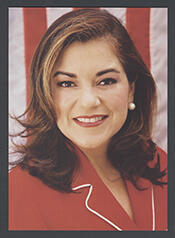
Here you will find contact information for Representative Loretta Sanchez, including email address, phone number, and mailing address.
| Name | Loretta Sanchez |
| Position | Representative |
| State | California |
| District | 46 |
| Party | Democratic |
| Status | Former Representative |
| Term Start | January 7, 1997 |
| Term End | January 3, 2017 |
| Terms Served | 10 |
| Born | January 7, 1960 |
| Gender | Female |
| Bioguide ID | S000030 |
About Representative Loretta Sanchez
Loretta Lorna Sanchez (born January 7, 1960) is an American politician who served as a Representative from California in the United States Congress from January 3, 1997, to January 3, 2017. A member of the Democratic Party, she represented parts of central Orange County, California, over ten consecutive terms in the U.S. House of Representatives. First elected in 1996, she gained national attention when she defeated long-serving Republican U.S. Representative Bob Dornan by fewer than 1,000 votes in what had long been a bastion of suburban conservatism. During her time in the House, Sanchez was associated with the Blue Dog Coalition of moderate-to-conservative Democrats as well as the New Democrat Coalition, and she became known for her interests in education, crime, economic development, and protections for senior citizens.
Sanchez was born in Lynwood, California, to Mexican immigrant parents and grew up in nearby Anaheim as one of seven children. Her father worked as a unionized machinist and her mother as a secretary. She has described herself as a “shy, quiet girl” who did not speak English when she was young and credits government programs and public institutions with much of her later success in public life. She graduated from Katella High School in Anaheim in 1978. While in high school, she worked as an ice cream server and joined the United Food and Commercial Workers union, later receiving a union scholarship that helped her attend college.
Sanchez earned her undergraduate degree in economics from Chapman College (now Chapman University) in Orange, California, in 1982. She then moved to Washington, D.C., where she obtained a Master of Business Administration from American University in 1984. Following her graduate studies, she worked as a financial analyst for the defense contractor Booz Allen Hamilton, gaining experience in defense-related financial and analytical work before entering elective politics. Her early professional background in economics and defense consulting informed her later legislative focus on military affairs, homeland security, and economic development.
In 1996, Sanchez ran for Congress in California’s 46th congressional district, centered in Orange County, and narrowly unseated incumbent Republican Bob Dornan, marking a significant political shift in a traditionally conservative region. She took office on January 3, 1997, and would go on to serve ten terms in the House of Representatives, representing evolving Orange County districts through subsequent rounds of redistricting. During her congressional career, she participated actively in the legislative process and represented the interests of her constituents during a significant period in American history, including the post–Cold War era, the September 11 attacks, and the wars in Afghanistan and Iraq.
Sanchez became a senior member of the House Committee on Armed Services, where she served on the Subcommittee on Oversight and Investigations, the Subcommittee on Emerging Threats and Capabilities, and as ranking member of the Subcommittee on Strategic Forces. She was the most senior woman on the Armed Services Committee and played a prominent role in efforts to reform the law and culture of the U.S. military regarding sexual assault. Her leadership contributed to a decision to examine the prevalence of sexual assault at the military service academies, which revealed that the problem was more widespread than previously understood, and she helped lead the fight to change sexual assault provisions in the Uniform Code of Military Justice. She also served on the Committee on Homeland Security, including the Subcommittee on Border and Maritime Security and the Subcommittee on Counterterrorism and Intelligence, eventually becoming the second-ranking Democrat on the Homeland Security Committee.
In addition to her committee assignments, Sanchez was active in several caucuses, including the Congressional Hispanic Caucus, the Congressional Human Rights Caucus, the International Conservation Caucus, and the Sportsmen’s Caucus. Her tenure in the Congressional Hispanic Caucus (CHC) was marked by controversy. In February 2006, she withdrew from the CHC’s political action committee, along with several other members, after then-chairman Joe Baca authorized political contributions to members of his family running for state and local offices in California. Sanchez and other CHC members also contended that Baca had been improperly elected chairman in November 2006 because the vote did not use secret ballots as required by the caucus’s bylaws. On January 31, 2007, she resigned from the CHC altogether, asserting that Baca repeatedly treated female members with disrespect. She and her sister, Representative Linda Sánchez, along with Representative Hilda Solis, alleged that Baca had referred to Loretta Sanchez as “a whore” in conversations with other lawmakers, a charge Baca denied. The episode drew national attention to internal tensions within the caucus and to issues of gender and leadership in Congress.
Ideologically, Sanchez has described herself as a “moderate” Democrat, and her membership in the Blue Dog Coalition reflected her willingness to engage with centrist and fiscally cautious positions. Nonetheless, in 2009 she received a zero approval rating from the American Conservative Union, and National Journal’s 2006 ratings scored her as 71 percent liberal and 28 percent conservative on economic issues, 80 percent liberal and 19 percent conservative on social issues, and 70 percent liberal and 28 percent conservative on foreign policy. She reportedly voted with House Democratic Leader and later Speaker Nancy Pelosi 97.8 percent of the time during the 111th Congress. Sanchez was regarded as liberal on social issues: she voted against a constitutional amendment to ban same-sex marriage, supported abortion rights, and sought to reverse the ban on abortions at overseas U.S. military bases and installations. In August 2000, she drew notice when she refused to relocate a political fundraiser planned at the Playboy Mansion in California; in response, Democratic National Committee chairman Joe Andrew cancelled her scheduled speaking role at the Democratic National Convention. Her address was later reinstated when she agreed to move the fundraiser to Universal Studios.
Sanchez’s legislative record reflected her personal experiences and policy priorities. She staunchly opposed Republican efforts to overhaul the Head Start program in the 108th Congress, invoking her own background growing up poor and overcoming a speech impediment. During debate on the bill, she stated, “I know about these kids, because I am one of those kids … It hurts to hear you talk about how we are not successful, or how we are losers. But we are very successful. We have had a lot of successes with Head Start.” She criticized what she viewed as conservative Republicans’ lack of commitment to improving public education, arguing in response to President George W. Bush’s 2003 budget proposal that “If he can run deficits for the military, then he can run deficits to educate our children.” In early 2011, she introduced legislation requiring the Department of Homeland Security to issue rules governing searches and seizures of laptops, cell phones, and other electronic devices belonging to American citizens returning to the United States from abroad, reflecting her concern with civil liberties in the context of national security.
Foreign policy and human rights were also central to Sanchez’s congressional work. On October 10, 2002, she was among the 133 House members who voted against authorizing the invasion of Iraq, though she subsequently voted in favor of every appropriation bill to fund the war and later opposed the 2007 troop surge. She led a female congressional delegation to visit U.S. troops in Iraq on March 7, 2007, her third visit to the country. According to Congressional Quarterly, she voted against reviving fast-track procedures for trade agreements in 2002 and opposed a trade agreement with Vietnam, citing concerns about political and human rights conditions there. Her outspokenness led the Vietnamese government to deny her a visa in late 2004, and by April 2006 she had been denied entry four times. In connection with International Human Rights Day, she joined a bipartisan group of 11 House members in sending a letter to Vietnamese Prime Minister Nguyen Tan Dung calling for the release of two U.S. citizens detained by the Vietnamese government. As a member of the Congressional Human Rights Caucus, she supported measures such as maintaining, and later lifting, the Cuba travel ban under differing conditions, and she voted to acknowledge the Armenian genocide of the early 1900s and to implement the 9/11 Commission Recommendations Act of 2007.
Sanchez’s work on homeland security and civil liberties occasionally intersected with her own personal experiences. She stated that she was briefly denied access to a United Airlines flight in October 2006 because her name appeared on a post–September 11 no-fly list; she recounted being instructed to check in with an airline employee who informed her that she was on a terrorist watch list and requested additional identification. In a December 2015 interview with Larry King, amid heightened public concern following the San Bernardino terrorist attack and then-candidate Donald Trump’s call for a temporary ban on Muslim immigration, Sanchez remarked that some experts estimated “anywhere between 5 and 20 percent” of Muslims worldwide supported the creation of a caliphate to overthrow the United States. Her comments drew criticism as contributing to anti-Muslim sentiment. Sanchez responded that she had been echoing President Barack Obama’s December 6, 2015 Oval Office address, in which he stated that extremist ideology had spread within some Muslim communities, and she emphasized her long record of defending the civil liberties of Muslim groups and her belief that most Muslims “are actually with us” in combating extremism.
In the later years of her House service, Sanchez continued to shape homeland security and cybersecurity policy. On September 13, 2016, the House Committee on Homeland Security unanimously approved two amendments she authored to strengthen counterterrorism and cybersecurity programs. The first, to the Community Counterterrorism Preparedness Act (H.R. 5859), established a grant program to help major metropolitan areas prepare for and respond to terror attacks involving active shooters; her amendment required the Department of Homeland Security to provide “unclassified threat information” to grant applicants so that, in her words, “we not only provide needed funds to help regions prepare for attacks, we also give them critical tips and best practices to help them respond.” The second, to the Cyber Preparedness Act of 2016 (H.R. 5459), clarified that DHS grants for states and urban areas could be used for statewide initiatives, with her amendment aimed at increasing the use of such grants to identify threats and improve “cybersecurity sharing dissemination,” reflecting her concern over the growing sophistication of cyberattacks against U.S. commerce and critical infrastructure.
After two decades in the House, Sanchez chose not to seek re-election in 2016, instead entering California’s U.S. Senate race to succeed retiring Senator Barbara Boxer. In the state’s top-two primary and subsequent general election, she faced fellow Democrat Kamala Harris, then California Attorney General and future Vice President of the United States. In the November 8, 2016 general election, Sanchez was defeated by Harris, 61.6 percent to 38.4 percent. Sanchez’s departure from the House on January 3, 2017, ended a notable chapter in Orange County’s political history and in Latino representation in Congress. Her family’s political legacy continued, however, through her sister Linda Sánchez, who has represented California’s 38th congressional district in the U.S. House of Representatives; together, Loretta and Linda Sánchez were the first, and as of December 2023 the only, sisters to serve simultaneously in the United States Congress.