Representative Loring Milton Black
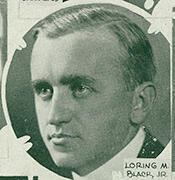
Here you will find contact information for Representative Loring Milton Black, including email address, phone number, and mailing address.
| Name | Loring Milton Black |
| Position | Representative |
| State | New York |
| District | 5 |
| Party | Democratic |
| Status | Former Representative |
| Term Start | December 3, 1923 |
| Term End | January 3, 1935 |
| Terms Served | 6 |
| Born | May 17, 1886 |
| Gender | Male |
| Bioguide ID | B000505 |
About Representative Loring Milton Black
Loring Milton Black Jr. (May 17, 1886 – May 21, 1956) was an American lawyer and Democratic politician who served six terms as a United States Representative from New York from 1923 to 1935. Over the course of his congressional career, he contributed to the legislative process during a significant period in American history, representing the interests of his constituents in the House of Representatives and participating actively in the democratic process.
Black was born in New York City on May 17, 1886, the son of Loring M. Black and Elizabeth Black. He was educated in the public schools of New York City and graduated from Fordham Preparatory School in 1903. He then attended Fordham University, receiving a Bachelor of Arts degree in 1907. That same year he entered Columbia Law School, where he studied from 1907 to 1909. He was admitted to the bar in 1909 and commenced the practice of law in New York City, establishing himself professionally before entering elective office.
Black’s political career began at an unusually young age. A member of the Democratic Party, he was elected to the New York State Senate from the 4th District and served in 1911 and 1912. Because of his youth, he became widely known as the “Kid Senator.” After a brief interval out of office, he returned to the State Senate, again representing the 4th District in 1919 and 1920. These early legislative experiences in Albany helped shape his political outlook and provided a foundation for his later service in the United States Congress.
In 1913, Black married Beatrice Marie Eddy. The couple had several children, including Loring M., Elizabeth V., Jeanne, and John E. The marriage later ended in divorce, and Black subsequently married Laura Spencer. His family life unfolded alongside his legal and political careers, as he continued to practice law while holding public office and remained closely tied to New York City’s legal and political communities.
Black was elected as a Democrat to the 68th, 69th, 70th, 71st, 72nd, and 73rd United States Congresses, serving from March 4, 1923, to January 3, 1935. His twelve years in the House of Representatives coincided with the Roaring Twenties, the onset of the Great Depression, and the early years of the New Deal era. During this time, he was particularly noted for his opposition to Prohibition and emerged as one of the leaders of the “wet bloc” in Congress, advocating for the modification and eventual repeal of the Eighteenth Amendment. Within the House, he also held positions of responsibility, serving as chairman of the Committee on Claims in the 72nd and 73rd Congresses, where he oversaw the consideration of private claims against the federal government.
After leaving Congress in January 1935, Black resumed the practice of law, maintaining offices in both New York City and Washington, D.C. His post-congressional career allowed him to draw on his legislative experience in advising clients and engaging with federal matters from the vantage point of private practice. He remained active in legal circles and continued to divide his time between the nation’s capital and his native state.
Loring Milton Black Jr. died of a heart attack on May 21, 1956, while shopping in a drugstore in Washington, D.C. He was interred at Fort Lincoln Cemetery in Brentwood, Maryland. His career spanned state and national office, and his six terms in the House of Representatives placed him at the center of major political debates of the early twentieth century, including the movement to end Prohibition and the federal response to economic crisis.