Senator Lot Myrick Morrill
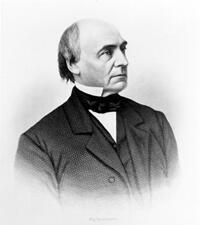
Here you will find contact information for Senator Lot Myrick Morrill, including email address, phone number, and mailing address.
| Name | Lot Myrick Morrill |
| Position | Senator |
| State | Maine |
| Party | Republican |
| Status | Former Representative |
| Term Start | July 4, 1861 |
| Term End | March 3, 1877 |
| Terms Served | 4 |
| Born | May 3, 1813 |
| Gender | Male |
| Bioguide ID | M000970 |
About Senator Lot Myrick Morrill
Lot Myrick Morrill (May 3, 1813 – January 10, 1883) was an American politician who served as the 28th governor of Maine, as a United States senator from Maine, and as U.S. secretary of the treasury under President Ulysses S. Grant. A member of the Republican Party for most of his national career, he was an advocate for hard currency rather than paper money and was popularly received as treasury secretary by the American press and Wall Street. Known for financial and political integrity, Morrill was widely regarded as being focused on serving the public good rather than party interests. He was President Grant’s fourth and last Secretary of the Treasury and held federal office during the Civil War and Reconstruction, a significant period in American history.
A native of Maine, Morrill was born in Belgrade, Kennebec County, on May 3, 1813. He received a public school education and, as a young man, briefly attended Waterville College (now Colby College). After leaving Waterville, he moved to New York, where he became principal of a private school, gaining early experience in administration and public speaking. Returning to Maine, he read law and was admitted to the bar in 1839. Morrill established law practices in Readfield and later in Augusta, Maine, where he built a reputation as an eloquent advocate. He became well known among his Democratic associates for his oratory and his support of the temperance movement, which was a prominent reform cause in mid-nineteenth-century Maine.
Morrill entered public life as a Democrat and was elected to the Maine House of Representatives in 1854. He rose quickly in party leadership and served as chairman of the Maine Democratic Party. During the 1850s, however, the intensifying national conflict over slavery led him to reassess his political allegiance. Morrill ultimately broke with the Democrats and joined the newly formed Republican Party for the explicit reason that Republicans opposed the expansion of slavery into the territories. As a Republican, he was elected to the Maine Senate in 1856. His leadership in that body led to his election as governor of Maine in 1858, and he served as the state’s 28th governor. His gubernatorial tenure, which extended into the late 1850s and early 1860s, coincided with the mounting sectional crisis that preceded the Civil War.
As the American Civil War broke out in 1861, Morrill was elected by the Maine legislature to fill the United States Senate seat vacated by Hannibal Hamlin, who had resigned to become vice president under President Abraham Lincoln. Lot Myrick Morrill served as a Senator from Maine in the United States Congress from 1861 to 1877, a span of nearly fifteen years that covered the Civil War and the waning days of Reconstruction. A member of the Republican Party, he contributed to the legislative process during four terms in office, participating in the democratic process and representing the interests of his Maine constituents at a time of profound national transformation. While in the Senate, Morrill sponsored legislation that abolished slavery in the District of Columbia and consistently advocated for education and suffrage for African American freedmen.
Morrill was an outspoken supporter of the Civil Rights Act of 1866 and recognized the sweeping nature of Reconstruction-era legislation. In a notable Senate speech, he acknowledged that such measures were “absolutely revolutionary,” asking whether senators were “utterly oblivious to the grand results of four years of war” and declaring that the nation was in the midst of a “civil and political revolution” that had fundamentally altered the Constitution, sweeping away a “civilization based on servitude.” In June 1866, he supported suffrage for African Americans in Washington, D.C. During the impeachment crisis of 1868, Morrill voted to convict President Andrew Johnson, while Maine’s other senator, William P. Fessenden, voted for acquittal. In 1869, Morrill was narrowly defeated by his old rival Hannibal Hamlin for a new Senate term by a single vote in the Maine legislature. However, after Senator Fessenden died later that year, Morrill was appointed to Fessenden’s seat to serve out the unexpired term. He was subsequently elected in his own right in 1871 and continued in the Senate until his appointment to the Treasury Department in 1876.
In 1876, President Ulysses S. Grant appointed Morrill to serve as secretary of the treasury following the resignation of Secretary Benjamin H. Bristow. Bristow, a noted reformer who had successfully prosecuted and shut down the Whiskey Ring scandal, had resigned amid friction with Grant over his aggressive reforms and his potential candidacy for the presidency in 1876. Upon assuming office, Secretary Morrill inherited all of the top secret and confidential files related to Bristow’s Whiskey Ring prosecutions. Although Morrill did not have the reputation of a technical financial expert, he was widely believed to possess strong political integrity, and it was expected that he would administer the department as effectively as Grant’s first treasury secretary, George S. Boutwell. His nomination was submitted by President Grant and was immediately approved by the Senate without serious question. Morrill’s appointment was well received by the press and by financial interests on Wall Street. When Morrill left the Senate to lead the Treasury Department, Maine Governor Seldon Connor filled the resulting vacancy by appointing Morrill’s political rival, James G. Blaine, to the Senate.
As secretary of the treasury, Morrill served from 1876 to 1877, including five days under President Rutherford B. Hayes at the close of his tenure. During his approximately eight months in office, he strongly advocated adherence to the gold standard and a hard-money policy, opposing inflationary schemes based on the expanded issuance of paper currency. His stance aligned with conservative financial opinion in the postwar era and reinforced his reputation for fiscal rectitude. Morrill was President Grant’s fourth and final treasury secretary, and his short but steady administration helped guide federal financial policy through the closing phase of Reconstruction and the transition to the Hayes administration.
Upon his retirement from the Treasury Department in 1877, President Hayes appointed Morrill as collector of customs for the port of Portland, Maine, a significant federal post in a major New England seaport. Morrill held this position from 1877 until his death, continuing his long record of public service at the state and federal levels. He remained in Portland, overseeing customs operations and maintaining his standing as a respected elder statesman in Maine politics. Lot Myrick Morrill died in Portland on January 10, 1883, while still serving as collector of customs, closing a public career that had spanned nearly three decades in state government, the United States Senate, the Cabinet, and the federal civil service.