Representative Louis Leon Ludlow
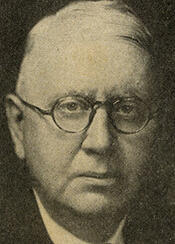
Here you will find contact information for Representative Louis Leon Ludlow, including email address, phone number, and mailing address.
| Name | Louis Leon Ludlow |
| Position | Representative |
| State | Indiana |
| District | 11 |
| Party | Democratic |
| Status | Former Representative |
| Term Start | April 15, 1929 |
| Term End | January 3, 1949 |
| Terms Served | 10 |
| Born | June 24, 1873 |
| Gender | Male |
| Bioguide ID | L000501 |
About Representative Louis Leon Ludlow
Louis Leon Ludlow (June 24, 1873 – November 28, 1950) was a Democratic Indiana congressman who served as a Representative from Indiana in the United States Congress from 1929 to 1949. Over the course of 10 consecutive terms in office, he contributed to the legislative process during a significant period in American history, spanning the Great Depression, the New Deal era, and World War II. He is best known for proposing a constitutional amendment in early 1938 requiring a national referendum on any U.S. declaration of war except in cases of direct attack, a measure that came to be known as the Ludlow Amendment. Congress rejected the Ludlow Amendment only by a narrow margin and after an appeal from President Franklin D. Roosevelt.
Ludlow was born on a farm near Connersville, Fayette County, Indiana, on June 24, 1873, one of eight children of Henry Louis Ludlow and Isabelle (Smiley) Ludlow. Raised in a rural environment in eastern Indiana, he grew up in modest circumstances typical of late nineteenth-century Midwestern farm families. His early life on the farm helped shape his understanding of the concerns of ordinary citizens, an outlook that later informed his work both as a journalist and as a legislator.
In 1892 Ludlow moved to Indianapolis, Indiana, where he began his career in journalism. He first worked as a reporter for the Indianapolis Sun and later for the Indianapolis Sentinel and the Indianapolis Press, gradually establishing himself as a capable reporter and political writer. His work in the state capital brought him into close contact with political affairs and public policy, and he developed a reputation for careful political reporting and commentary. On September 17, 1896, he married Katherine Huber of Irvington, Indiana, who was then the society editor on the Sentinel in Washington. Their marriage produced four children—Margery, Blanche, Virginia, and Louis—and Katherine remained an important partner in his professional and public life.
Ludlow’s journalistic career advanced further when he became a Washington correspondent for Indiana and Ohio newspapers. Beginning in 1901, he reported from the nation’s capital for the Indianapolis Star, the Star League of Indiana, the Columbus Dispatch, and the Ohio State Journal. During this period, from 1901 to 1929, he was a member of the Congressional Press Galleries, covering the proceedings of Congress and national politics for nearly three decades. This long tenure in Washington as a correspondent gave him an intimate familiarity with congressional procedure, national issues, and the workings of the federal government, experience that would later ease his transition from observer to lawmaker.
In 1928 Ludlow successfully sought elective office as a Democrat and was elected to the Seventy-first Congress, taking his seat in the House of Representatives in March 1929. He was subsequently reelected to the nine succeeding Congresses, serving continuously until 1949. As a member of the House of Representatives, Ludlow participated actively in the democratic process and represented the interests of his Indiana constituents through the economic crises of the Great Depression and the challenges of global conflict. His most notable legislative initiative, the Ludlow Amendment, reflected a strong current of isolationist and pacifist sentiment in the interwar United States. Introduced in early 1938, the proposed constitutional amendment would have required a national referendum before Congress could declare war, except in cases where the United States had been directly attacked. The measure attracted substantial public support and significant backing in the House, but it was narrowly defeated after President Franklin D. Roosevelt personally appealed to Congress, arguing that such a requirement would dangerously limit the nation’s ability to respond to international threats.
Ludlow’s congressional service, extending from 1929 to 1949, placed him at the center of debates over New Deal legislation, neutrality and foreign policy in the 1930s, and wartime measures in the 1940s. While best remembered for the Ludlow Amendment, his decade-spanning tenure also involved routine legislative work on domestic policy, appropriations, and constituent services, reflecting the broad responsibilities of a House member during a transformative era in American political and economic life. He remained a loyal member of the Democratic Party throughout his service, aligning himself with many of the party’s priorities while also giving voice to strong antiwar sentiment among portions of the electorate.
After his tenth term in Congress, Ludlow left office in 1949 and resumed work as a newspaper correspondent in Washington, D.C., returning to the profession in which he had first made his name. He continued to live and work in the capital until his final illness. Louis Leon Ludlow died in Washington, D.C., at George Washington University Hospital on November 28, 1950, at the age of 77. He was buried in Rock Creek Cemetery in Washington, D.C. He was survived by his wife, Katherine, and their four children—Margery, Blanche, Virginia, and Louis—closing a life that bridged journalism and public service during some of the most consequential decades in modern American history.