Representative Louis Thomas McFadden
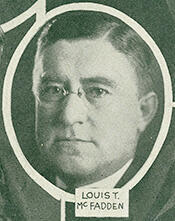
Here you will find contact information for Representative Louis Thomas McFadden, including email address, phone number, and mailing address.
| Name | Louis Thomas McFadden |
| Position | Representative |
| State | Pennsylvania |
| District | 15 |
| Party | Republican |
| Status | Former Representative |
| Term Start | December 6, 1915 |
| Term End | January 3, 1935 |
| Terms Served | 10 |
| Born | July 25, 1876 |
| Gender | Male |
| Bioguide ID | M000434 |
About Representative Louis Thomas McFadden
Louis Thomas McFadden (July 25, 1876 – October 1, 1936) was a Republican member of the United States House of Representatives from Pennsylvania, serving ten consecutive terms from 1915 to 1935. A banker by profession, he became a prominent figure in national financial legislation as the chief sponsor of the McFadden Act of 1927, which rechartered the Federal Reserve System in perpetuity, liberalized branch banking for national banks, and reshaped competition between member and non-member banks. Over the course of his congressional career, he participated actively in the legislative process and represented the interests of his Pennsylvania constituents during a period marked by World War I, the Roaring Twenties, and the onset of the Great Depression. He is also known for his antisemitic conspiracy theories, which contributed significantly to his political isolation and eventual loss of his seat in the House of Representatives.
McFadden was born in Granville Center, Granville Township, Bradford County, Pennsylvania. He attended local schools and pursued business studies at Warner’s Commercial College in Elmira, New York, an institution now known as the Elmira Business Institute. In 1892, he entered the employ of the First National Bank in Canton, Pennsylvania, beginning a banking career that would shape his later legislative work. Demonstrating rapid advancement in the field, he was elected cashier of the bank in 1899. On January 11, 1916, while already serving in Congress, he became president of the First National Bank of Canton, a position he held until 1925.
In addition to his responsibilities at the First National Bank, McFadden became an influential figure in state banking circles. He served as treasurer of the Pennsylvania Bankers’ Association in 1906 and 1907, and later as its president in 1914 and 1915. His prominence in financial and civic affairs led to his appointment in 1914 by the agricultural societies of the Commonwealth of Pennsylvania as a trustee of Pennsylvania State College (now Pennsylvania State University). These roles underscored his reputation as a leading banking expert in the state and provided a platform for his entry into national politics.
In 1914, McFadden was elected as a Republican Representative to the Sixty-fourth Congress and to the nine succeeding Congresses, serving from March 4, 1915, to January 3, 1935. During his tenure in the House of Representatives, he became one of the chamber’s most influential voices on banking and currency matters. He served as chairman of the House Committee on Banking and Currency during the Sixty-sixth through Seventy-first Congresses, from 1920 to 1931, a period in which the federal banking framework and the role of the Federal Reserve were subjects of intense legislative attention. Though re-elected without opposition in 1932, he was defeated by the Democratic nominee in 1934, marking the only election between 1912 and 1950 in which his district elected a Democrat.
McFadden’s principal legislative legacy was the McFadden Act of 1927. As its chief sponsor, he oversaw legislation that rechartered the Federal Reserve System in perpetuity and sought to establish competitive equality between nationally chartered and state-chartered banks. The Act liberalized branch banking for national banks by allowing them to operate branches to the extent permitted by the laws of the state in which they were located, while at the same time specifically prohibiting interstate branching by limiting national bank branches to their home state. This framework governed American branch banking for decades until the interstate restrictions were repealed by the Riegle-Neal Interstate Banking and Branching Efficiency Act of 1994, which nonetheless preserved the principle that state law controls intrastate branching for both state and national banks.
Over time, McFadden became a vociferous foe of the Federal Reserve, advancing conspiracy theories that it was created and controlled by Jewish banking interests who, he alleged, sought economic domination of the United States. In a speech in the House of Representatives in December 1931, he accused Paul Warburg, one of the leading forces behind the Federal Reserve Act, of having “engineered the great depression.” On June 10, 1932, he delivered a 25-minute speech on the House floor in which he charged that the Federal Reserve had deliberately caused the Great Depression. Following the expulsion from Washington, D.C., of the Bonus Army veterans—an event he denounced as “the greatest crime in modern history”—McFadden moved in 1932 to impeach President Herbert Hoover. He also introduced a resolution bringing conspiracy charges against the Board of Governors of the Federal Reserve. The impeachment resolution against Hoover was overwhelmingly defeated by a vote of 361 to 8 and was widely interpreted as a strong vote of confidence in the President. According to contemporary accounts, including Time magazine and the Central Press Association, McFadden was “denounced and condemned by all Republicans” for what was termed a “contemptible gesture,” was virtually read out of his party, stripped of his committee posts, and ostracized by Republican colleagues. Senator David A. Reed of Pennsylvania remarked that Republicans intended to act “to all practical purposes as though McFadden had died.”
McFadden continued to press his attacks on federal financial authorities. In 1933, he introduced House Resolution No. 158, which included articles of impeachment against the Secretary of the Treasury, two assistant secretaries of the Treasury, the Board of Governors of the Federal Reserve, and the officers and directors of its twelve regional banks. His rhetoric increasingly incorporated overt antisemitism. In 1934, he made a series of statements on the House floor and in newsletters to his constituents in which he cited the fabricated “Protocols of the Elders of Zion,” claimed that the administration of President Franklin D. Roosevelt was controlled by Jews, and objected to the appointment of Henry Morgenthau Jr., who was Jewish, as Secretary of the Treasury. Journalist Drew Pearson reported in his “Washington Merry-Go-Round” column that McFadden had been extensively quoted in publications of the American fascist Silver Shirts in support of Adolf Hitler. In September 1934, the Nazi tabloid Der Stürmer praised McFadden, and he was repeatedly lauded in the publications of William Dudley Pelley, leader of the Silver Shirts. On election day that year, amid growing controversy over his views, he lost his House seat to Democrat Charles E. Dietrich by about 2,000 votes.
After leaving Congress, McFadden remained active in politics on the far-right fringe. According to his obituary in the Jewish Telegraphic Agency, in January 1935 he announced his candidacy for the presidency of the United States with the backing of an organization called the “Independent Republican National Christian-Gentile Committee,” running on a platform to “keep the Jew out of control of the Republican Party!” His presidential bid attracted little support, and he turned his attention to regaining his former congressional seat. In 1936, he sought the Republican nomination for his old district but lost by a wide margin to Colonel Albert G. Rutherford, who went on to win the general election.
In late September 1936, while visiting New York City with his wife and son, McFadden was taken ill at his hotel. He died shortly thereafter, on October 1, 1936, of coronary thrombosis at the Hospital for Ruptured and Crippled in Manhattan. His remains were returned to Pennsylvania, and he was interred in East Canton Cemetery in Canton Township, Bradford County, Pennsylvania.