Representative Louis Charles Rabaut
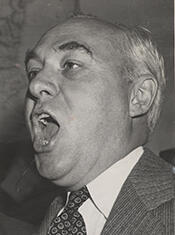
Here you will find contact information for Representative Louis Charles Rabaut, including email address, phone number, and mailing address.
| Name | Louis Charles Rabaut |
| Position | Representative |
| State | Michigan |
| District | 14 |
| Party | Democratic |
| Status | Former Representative |
| Term Start | January 3, 1935 |
| Term End | January 3, 1963 |
| Terms Served | 13 |
| Born | December 5, 1886 |
| Gender | Male |
| Bioguide ID | R000001 |
About Representative Louis Charles Rabaut
Louis Charles Rabaut (December 5, 1886 – November 12, 1961) was an American lawyer and Democratic politician from Michigan who served as a Representative in the United States Congress from 1935 to 1947 and from 1949 to 1961. Representing Michigan’s 14th congressional district for a total of 13 terms, he played an active role in the legislative process during a significant period in American history, spanning the New Deal, World War II, the early Cold War, and the beginnings of the civil rights era. He is best known nationally for introducing legislation that added the words “under God” to the Pledge of Allegiance.
Rabaut was born in Detroit, Michigan, the grandson of immigrants from Kortrijk, West Flanders, Belgium. His parents, Louis Aloysius Rabaut and Clara Lenau Reid Rabaut, operated a wholesale toy and fireworks store in Detroit, providing a modest commercial background for their family. Raised in this environment, he developed early ties to the city and its growing immigrant and working-class communities. In 1911, he married Stella Marie Petz, with whom he had nine children, establishing a large family that remained rooted in the Detroit area throughout his life.
Rabaut pursued higher education in Detroit, graduating from Detroit College in 1909. He continued his studies at the Detroit College of Law, from which he graduated in 1912. That same year he was admitted to the bar and commenced the practice of law in Detroit. His legal career, grounded in the city’s diverse and industrial setting, provided the professional foundation and public visibility that would later support his entry into electoral politics and his long tenure in Congress.
Rabaut’s congressional career began with the 1934 elections, when he defeated incumbent Democrat Carl M. Weideman in the primary for Michigan’s 14th congressional district. He was subsequently elected to the 74th Congress and to the five succeeding Congresses, serving from January 3, 1935, to January 3, 1947. During this period he participated in the legislative implementation of New Deal programs and wartime measures, representing the interests of his Detroit-area constituents in the House of Representatives. In the 1946 general election, amid a national Republican resurgence following World War II, he was defeated by Republican Harold F. Youngblood.
Rabaut returned to Congress two years later. In the 1948 elections he successfully regained his seat from Harold F. Youngblood and was elected to the 81st Congress and the six succeeding Congresses, serving from January 3, 1949, until his death on November 12, 1961. Over these years he became a senior Democratic member of the House and was involved in debates over postwar economic policy, Cold War defense and foreign policy, and domestic social and economic issues. In 1951, during discussions over economic stabilization and inflation, he argued strongly for federal price controls, warning that without such authority the 82nd Congress would be remembered by the American people as “the horse-meat Congress” — “the Congress that put the old gray mare on the family dinner table.”
Rabaut’s most enduring legislative legacy arose from the intersection of Cold War politics and public expressions of faith. On April 20, 1953, prompted by a letter from Brooklyn resident H. Joseph Mahoney and influenced by a practice already adopted by the Knights of Columbus, he introduced a resolution to amend the Pledge of Allegiance by inserting the words “under God.” His proposal was the first of a series of similar efforts in Congress and helped frame the debate that culminated in the joint resolution sponsored by Representative Charles Oakman of Michigan and Senator Homer Ferguson of Michigan in 1954. In support of the measure, Rabaut argued that belief in Almighty God marked the fundamental distinction between the United States and Communist Russia, contending that atheism lay at the root of communism, materialism, and political dictatorship. The bill adding “under God” to the Pledge passed and was signed into law by President Dwight D. Eisenhower on June 14, 1954, Flag Day, embedding Rabaut’s initiative in a lasting national ritual.
Within the House, Rabaut also exercised influence through committee work and leadership positions. From 1955 until his death in 1961, he served as chair of the House Subcommittee on the District of Columbia, giving him a central role in oversight of the federal district’s local affairs during a period of demographic change and growing demands for home rule. In recognition of his service, both a park and a junior high school in Washington, D.C., were later named in his honor. Rabaut Park was established on Mt. Pleasant Street between 16th and Harvard Streets NW, and Rabaut Junior High School was built at 100 Peabody Street NW in 1966. Although the school was closed in the 1990s, the building subsequently became the home of Capital City Public Charter School in 2012, extending his name’s association with public education and civic life.
Rabaut remained an active member of Congress until his final illness. Reflecting on the nature of House service in a 1959 interview, he described representatives as “the guinea pigs of the country,” emphasizing the constant electoral accountability of House members, who, he noted, had to return to the voters every two years, unlike senators who could “rely on the short memory of the people.” Louis Charles Rabaut died in office on November 12, 1961, in Hamtramck, Michigan. He was interred at Mount Olivet Cemetery in Detroit. Following his death, Democrat Harold M. Ryan was elected in a special election on February 13, 1962, to succeed him in representing Michigan’s 14th congressional district, closing a congressional career that had spanned more than a quarter century and left a distinct imprint on both national symbolism and the governance of the nation’s capital.