Representative Louis Stokes
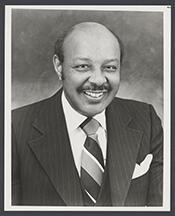
Here you will find contact information for Representative Louis Stokes, including email address, phone number, and mailing address.
| Name | Louis Stokes |
| Position | Representative |
| State | Ohio |
| District | 11 |
| Party | Democratic |
| Status | Former Representative |
| Term Start | January 3, 1969 |
| Term End | January 3, 1999 |
| Terms Served | 15 |
| Born | February 23, 1925 |
| Gender | Male |
| Bioguide ID | S000948 |
About Representative Louis Stokes
Louis Stokes (February 23, 1925 – August 18, 2015) was an American attorney, civil rights pioneer, and Democratic politician who served as a Representative from Ohio in the United States Congress from 1969 to 1999. Over the course of 15 consecutive terms in the House of Representatives, he represented the east side of Cleveland and became the first African American congressman elected in the state of Ohio. His three-decade tenure in Congress coincided with a significant period in American history, during which he participated actively in the legislative process and represented the interests of his constituents while emerging as a national leader on civil rights, ethics, intelligence oversight, and appropriations.
Born in Cleveland, Ohio, on February 23, 1925, Stokes grew up in a working-class African American family during the era of Jim Crow segregation and the Great Depression. He was raised in the city’s public housing and experienced firsthand the racial and economic barriers that shaped his later commitment to civil rights and social justice. His early life in Cleveland’s neighborhoods, which he would later represent in Congress, informed his understanding of urban poverty, discrimination, and the importance of public service. These formative experiences helped lay the foundation for his eventual role as a civil rights pioneer and political leader.
Stokes served in the United States Army during World War II, an experience that broadened his perspective on democracy, citizenship, and equality at a time when African American servicemembers faced discrimination both in and out of uniform. After his military service, he returned to Cleveland and pursued higher education, ultimately studying law. He attended Cleveland–Marshall College of Law, from which he graduated and was admitted to the bar, beginning a legal career that would make him one of Ohio’s most prominent civil rights attorneys. As a lawyer, he took on cases that challenged discriminatory practices and helped open doors for African Americans in housing, employment, and political representation.
Before his election to Congress, Stokes built a reputation as a skilled trial lawyer and advocate for civil rights, often working in tandem with his younger brother, Carl B. Stokes, who in 1967 became the first African American mayor of a major U.S. city when he was elected mayor of Cleveland. Louis Stokes’s legal and civic work in this period positioned him as a leading figure in the struggle for racial equality in Ohio. His advocacy and visibility in the civil rights movement, combined with his deep ties to Cleveland’s African American community, set the stage for his successful run for Congress in 1968, when he won election to the U.S. House of Representatives as a Democrat from Ohio.
Stokes took office in January 1969 and served in the House of Representatives until his retirement in 1999, completing 15 terms in office. As a member of the House, he participated fully in the democratic process, contributing to legislation affecting civil rights, health care, housing, education, and urban development. In 1971, he was a founding member of the Congressional Black Caucus, an organization created to strengthen the political influence of African American members of Congress and to advocate for policies addressing racial inequality and social justice. Over time, he rose to leadership within the caucus and ultimately headed the Congressional Black Caucus, helping to shape its agenda and national profile.
During his congressional service, Stokes held several influential committee assignments and leadership positions. He became the first African American to serve on the powerful United States House Committee on Appropriations, which oversees federal spending, and his presence there marked a significant milestone in the inclusion of African Americans in the highest levels of fiscal policymaking. He also served as one of the Cold War era chairmen of the United States House Permanent Select Committee on Intelligence, where he played a key role in overseeing the nation’s intelligence agencies at a time of intense global rivalry and domestic concern over civil liberties. In addition, he served on the House committee that investigated the Iran–Contra Affair, contributing to congressional scrutiny of executive branch actions in foreign policy and national security.
Stokes was also a central figure in some of the most sensitive ethics and investigative work undertaken by the House in the late twentieth century. In the 1970s, he served as chairman of the United States House Select Committee on Assassinations, which was charged with investigating the murders of President John F. Kennedy and civil rights leader Martin Luther King Jr. Under his leadership, the committee conducted extensive hearings and gathered evidence in an effort to resolve lingering questions about these historic crimes. As chairman of the United States House Committee on Ethics, he oversaw the committee’s investigation of the Abscam corruption scandal in 1979–80, which ultimately led to the convictions of one senator and six House members. His conduct during these investigations earned him a reputation for fairness and integrity; U.S. Attorney Steven Dettelbach later recalled that during a period when public service was under intense scrutiny, “Lou Stokes was there as a shining beacon of integrity, of excellence and most important of all for us, of justice.”
In addition to his committee leadership, Stokes played a notable role in presidential politics. In 1992, he ran as an Ohio “favorite son” candidate for the Democratic presidential nomination, securing the delegates from his home district. At the Democratic National Convention that year, he briefly became the focus of a minor convention drama when he refused to release his delegates’ votes until the Clinton campaign formally requested them, underscoring both his loyalty to his constituents and his stature within the party. Throughout his congressional career, he remained closely identified with the concerns of Cleveland’s east side, advocating for federal investment in health care, housing, transportation, and education in his district.
After leaving Congress in 1999, Stokes continued his commitment to public service and education. He became a distinguished visiting professor at the Jack, Joseph and Morton Mandel School of Applied Social Sciences at Case Western Reserve University in Cleveland. In this role, which he actively held until his death, he shared his extensive experience in lawmaking, civil rights, and public policy with students and faculty, helping to train a new generation of public servants and social advocates. His post-congressional work extended his influence beyond the legislative arena into academia and community engagement.
Louis Stokes died on August 18, 2015, in Cleveland, Ohio, the city where he had been born, raised, and which he had represented for three decades in Congress. At the time of his death, he was widely recognized as a trailblazing African American legislator, a civil rights pioneer, and a respected figure in national politics. His career is frequently cited in discussions of African-American members of the United States House of Representatives, Cleveland–Marshall College of Law alumni, and members who served on key investigative bodies such as the House Un-American Activities Committee and its successor oversight and intelligence panels. His legacy endures in the institutions he helped shape and the communities he served.