Senator Louis Crosby Wyman
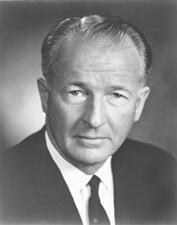
Here you will find contact information for Senator Louis Crosby Wyman, including email address, phone number, and mailing address.
| Name | Louis Crosby Wyman |
| Position | Senator |
| State | New Hampshire |
| Party | Republican |
| Status | Former Representative |
| Term Start | January 9, 1963 |
| Term End | January 3, 1975 |
| Terms Served | 6 |
| Born | March 16, 1917 |
| Gender | Male |
| Bioguide ID | W000782 |
About Senator Louis Crosby Wyman
Louis Crosby Wyman (March 16, 1917 – May 5, 2002) was an American politician, lawyer, and jurist who served as both a United States Representative and a United States Senator from New Hampshire. A member of the Republican Party, he contributed to the legislative process in Congress during a period of significant political and social change in the mid-twentieth century, and later served as an associate justice of the New Hampshire Superior Court.
Wyman was born on March 16, 1917, in Manchester, New Hampshire, the son of Alice Sibley (Crosby) Wyman and Louis Eliot Wyman. He was educated in New Hampshire and attended the University of New Hampshire at Durham, from which he graduated in 1938. He then studied law at Harvard Law School, earning his degree in 1941. That same year he was admitted to the bars of Massachusetts and New Hampshire and later, in 1957, to the bar of Florida. He commenced the practice of law in Boston, Massachusetts, with the firm Ropes and Gray, laying the foundation for a career that would combine legal practice, public service, and elected office.
During World War II, Wyman served in the United States Naval Reserve from 1942 to 1946, attaining the rank of lieutenant and serving in the Alaskan Theater. After the war, he moved into legal and legislative roles in Washington, D.C. In 1946 he served as general counsel to a United States Senate committee, and in 1947 he was secretary to Senator Styles Bridges of New Hampshire. From 1948 to 1949 he was counsel to the Joint Congressional Committee on Foreign Economic Cooperation, which oversaw aspects of postwar foreign aid and economic reconstruction. Returning to New Hampshire, he became attorney general of the state, serving from 1953 to 1961. In that capacity he was president of the National Association of Attorneys General in 1957 and served as a member and chairman of several state legal and judicial commissions. His efforts as attorney general to investigate alleged communists led to the landmark Supreme Court case Sweezy v. New Hampshire, in which the Court ruled against the state and Wyman on due process grounds, marking an important limitation on state investigative powers. In 1961 he served as legislative counsel to the governor of New Hampshire, further solidifying his reputation as a leading legal and political figure in the state.
Wyman entered national elective office in 1962, when he was elected as a Republican to the United States House of Representatives from New Hampshire’s 1st congressional district. He took his seat in the 88th Congress in January 1963. His service in Congress occurred during a significant period in American history, encompassing the civil rights movement, the Great Society, and the Vietnam War. He was defeated in the Democratic landslide of 1964 but regained his House seat in the 1966 election. He was subsequently reelected three more times, serving multiple terms and contributing to the legislative process over the course of his House career. Among his legislative activities, Wyman was associated with an amendment to 1964 automobile safety legislation that prohibited the use of a “seat belt interlock system” in automobiles, a mechanism that would have prevented cars from starting unless the driver was wearing a seat belt. While consumer advocates had promoted the interlock as a safety measure, it also provoked substantial public opposition, and Wyman’s amendment reflected the tension between regulatory safety initiatives and consumer acceptance.
In 1974 Wyman chose not to run for reelection to his House seat, instead seeking a seat in the United States Senate. He ran for the Senate seat that was to be vacated by Republican Senator Norris Cotton, who was retiring after twenty years of service. The ensuing election produced one of the closest and most contested Senate races in modern American history. Initial returns on election night showed Wyman defeating the Democratic candidate, John A. Durkin, by 355 votes. Durkin requested a recount, which reversed the outcome and gave Durkin a ten-vote lead; Governor Meldrim Thomson then certified Durkin as the winner. Wyman in turn demanded another recount, after which he was declared ahead by two votes. On December 31, 1974, Senator Cotton resigned his seat, and Governor Thomson appointed Wyman to fill the vacancy for the balance of the term ending January 3, 1975, in an effort to give him a seniority advantage. Although Louis Crosby Wyman is noted as having served as a Senator from New Hampshire in the United States Congress from 1963 to 1975, and as a member of the Senate he participated in the democratic process and represented the interests of his constituents, the long-running dispute over the 1974 election meant that his service for the full 1975–1981 term was never conclusively established.
The contested 1974 Senate election was ultimately referred to the United States Senate, which under the Constitution is the final arbiter of its own elections. The Senate Rules Committee, which has jurisdiction over such matters, deadlocked on whether to seat Wyman for the 1975–1981 term while the dispute was being resolved. On January 14, 1975, the full Senate returned the case to the Rules Committee, which identified 35 disputed points involving some 3,000 questionable ballots and referred those points back to the Senate. The Senate, however, was unable to break a deadlock on any of the 35 issues. After seven months of debate and six unsuccessful attempts by Senate Democrats to seat Durkin, Wyman, who had never been seated for the contested full term, proposed that he and Durkin submit the matter to the voters again in a special election. Durkin agreed, and on August 8, 1975, the Senate declared the seat vacant pending the new election. Governor Thomson temporarily reappointed Norris Cotton to his old seat. In the special election held on September 16, 1975, Durkin defeated Wyman by nearly 28,000 votes, bringing to a close what remains one of the closest and most protracted Senate election disputes since the direct election of senators was established by the Seventeenth Amendment in 1913.
After leaving Congress, Wyman returned to the law and public service in New Hampshire. In 1978 he was appointed an associate justice of the New Hampshire Superior Court, a position he held until 1987. His judicial service capped a career that had included roles as practicing attorney, naval officer, legislative counsel, state attorney general, member of Congress, and briefly appointed United States senator. In his later years he divided his time between Manchester, New Hampshire, and West Palm Beach, Florida. Louis Crosby Wyman died of cancer on May 5, 2002. His remains were cremated, and his ashes were scattered at sea.