Representative Lowell Stockman
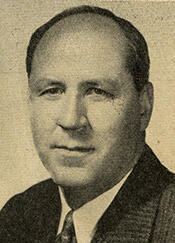
Here you will find contact information for Representative Lowell Stockman, including email address, phone number, and mailing address.
| Name | Lowell Stockman |
| Position | Representative |
| State | Oregon |
| District | 2 |
| Party | Republican |
| Status | Former Representative |
| Term Start | January 6, 1943 |
| Term End | January 3, 1953 |
| Terms Served | 5 |
| Born | April 12, 1901 |
| Gender | Male |
| Bioguide ID | S000936 |
About Representative Lowell Stockman
Lowell Stockman (April 12, 1901 – August 9, 1962) was an American farmer, local official, and Republican politician who represented Oregon in the United States House of Representatives from 1943 to 1953. His decade of congressional service spanned World War II and the early Cold War, during which he served five consecutive terms and participated actively in the legislative process on behalf of his constituents in Eastern Oregon.
Stockman was born on a farm near Helix, Umatilla County, Oregon, on April 12, 1901, to W. J. Stockman and the former Etta Edmiston. He grew up in a rural agricultural setting and attended public schools in nearby Pendleton, Oregon. This early exposure to farming and small-town life shaped his later career and political priorities, particularly his interest in agricultural and local governance issues.
After completing his primary and secondary education in Pendleton, Stockman enrolled at Oregon State University in Corvallis. He graduated in 1922, and in the same year he returned to Eastern Oregon to engage in wheat farming in Umatilla County. His work as a wheat farmer from 1922 onward established him as a prominent figure in the local agricultural community. In 1924 he married Dorcas Conklin; the couple had two daughters and one son, and they maintained their home and livelihood in the farming regions of Eastern Oregon.
Stockman’s involvement in public affairs began at the local and state levels while he continued his farming operations. He served as a member of the Pendleton School Board, where he participated in overseeing local educational policy and administration. He also served on the Oregon Liquor Control Commission, a statewide regulatory body, gaining experience in public regulation and state governance. These roles helped build his reputation as a civic-minded leader and provided a foundation for his later entry into national politics.
A member of the Republican Party, Stockman was elected to the United States House of Representatives in 1942 and took office on January 3, 1943, as a Representative from Oregon in the Seventy-eighth Congress. He was subsequently reelected to the Seventy-ninth, Eightieth, Eighty-first, and Eighty-second Congresses, serving continuously from January 3, 1943, to January 3, 1953. During these five terms in office, he contributed to the legislative process at a time of major national and international developments, including World War II, postwar reconstruction, and the onset of the Cold War. As a member of the House of Representatives, he participated in the democratic process and represented the interests of his Eastern Oregon constituents, particularly those connected to agriculture and rural communities. He chose not to be a candidate for renomination in 1952, thus concluding a decade of congressional service.
After leaving Congress in January 1953, Stockman returned to private life and resumed his farming operations in Oregon, continuing in agriculture until 1959. During this period he also remained active in public and civic affairs at the national level, serving as a member of the Theodore Roosevelt Centennial Commission from 1956 to 1959, which was established to commemorate the 100th anniversary of President Theodore Roosevelt’s birth. In addition to his farming interests, he entered the business sector, becoming vice president of Oregon Fiber Products, Inc., and treasurer of the Pilot Rock Lumber Company, positions that reflected his ongoing engagement with the regional resource-based economy.
In 1959 Stockman moved to Bellevue, Washington, where he transitioned into a new line of work by operating a trailer court. He continued to reside there until his death on August 9, 1962, in Bellevue. He was buried on University of Washington property near Pack Forest, Washington, a forested research and educational area in the foothills of the Cascade Range. His life and career reflected a trajectory from rural Oregon farm boy to local official, business leader, and five-term member of the United States House of Representatives, maintaining close ties to the agricultural and timber communities of the Pacific Northwest throughout his public and private endeavors.