Representative Lucien Anderson
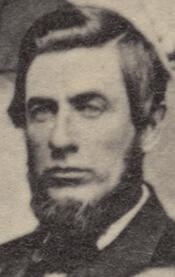
Here you will find contact information for Representative Lucien Anderson, including email address, phone number, and mailing address.
| Name | Lucien Anderson |
| Position | Representative |
| State | Kentucky |
| District | 1 |
| Party | Unconditional Unionist |
| Status | Former Representative |
| Term Start | December 7, 1863 |
| Term End | March 3, 1865 |
| Terms Served | 1 |
| Born | June 23, 1824 |
| Gender | Male |
| Bioguide ID | A000201 |
About Representative Lucien Anderson
Lucien Anderson (June 23, 1824 – October 18, 1898) was a Unionist slave owner, attorney, and United States Representative from Kentucky who served one term in Congress during the American Civil War. He was born near Mayfield, Graves County, Kentucky. The spelling of his first name is disputed; his official Congressional biography and many contemporaneous accounts spell it “Lucien,” but some modern biographers claim the original spelling was “Lucian.” He grew up in western Kentucky and attended the local public schools, receiving the basic education typical of the region and period.
After completing his early schooling, Anderson studied law and prepared for a legal career. In 1845 he was admitted to the bar and commenced the practice of law in Mayfield, Kentucky. He quickly became active in local legal and civic affairs and served as Graves County Attorney, a position that placed him at the center of county governance and judicial administration. His legal practice and county office helped establish his reputation as a capable lawyer and public servant in a predominantly rural, slaveholding community.
Anderson’s involvement in politics developed alongside his legal career. A member of the Whig Party in the antebellum period, he served as a Presidential Elector on the Whig ticket of Winfield Scott and William A. Graham in the 1852 presidential election. He subsequently won election to the Kentucky House of Representatives, serving as a state legislator from 1855 to 1857. In the state house he participated in debates over issues affecting Kentucky in the turbulent years leading up to the Civil War, while himself remaining a slave owner even as national tensions over slavery intensified.
With the outbreak of the Civil War, Anderson aligned himself firmly with the Union cause. He was elected as a Union Democrat to the Thirty-eighth Congress and served as a Representative from Kentucky in the United States House of Representatives from 1863 to 1865. Once in office he emerged as a leader of the new Unconditional Unionist Party, which favored the preservation of the Union without compromise and supported the abolition of slavery. His service in Congress occurred during a significant period in American history, and as a member of the House of Representatives he participated in the democratic process and represented the interests of his Kentucky constituents while backing the Lincoln administration’s war policies.
Anderson’s congressional tenure was marked by both personal peril and notable legislative positions. Shortly after his election he was kidnapped by Confederate sympathizers, reflecting the deep divisions within Kentucky and the dangers faced by prominent Unionists in a border state. He was subsequently released in a prisoner exchange for Confederate prisoners. In the House he advocated the emancipation of all slaves and voted in favor of the Thirteenth Amendment to the United States Constitution, which abolished slavery throughout the nation. This stance was particularly striking given that he was a slave owner, possibly even at the time he cast his vote for the amendment, underscoring the complexity of his position as a Unionist from a slaveholding background.
After completing his single term, Anderson declined to be a candidate for renomination in 1864. He remained involved in national politics as a delegate to the 1864 National Union Convention that nominated President Abraham Lincoln for re-election, aligning himself with the broader coalition of Republicans and War Democrats committed to prosecuting the war to a successful conclusion. Following his departure from Congress, he returned to Mayfield and resumed the practice of law, continuing his professional life in the community where he had long been established.
In his later years, Anderson’s health and mental condition deteriorated. Near the end of his life he was judged to be of unsound mind as a result of age and ill health, and a trustee was appointed to manage his affairs. He died in Mayfield, Kentucky, on October 17, 1898 (with some records giving October 18, 1898, as the date of death), closing the life of a Civil War–era Unionist who had navigated the tensions of loyalty to the Union and the institution of slavery in a deeply divided state.