Representative Lucille Roybal-Allard
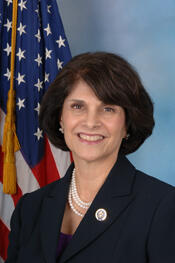
Here you will find contact information for Representative Lucille Roybal-Allard, including email address, phone number, and mailing address.
| Name | Lucille Roybal-Allard |
| Position | Representative |
| State | California |
| District | 40 |
| Party | Democratic |
| Status | Former Representative |
| Term Start | January 5, 1993 |
| Term End | January 3, 2023 |
| Terms Served | 15 |
| Born | June 12, 1941 |
| Gender | Female |
| Bioguide ID | R000486 |
About Representative Lucille Roybal-Allard
Lucille Elsa Roybal-Allard (born June 12, 1941) is an American politician who served as a U.S. representative from California from 1993 to 2023. A member of the Democratic Party, she represented districts based in southern and central Los Angeles and surrounding communities for 15 consecutive terms in Congress. Over the course of her tenure, her district was numbered the 33rd from 1993 to 2003, the 34th from 2003 to 2013, and the 40th from 2013 to 2023. These districts included much of southern Los Angeles and several eastern suburbs, such as Downey, Bell, and Bell Gardens, and, until 2013, much of downtown Los Angeles. As of the 2010 census, her district was the most Latino in the nation, with a Latino majority of 86.5 percent. On December 20, 2021, Roybal-Allard announced that she would retire at the end of the 117th Congress, concluding three decades of service in the U.S. House of Representatives.
Roybal-Allard was born in Boyle Heights, California, the daughter of Edward R. Roybal and Lucille Beserra Roybal. Her father, a pioneering Mexican American politician, served in the U.S. House of Representatives from 1963 to 1993, representing a Los Angeles–area district and helping to open doors for Latino political participation nationwide. Raised in a Roman Catholic household, she attended Ramona Convent Secondary School in Alhambra, California, graduating in 1959. She later attended California State University, Los Angeles. Her early exposure to public service through her father’s career and her upbringing in a diverse, working-class neighborhood of Los Angeles helped shape her long-standing focus on civil rights, immigrant communities, and economic opportunity.
Before entering elective office, Roybal-Allard worked as a public relations officer and fund-raising executive, gaining experience in communications, community outreach, and organizational development. Her professional background in these fields provided a foundation for her later work in coalition building and legislative advocacy. She became active in local and state politics as a Democrat, building on her family’s political legacy while establishing her own policy priorities, particularly in the areas of children’s welfare, public health, and immigrant rights.
Roybal-Allard’s legislative career began in the California State Assembly, where she served from 1987 to 1992. She was first elected on May 12, 1987, in a special election to replace Assemblywoman Gloria Molina, who had resigned after being elected to the Los Angeles City Council. In the Assembly, Roybal-Allard represented a heavily Latino, urban district and focused on issues such as education, health care, and services for low-income families. Her work at the state level helped solidify her reputation as an advocate for underserved communities and positioned her for a successful run for Congress when an open seat emerged following redistricting and her father’s retirement.
In 1992, Roybal-Allard won the Democratic nomination for California’s newly created 33rd congressional district, which included a portion of the area her father had represented for 30 years. She won the general election handily and entered the U.S. House of Representatives in January 1993. Over the next three decades, she was re-elected 14 times with no substantial opposition in her heavily Democratic, Latino-majority district. As a member of the House of Representatives, she participated actively in the legislative process and represented the interests of her constituents during a significant period in American history, including debates over immigration reform, homeland security, health care, and economic policy. She was the first Democratic Mexican-American woman to serve in Congress, and, along with Nydia Velázquez, she was among the third and fourth Latinas ever elected to Congress, following Barbara Vucanovich and Ileana Ros-Lehtinen. She and Velázquez were the first Latina Democrats to serve in the House and the first two Latinas elected to a full term.
Roybal-Allard became particularly influential through her work on the House Committee on Appropriations. She was the first Latina to serve on the Appropriations Committee and the first Latina to serve as one of the 12 “cardinals,” or chairs, of a House Appropriations Subcommittee. She chaired the Subcommittee on Homeland Security and also served on the Subcommittee on Labor, Health and Human Services, Education, and Related Agencies. From these positions, she spearheaded numerous federal projects that created jobs and improved infrastructure in her district and the broader Los Angeles region, including the construction of a new federal courthouse in downtown Los Angeles, the Metro Gold Line Light Rail Eastside Extension, the deepening of the Port of Los Angeles, and the ongoing revitalization of the Los Angeles River. She chaired the California Democratic congressional delegation in 1998–1999 and was the first woman to chair both the Congressional Hispanic Caucus and the California Democratic congressional delegation. She also founded the Women’s Working Group on Immigration Reform and was active in the Congressional Children’s Caucus, as well as on the Democratic Homeland Security and Livable Communities task forces.
Throughout her congressional career, Roybal-Allard developed a legislative portfolio centered on public health, children’s welfare, labor protections, and the rights of women and immigrants. She authored the Sober Truth on Preventing Underage Drinking (STOP) Act, which has been credited with helping to reduce underage drinking and its consequences by supporting community-based prevention efforts and public education. She introduced the Newborn Screening Saves Lives Reauthorization Act of 2013 (H.R. 1281; 113th Congress), which amended the Public Health Service Act to reauthorize grant programs and other initiatives to promote expanded screening of newborns and children for heritable disorders. In advocating for the bill, she emphasized that newborn screening not only saves lives but also saves money, noting that in California newborns are screened for more than 40 preventable and treatable conditions and that every dollar spent on screening yields a benefit of more than nine dollars by preventing disease in children diagnosed with treatable conditions. She was the original House author of the Security and Financial Empowerment (SAFE) Act, designed to ensure that survivors of domestic violence, sexual assault, and stalking can seek help without fearing the loss of their jobs or economic security; key provisions of the SAFE Act were later incorporated into the House’s 2019 reauthorization of the Violence Against Women Act. She also authored the Children’s Act for Responsible Employment (CARE) to address abusive and exploitative child labor practices in agriculture and to achieve parity between minor workers in agriculture and those in other industries, an effort that drew additional public attention through the related documentary film “The Harvest.”
Roybal-Allard’s policy positions reflected a consistently progressive record. She was a member of the Congressional Progressive Caucus, an associate member of the Congressional Asian Pacific American Caucus, and a member of the Congressional Hispanic Caucus, the Congressional Arts Caucus, the House Baltic Caucus, and the Medicare for All Caucus. On reproductive rights, she maintained a strong pro-choice voting record; as of 2020, she held a 100 percent rating from NARAL Pro-Choice America and an “F” rating from the Susan B. Anthony List for her abortion-related votes. She opposed the overturning of Roe v. Wade, characterizing it as an infringement on a woman’s right to choose. Her long tenure and leadership roles made her a key voice on immigration, homeland security funding, and social policy affecting children and families, particularly in Latino and immigrant communities.
Roybal-Allard is married to Edward Allard III. Together they have four children, two of whom are her stepchildren. She is Roman Catholic and has maintained close ties to her Los Angeles roots and to the communities she represented for three decades. After announcing her retirement in December 2021 and leaving Congress at the conclusion of the 117th Congress in January 2023, her papers and official records were placed in the collection of the California State Archives, preserving the legislative history and public service legacy of one of the pioneering Latina members of the United States House of Representatives.