Representative Luis G. Fortuño
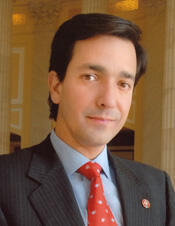
Here you will find contact information for Representative Luis G. Fortuño, including email address, phone number, and mailing address.
| Name | Luis G. Fortuño |
| Position | Representative |
| State | Puerto Rico |
| District | At-Large |
| Party | Republican |
| Status | Former Representative |
| Term Start | January 4, 2005 |
| Term End | January 3, 2009 |
| Terms Served | 2 |
| Born | October 31, 1960 |
| Gender | Male |
| Bioguide ID | F000452 |
About Representative Luis G. Fortuño
Luis Guillermo Fortuño Burset (born October 31, 1960) is a Puerto Rican politician and attorney who served as the governor of Puerto Rico, an unincorporated territory of the United States, from January 2, 2009, to January 2, 2013, and as resident commissioner of Puerto Rico in the United States House of Representatives from January 3, 2005, to January 3, 2009. A member of the Republican Party in the United States and of the New Progressive Party (Partido Nuevo Progresista, PNP) in Puerto Rico, he has been a prominent advocate of statehood for Puerto Rico and an influential figure in both island and mainland conservative politics.
Fortuño was born in San Juan, Puerto Rico, on October 31, 1960. He was raised and educated on the island, where he became active at an early age in pro-statehood and student political organizations. During his youth he was involved with the Puerto Rico Statehood Students Association, an experience that helped shape his political outlook and introduced him to future collaborators, including Pedro Pierluisi. He attended Colegio Marista in Guaynabo, a private Catholic school, where he and Pierluisi were classmates, and where he began forming the political and professional networks that would later play a role in his public career.
After completing his primary and secondary education in Puerto Rico, Fortuño pursued higher education in the mainland United States. He studied at Georgetown University in Washington, D.C., where he earned a Bachelor of Science degree in foreign service. He then continued at Georgetown University Law Center, receiving his Juris Doctor. His years in Washington exposed him to federal institutions and national politics, experience that would later prove central to his role as Puerto Rico’s representative in Congress. Following law school, he returned to Puerto Rico to practice law and became active in the New Progressive Party, aligning himself with its pro-statehood, pro-market orientation.
Fortuño’s governmental career began in the administration of Governor Pedro Rosselló in the 1990s. He served as executive director of the Puerto Rico Tourism Company from 1993 to 1994, where he oversaw efforts to promote the island as a travel destination. He was also president of the Puerto Rico Hotel Development Corporation, working to expand and modernize the island’s tourism infrastructure. From 1994 to 1997, he served as the first secretary of economic development and commerce of Puerto Rico, a newly organized portfolio in which he was responsible for promoting investment, job creation, and economic growth. These roles established his reputation as a pro-business technocrat and positioned him as a rising figure within the PNP.
In 2004, Fortuño was elected resident commissioner of Puerto Rico, defeating Senator Roberto Prats. As resident commissioner, he represented Puerto Rico in the United States House of Representatives from January 3, 2005, to January 3, 2009, serving two terms. Although the resident commissioner does not have a vote on the House floor, Fortuño participated fully in committee work and caucus activities, contributing to the legislative process and representing the interests of his constituents during a significant period in American history. During his tenure, he served as chair of the Congressional Hispanic Conference, a caucus of Republican Hispanic members of Congress, and as a member of the newly created House Natural Resources Subcommittee on Insular Affairs, which has jurisdiction over U.S. territories. He also served as co-chair of the Friends of Spain Caucus. A member of the Republican Party, he was one of the most visible Hispanic Republicans in Congress and used his position to advocate for Puerto Rico’s economic development and for changes in the island’s political status.
While still serving in Congress, Fortuño emerged as a leading contender for the governorship of Puerto Rico. A poll taken by Gaither International for Caribbean Business before he announced his gubernatorial bid in February 2007 suggested he was the most well-liked public figure in the PNP and indicated that incumbent Governor Aníbal Acevedo Vilá would fare poorly against him in a general election. Another poll released in May 2007 by Kaagan Research Associates for El Nuevo Día showed Fortuño with a 46 percent to 25 percent advantage over Acevedo Vilá, and a May 16, 2007, poll showed him leading former governor Pedro Rosselló 49 percent to 37 percent in a potential primary. On February 19, 2007, Fortuño formally announced his candidacy for governor in the 2008 general election. On May 18, 2007, he announced that former attorney general Pedro Pierluisi Urrutia, his classmate at Colegio Marista, fellow member of the Puerto Rico Statehood Students Association, and former cabinet colleague in the Rosselló administration, would be his running mate and candidate for resident commissioner. In the PNP primary held on March 9, 2008, Fortuño decisively defeated Rosselló by a margin of approximately 60 percent to 40 percent, becoming president of the New Progressive Party and its official candidate for governor; Pierluisi simultaneously won the primary for resident commissioner.
In the general election of November 4, 2008, Fortuño became the ninth governor-elect of Puerto Rico by popular election, winning by more than 220,000 votes over incumbent Governor Aníbal Acevedo Vilá. This was the largest victory margin in 44 years and gave the New Progressive Party its largest electoral victory in history. He became only the second governor in Puerto Rican history to receive more than one million votes, following Pedro Rosselló’s reelection in 1996. The PNP’s sweeping victory also delivered control of both houses of the Legislative Assembly by historic margins and a majority of the island’s mayoralties, giving Fortuño and his party the power to appoint three justices to the Supreme Court of Puerto Rico, which for the first time would have a majority of PNP appointees. The administration also gained the opportunity to fill several fixed-term posts, including the comptroller, the ombudsman, and the director of the Government Ethics Office. Immediately after the election, Fortuño began organizing his incoming administration. On November 7, 2008, he convened a caucus of incoming PNP legislators, who chose Thomas Rivera Schatz as the next president of the Senate and Representative Jenniffer González as speaker of the House. On November 9, he named outgoing Senate president Kenneth McClintock to head the Committee on Government Transition, and on November 11 he began announcing his cabinet, appointing McClintock as secretary of state, the office equivalent to lieutenant governor.
As governor from 2009 to 2013, Fortuño pursued a platform of fiscal austerity, structural reform, and pro-growth economic policies in response to Puerto Rico’s prolonged recession and fiscal crisis. His administration implemented significant budget cuts, public-sector layoffs, and changes to labor and regulatory frameworks, measures that drew strong support from business and conservative circles but also generated substantial public opposition and large-scale protests. During his tenure he served as president of the New Progressive Party of Puerto Rico, the Council of State Governments, and the Southern Governors Association, extending his influence beyond the island into broader regional and national policy discussions. In the 2012 elections he sought reelection but was narrowly defeated by Popular Democratic Party candidate Alejandro García Padilla by a margin of approximately 0.6 percent. On January 9, 2013, shortly after leaving office, Fortuño submitted his resignation as president of the New Progressive Party; at the request of the party directorate, he remained as acting president until February 3, 2013, when Pedro Pierluisi was selected to succeed him.
Following his gubernatorial term, Fortuño relocated to Washington, D.C., in early 2013 and entered private legal practice. He joined the law firm Steptoe & Johnson LLP as a partner in its Corporate, Securities & Finance Group and its Government Affairs and Public Policy Group, and became involved in the firm’s Latin American practice, advising clients on regulatory, transactional, and public policy matters. In February 2024 he moved to Reed Smith LLP, where he serves as a partner in the firm’s Global Regulatory Enforcement Practice Group. In his post-government career he has remained active in public affairs as a frequent speaker at forums related to business, economic policy, and conservative causes. After the attack on the U.S. Capitol on January 6, 2021, he joined 30 other former Republican members of Congress in calling on their former colleagues to pass articles of impeachment against President Donald J. Trump. In 2023 he publicly supported libertarian candidate Javier Milei in the Argentine general election, reflecting his continued engagement with international and Latin American political developments.