Representative Lunsford Richardson Preyer
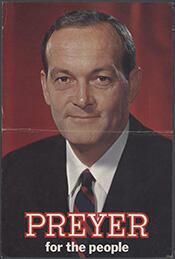
Here you will find contact information for Representative Lunsford Richardson Preyer, including email address, phone number, and mailing address.
| Name | Lunsford Richardson Preyer |
| Position | Representative |
| State | North Carolina |
| District | 6 |
| Party | Democratic |
| Status | Former Representative |
| Term Start | January 3, 1969 |
| Term End | January 3, 1981 |
| Terms Served | 6 |
| Born | January 11, 1919 |
| Gender | Male |
| Bioguide ID | P000520 |
About Representative Lunsford Richardson Preyer
Lunsford Richardson Preyer (January 11, 1919 – April 3, 2001) was a United States district judge of the United States District Court for the Middle District of North Carolina and later a United States Representative from North Carolina. Born in Greensboro, Guilford County, North Carolina, he was the grandson and namesake of Lunsford Richardson, founder of the Vick Chemical Company. He grew up in Greensboro and attended Woodberry Forest School in Woodberry Forest, Virginia, before matriculating at Princeton University. At Princeton, he was active in athletics, playing on the 150-pound football team and the golf team, and he served as vice president of the Princeton Tower Club. He received an A.B. in English in 1941, completing a senior thesis titled “The Contrasting Values of Dickens and Daudet.”
Immediately after college, Preyer entered military service during World War II. He served in the United States Navy from 1941 to 1946, rising to the positions of gunnery officer and executive officer on destroyers that saw duty in both the Atlantic and Pacific theaters. For his actions during the Battle of Okinawa, he was awarded the Bronze Star. Following his wartime service, he pursued legal studies at Harvard Law School, where he earned a Bachelor of Laws degree in 1949, preparing for a career that would combine private practice, corporate work, and public service.
After law school, Preyer began his legal career in private practice in New York City, New York, from 1949 to 1950. In 1950 he joined the Vick Chemical Company, the family-founded enterprise established by his grandfather, gaining experience in corporate affairs. He returned to his hometown and entered private practice in Greensboro in 1951, continuing there until 1956. During this period he also began his judicial career, serving as a city judge in Greensboro from 1953 to 1954. His performance on the municipal bench led to his appointment and subsequent service as a judge of the North Carolina Superior Court from 1956 to 1961, where he presided over a broad range of civil and criminal matters at the state level.
Preyer’s federal judicial service began with a recess appointment from President John F. Kennedy on October 7, 1961, to a new seat on the United States District Court for the Middle District of North Carolina created by 75 Stat. 80. Kennedy formally nominated him to the same seat on January 15, 1962. The United States Senate confirmed his nomination on February 7, 1962, and he received his commission on February 17, 1962. As a United States district judge, he served until October 9, 1963, when he resigned from the bench. Seeking higher statewide office, he ran unsuccessfully for Governor of North Carolina in 1964. He then entered the banking field, serving as senior vice president and trust officer of North Carolina National Bank (later part of Bank of America) from 1965 to 1968, further broadening his experience in finance and public affairs.
Lunsford Richardson Preyer served as a Representative from North Carolina in the United States Congress from January 3, 1969, to January 3, 1981. A member of the Democratic Party, he was elected to the 91st United States Congress and to the five succeeding Congresses, for a total of six terms in office. His service in Congress occurred during a significant period in American history marked by the Vietnam War, the civil rights movement, the Watergate era, and shifting national economic and social policies. As a member of the House of Representatives, Preyer participated in the legislative process and represented the interests of his North Carolina constituents, contributing to debates and policymaking on issues of ethics, justice, and governance.
During his congressional tenure, Preyer held several important leadership roles. He served as chairman of the House Committee on Standards of Official Conduct (commonly known as the House Ethics Committee), where he was involved in overseeing and enforcing ethical standards for members of the House. He also chaired the John F. Kennedy Subcommittee of the House Select Committee on Assassinations during the 95th Congress, playing a prominent role in the congressional re-examination of the circumstances surrounding President Kennedy’s assassination. Despite his seniority and committee influence, he was an unsuccessful candidate for reelection to the 97th Congress in 1980, concluding his House service at the end of his sixth term.
In the years following his congressional career, Preyer remained active in public and civic life. In 1988, he was elected to the National Governing Board of Common Cause, a nonpartisan citizens’ organization dedicated to government accountability and political reform, reflecting his long-standing interest in ethics and public service. He and his wife, Emily, were jointly recognized for their contributions to the state when both received the North Carolina Award for Public Service, the state’s highest civilian honor. His legacy in the federal judiciary is commemorated in Greensboro by the L. Richardson Preyer Federal Building, named in his honor, underscoring his impact on both the legal system and public life in North Carolina.
Preyer resided in Greensboro for most of his life and returned there permanently after leaving Congress. He died of cancer in Greensboro on April 3, 2001, and was interred in Green Hill Cemetery in that city. His career, spanning military service, the practice of law, state and federal judgeships, corporate leadership, and six terms in the United States House of Representatives, left a lasting imprint on North Carolina’s legal and political history.