Representative Lyman Tremain
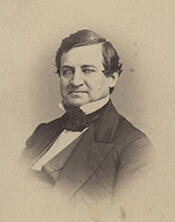
Here you will find contact information for Representative Lyman Tremain, including email address, phone number, and mailing address.
| Name | Lyman Tremain |
| Position | Representative |
| State | New York |
| District | -1 |
| Party | Republican |
| Status | Former Representative |
| Term Start | December 1, 1873 |
| Term End | March 3, 1875 |
| Terms Served | 1 |
| Born | June 14, 1819 |
| Gender | Male |
| Bioguide ID | T000364 |
About Representative Lyman Tremain
Lyman Tremain (June 14, 1819 – November 30, 1878) was an American jurist, legislator, and United States Representative from New York whose career spanned local, state, and national office during a transformative period in nineteenth-century American politics. He was born on June 14, 1819, in Durham, Greene County, New York. Little is recorded about his early family background, but his subsequent public career indicates an early engagement with the law and civic affairs in his native county.
Tremain studied law in New York, was admitted to the bar in 1840, and began practicing in Durham. His legal training and early professional work in Greene County formed the foundation for a long career in public service. Within two years of his admission to the bar, he entered local politics, reflecting both his growing stature in the community and the close connection between legal practice and public office in that era.
In 1842, Tremain was elected town supervisor of Durham, marking his first formal political office. He advanced quickly in county legal affairs, being appointed District Attorney of Greene County in 1844. In 1846 he was elected Surrogate of Greene County, an office he held until 1851, when he was defeated for reelection. In 1853 he moved to Albany, New York, where he broadened his professional and political reach. There he entered into a law partnership in 1855 with former Congressman Rufus Wheeler Peckham, a connection that placed him at the center of influential legal and political networks in the state capital. Originally aligned with the Democratic Party, Tremain was elected New York State Attorney General as a Democrat and served from January 1, 1858, to December 31, 1859.
By the Civil War era, Tremain had shifted his political allegiance to the Republican Party. In 1862 he ran unsuccessfully as the Republican candidate for Lieutenant Governor of New York. He was active in national politics as well: in June 1864 he served as a delegate to the Baltimore Convention of the National Union Party, where he placed the name of Daniel S. Dickinson in contention for the vice-presidential nomination on the ticket with President Abraham Lincoln. Tremain continued his state legislative career as a member of the New York State Assembly in 1866, where he was elected Speaker. He was again a national party figure in 1868, serving as a delegate to the Republican National Convention and placing the name of Governor Reuben E. Fenton in contention for the vice-presidential nomination on the ticket with General Ulysses S. Grant.
In 1872, Tremain was elected as a Republican to the Forty-third United States Congress, representing New York in the House of Representatives. He defeated the incumbent Democrat Samuel Sullivan Cox and served one term from March 4, 1873, to March 3, 1875. A member of the Republican Party, Tremain contributed to the legislative process during this single term in office. His service in Congress occurred during a significant period in American history, in the aftermath of the Civil War and during Reconstruction. As a Representative from New York, he participated in the democratic process and represented the interests of his constituents, taking part in the deliberations of the national legislature at a time of ongoing political and social realignment. He did not seek reelection at the conclusion of his term.
Tremain’s legal career continued alongside and beyond his congressional service. In 1873, while still in office, he served as special counsel to the State of New York in the prosecution of William M. “Boss” Tweed, working in that capacity with Wheeler Hazard Peckham, the eldest son of his former law partner Rufus Wheeler Peckham. This role in the Tweed prosecution placed Tremain among the prominent legal figures engaged in the era’s major anti-corruption efforts. After leaving Congress in 1875, he returned to private legal practice in Albany, maintaining his standing as a leading member of the New York bar.
Tremain’s family life intersected with the national crisis of the Civil War. His son, Frederick Lyman Tremain (June 1843 – February 6, 1865), served as a lieutenant colonel in the 10th New York Cavalry and was killed in action at the Battle of Hatcher’s Run in Virginia, reflecting the personal sacrifices borne by many political and professional families of the period. Lyman Tremain died on November 30, 1878, in New York City while visiting there. He was buried in Albany Rural Cemetery in Menands, New York. His career, extending from local office in Greene County to the halls of Congress and to high-profile legal proceedings in Albany, illustrates the trajectory of a nineteenth-century American lawyer-politician who navigated shifting party alignments and played a role in both state and national affairs.