Representative Lynn Jenkins
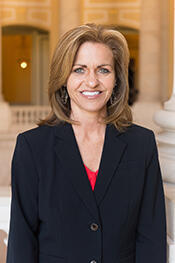
Here you will find contact information for Representative Lynn Jenkins, including email address, phone number, and mailing address.
| Name | Lynn Jenkins |
| Position | Representative |
| State | Kansas |
| District | 2 |
| Party | Republican |
| Status | Former Representative |
| Term Start | January 6, 2009 |
| Term End | January 3, 2019 |
| Terms Served | 5 |
| Born | June 10, 1963 |
| Gender | Female |
| Bioguide ID | J000290 |
About Representative Lynn Jenkins
Lynn Haag Jenkins (born June 10, 1963) is an American politician and lobbyist who represented Kansas’s 2nd congressional district in the U.S. House of Representatives from January 3, 2009, to January 3, 2019. A member of the Republican Party, she served five consecutive terms in Congress during a significant period in American political history, participating in the legislative process and representing the interests of her constituents. Before her election to Congress, she held a series of state offices, including service in the Kansas House of Representatives, the Kansas Senate, and as Kansas State Treasurer.
Jenkins was born in Holton, Kansas, and is a sixth-generation Kansan. She was raised on a dairy farm near Holton, where she attended high school, an upbringing that informed her later interest in agricultural and rural issues. She has at least two siblings, including a brother, Chris Haag, and a sister. After graduating from high school, Jenkins attended Kansas State University and Weber State College, where she majored in accounting and minored in economics. She subsequently became a Certified Public Accountant, a professional background that shaped her focus on fiscal policy and budgetary matters throughout her political career.
Jenkins began her public service in the Kansas Legislature. She was elected to the Kansas House of Representatives, serving from 1999 to 2000, and then won a seat in the Kansas Senate, where she served from 2000 to 2002. During her time in the state legislature, she developed a reputation as a fiscal conservative, and her voting record included support for certain tax measures that later became a point of contention in subsequent campaigns. In 2002, she successfully ran for statewide office and was elected Kansas State Treasurer, taking office in 2003. As treasurer, she managed state investment and cash-management programs and became active in national professional organizations, serving, among other roles, as president of the National Association of State Treasurers. She was reelected as state treasurer and held the post until 2009.
On April 4, 2007, Jenkins announced that she had filed papers with the Federal Election Commission as a first step toward running for the U.S. House of Representatives from Kansas’s 2nd congressional district. In the 2008 Republican primary, her principal opponent was former U.S. Representative Jim Ryun, who had previously served five terms before losing the seat in 2006 to Democrat Nancy Boyda. The primary campaign was competitive and ideologically charged: Ryun criticized Jenkins for having voted for tax increases while a state legislator, while she faulted him for his support of congressional earmarks. Seen as more moderate than Ryun, Jenkins received backing from the Republican Leadership Council. In the primary held on August 5, 2008, she narrowly won the Republican nomination by approximately 1,000 votes. In the general election, she defeated incumbent Democrat Nancy Boyda by a margin of 51 percent to 46 percent, securing her first term in Congress.
Jenkins took office in the U.S. House of Representatives on January 3, 2009, and went on to win reelection four times. She was reelected to a second term in 2010, defeating Democratic candidate Cheryl Hudspeth by a margin of 63 percent to 32 percent. In 2012, she won a third term, defeating Democratic candidate Tobias Schlingensiepen, 57 percent to 39 percent. She continued to hold the seat in subsequent elections, serving a total of five terms until 2019. During her tenure, Jenkins was assigned to the House Committee on Financial Services, where she served on the Subcommittee on Capital Markets, Insurance, and Government-Sponsored Enterprises and the Subcommittee on Housing and Community Opportunity. After Republicans gained control of the House for the 112th Congress, she was named to the influential Committee on Ways and Means, which oversees taxation, trade, and entitlement programs. She participated in a wide range of caucuses, including the Republican Study Committee, the Republican Main Street Partnership, the Tea Party Caucus, the Congressional Cement Caucus, the Congressional Prayer Caucus, the Congressional Constitution Caucus, the Congressional Arts Caucus, the Congressional Western Caucus, the Climate Solutions Caucus, and the bipartisan Problem Solvers Caucus.
Throughout her congressional service, Jenkins maintained a generally conservative voting record. According to the Washington Examiner, she proved to be a “fairly reliable conservative vote” in Congress, with a lifetime rating of 91 percent from the American Conservative Union and a 73 percent rating from Heritage Action in the last Congress in which she served. In 2013, the nonpartisan National Journal rated her 77 percent conservative and 23 percent liberal. Earlier, in a 2000 survey from Vote Smart during her state legislative career, she indicated support for the use of the death penalty in Kansas, for contracting with private-sector firms to build and/or manage state prisons, and for prosecuting youth accused of felonies as adults. In June 2013, following the failure of the federal farm bill in the House, Jenkins publicly expressed disappointment with House Republicans, criticizing both parties for allowing politics to override progress and for failing to find common ground on critical agricultural and nutrition legislation. In the 114th Congress, the Lugar Center and the McCourt School of Public Policy ranked her as the 96th most bipartisan member of the House, reflecting occasional cross-party cooperation despite her overall conservative profile. In December 2017, she voted in favor of the Tax Cuts and Jobs Act of 2017, asserting that the legislation would provide tax relief to middle-class Americans, create jobs, improve the economy, and ultimately help “pay down our national debt,” even as independent analyses projected the measure would add over $1 trillion to the national debt.
Jenkins’s congressional career also included moments of controversy. At a town hall meeting on August 19, 2009, while criticizing President Barack Obama’s policies, she told the audience that “Republicans are struggling right now to find the great white hope,” and then cited several young, white Republican members of Congress as examples of emerging leadership. The phrase “Great White Hope” historically referred to white boxers whom some white Americans hoped would defeat the Black heavyweight champion Jack Johnson in the early 20th century. Jenkins later apologized, stating that she had been unaware of the phrase’s racial connotations and that she had intended only to highlight promising young Republican lawmakers. The incident drew additional scrutiny because, only a month earlier, she had voted for a congressional resolution urging President Obama to pardon Jack Johnson, a resolution whose text explicitly explained the meaning of “Great White Hope.” Jenkins responded by saying she had voted for the resolution without reading it first.
Beyond her legislative work, Jenkins was active in efforts to promote conservative women in federal office. She was a founder of Maggie’s List, a political action committee created to increase the number of conservative women elected to Congress and other federal positions. In January 2017, she announced that she would not seek reelection in 2018, signaling the end of her decade-long tenure in the House. She completed her final term and left Congress when her term expired on January 3, 2019. Before her tenure ended, she established a lobbying and consulting firm, LJ Strategies, which she registered in Kansas on November 20, 2018. Her spokesperson indicated that she did not intend to actively seek clients until after her congressional service concluded. Following her departure from Congress, Jenkins continued her career in the private sector as a lobbyist and consultant, drawing on her background as a Certified Public Accountant, former state treasurer, and experienced legislator at both the state and federal levels.