Representative Lynn Morley Martin
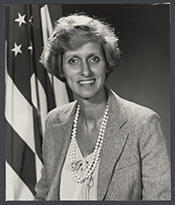
Here you will find contact information for Representative Lynn Morley Martin, including email address, phone number, and mailing address.
| Name | Lynn Morley Martin |
| Position | Representative |
| State | Illinois |
| District | 16 |
| Party | Republican |
| Status | Former Representative |
| Term Start | January 5, 1981 |
| Term End | January 3, 1991 |
| Terms Served | 5 |
| Born | December 26, 1939 |
| Gender | Female |
| Bioguide ID | M000195 |
About Representative Lynn Morley Martin
Lynn Morley Martin (born Judith Lynn Morley; December 26, 1939) is an American businesswoman, educator, and former public official who served as the 21st United States secretary of labor from 1991 to 1993 under President George H. W. Bush. A member of the Republican Party, she previously represented Illinois’s 16th congressional district in the United States House of Representatives from 1981 to 1991, serving five terms in Congress. Over the course of her career she also held elected office at the county and state levels in Illinois and later served in academia and on numerous corporate and nonprofit boards.
Martin was born in Evanston, Illinois, the daughter of Helen Catherine (Hall) and Lawrence William Morley, an accountant. She grew up in the Chicago area and attended Taft High School in Chicago from 1952 to 1956, later being named to Taft’s Hall of Fame. She went on to the University of Illinois, where she was a member of the Gamma Phi Beta sorority, and graduated in 1960. That same year she married John Martin; the couple had two daughters before divorcing in 1978. In 1987 she married Harry Leinenweber, who later became a judge of the United States District Court; he died in 2024, and through that marriage she has five stepchildren.
After completing her education, Martin became a teacher in the Rockford Public School District in northern Illinois. She continued in that position even as she began her political career, first winning election to the Winnebago County Board, on which she served from 1972 to 1976. Building on her local experience, she was elected to the Illinois House of Representatives, serving from 1977 to 1979, and then to the Illinois Senate, where she served from 1979 to 1980. Her work in the Illinois General Assembly established her as a rising Republican figure with a reputation for fiscal conservatism combined with comparatively moderate positions on social issues.
Martin entered national politics in 1980, when Representative John B. Anderson retired from Illinois’s 16th congressional district to pursue an independent campaign for the presidency. She sought the open U.S. House seat and won a competitive four-way Republican primary, running on a platform that was fiscally conservative—emphasizing lower taxes and business deregulation—while socially liberal, including support for abortion rights and advocacy of the Equal Rights Amendment. She won the general election and took office in the 97th Congress on January 3, 1981. Lynn Morley Martin served as a Representative from Illinois in the United States Congress from 1981 to 1991, contributing to the legislative process during five terms in office and representing the interests of her constituents during a significant period in American history.
During her decade in the House of Representatives, Martin rose within the Republican leadership and served on several key committees. She was vice chair of the House Republican Conference, becoming the first woman elected to a position in the Republican House leadership. Her committee assignments included the Armed Services Committee, the Budget Committee, and the House Rules Committee. On the Budget Committee she earned the nickname “the Axe” for her efforts to reduce federal spending. Although a loyal supporter of the Reagan administration on many issues, she at times broke with her party, arguing for an increase in the federal minimum wage, voting to override President Ronald Reagan’s 1986 veto of sanctions against the apartheid regime in South Africa, joining Democrats in backing tougher penalties for white-collar crime, and supporting pro-choice legislation. Within the party, she sought higher leadership roles, including a bid for chair of the House Republican Conference after Representative Dick Cheney ran for the Whip position; she lost that race to Representative Jerry Lewis of California by three votes after conservative hardliners opposed her in part because of her social policy positions.
Martin’s congressional service also brought her into national Republican politics beyond the House. A loyalist to the Reagan administration and an ally of Vice President George H. W. Bush, she helped Bush prepare for his 1984 vice presidential debate against Representative Geraldine Ferraro by adopting an aggressive style in mock debates that convinced him to take the encounter more seriously. She was chosen to deliver Bush’s nominating speech at the 1984 Republican National Convention in Dallas, and Bush later mentioned her as a possible running mate during his 1988 presidential campaign, though he ultimately selected Senator Dan Quayle of Indiana. In 1990, rather than seek reelection to the House, Martin ran for the United States Senate from Illinois against Democratic incumbent Paul Simon. Initially regarded as a formidable challenger, her campaign struggled with fundraising and messaging; she was outspent roughly two-to-one, and television advertisements that mocked Simon’s trademark bow tie were criticized as petty. In a midterm year favorable to Democrats, and amid controversy over negative campaign tactics associated with advisor Roger Ailes and gaffes including a reference to some downstate voters as “rednecks,” Simon defeated her with about 65 percent of the vote, carrying all but two counties in the state—Edwards County in the southeast and McHenry County in the Chicago exurbs, the latter lying within the district Martin had represented. Despite the loss, she raised more money than any other Republican Senate challenger that cycle.
Following her Senate campaign, Martin was selected by President George H. W. Bush to join his Cabinet as secretary of labor, succeeding Elizabeth Dole, who resigned to become president of the American Red Cross. The Senate confirmed Martin on January 22, 1991, by a vote of 94–0. As secretary of labor from 1991 to 1993, she focused on preparing a highly skilled American workforce and on expanding opportunities for women and minorities in the workplace. Her signature initiative was the Glass Ceiling Commission, which examined barriers to advancement for women and minorities in corporate America. She was an outspoken advocate for greater representation of underrepresented groups in management and a prominent critic of sexual harassment in the workplace. In 1992 she was again given a high-profile role at the Republican National Convention, delivering the nominating address for President Bush.
After leaving the Cabinet in 1993, Martin transitioned to academic and advisory roles while remaining active in public affairs. From 1993 to 1999 she served as a professor at the Kellogg School of Management at Northwestern University and chaired the Council for the Advancement of Women. She also became an advisor to Deloitte & Touche LLP on internal human resources and minority advancement issues and was briefly a fellow at Harvard University’s John F. Kennedy School of Government. In 1993 she was mentioned as a finalist for the position of commissioner of Major League Baseball, though the post ultimately went to Bud Selig. In 1995 she explored a possible candidacy for the 1996 Republican presidential nomination and even participated in a Republican primary debate in New Hampshire on local television, but she concluded there was insufficient support and did not formally enter the race; observers noted that, had she run, she would have been among the most viable women to seek the Republican presidential nomination up to that time.
In later years Martin developed a substantial career in the corporate and nonprofit sectors. She has served on the boards of AT&T Corporation, Ryder System Inc., Dreyfus Funds, Constellation Energy Group, and Procter & Gamble, and she chaired the board of the Lincoln Park Zoo in Chicago. Her long record of public service was recognized in 2000 when she was inducted as a laureate of The Lincoln Academy of Illinois and awarded the Order of Lincoln, the state’s highest honor, by Governor George Ryan in the area of government. Her connection to political media strategist Roger Ailes, dating from her 1990 Senate campaign, has been briefly noted in later cultural portrayals, including the television miniseries “The Loudest Voice.” Martin’s career has placed her among the notable women in the United States House of Representatives and among the women who have served in the United States Cabinet.