Representative Malcolm Rice Patterson
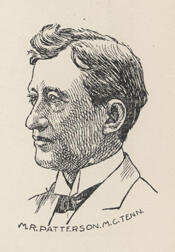
Here you will find contact information for Representative Malcolm Rice Patterson, including email address, phone number, and mailing address.
| Name | Malcolm Rice Patterson |
| Position | Representative |
| State | Tennessee |
| District | 10 |
| Party | Democratic |
| Status | Former Representative |
| Term Start | December 2, 1901 |
| Term End | March 3, 1907 |
| Terms Served | 3 |
| Born | June 7, 1861 |
| Gender | Male |
| Bioguide ID | P000126 |
About Representative Malcolm Rice Patterson
Malcolm Rice Patterson (born Hamilton Rice Patterson, June 7, 1861 – March 8, 1935) was an American politician and jurist who served as a Democratic Representative from Tennessee in the United States Congress from 1901 to 1906, as the 30th governor of Tennessee from 1907 to 1911, and later as a circuit court judge in Memphis from 1923 to 1934. A prominent and often controversial figure in early twentieth-century Tennessee politics, he also wrote a widely read weekly newspaper column for the Memphis Commercial Appeal between 1921 and 1933.
Patterson was born on June 7, 1861, in Somerville, Morgan County, Alabama, as Hamilton Rice Patterson, the son of Colonel Josiah Patterson (1837–1904), a Confederate cavalry officer who later served in Congress, and Josephine (Rice) Patterson. In 1866, his father changed his first name to “Malcolm.” The family moved to Memphis, Tennessee, in 1872, where Patterson grew up in a politically connected household shaped by his father’s legal and congressional career. He attended Christian Brothers College (now Christian Brothers University) in Memphis, from which he graduated, and subsequently studied at Vanderbilt University in the early 1880s. He read law under the guidance of his father and was admitted to the bar in 1883, beginning a legal career that would underpin his later roles in public office.
Patterson first gained public prominence as attorney general for Shelby County, Tennessee, a position he held from 1894 to 1900. In this capacity he developed a reputation as a capable prosecutor and Democratic Party loyalist. In 1900 he was elected to the United States House of Representatives from Tennessee, representing his father’s former district, the then-Tenth District. He served three terms in Congress, from March 4, 1901, to March 3, 1907, participating in the legislative process during a significant period in American history marked by the Progressive Era and debates over economic regulation and political reform. As a member of the House of Representatives, Patterson represented the interests of his Memphis-area constituents and contributed to the work of the Democratic minority in a Republican-dominated Congress.
The circumstances that propelled Patterson to the governorship arose from intraparty conflict in Tennessee. Following the death of U.S. Senator William B. Bate in March 1905, Governor James B. Frazier quickly convened the General Assembly and secured his own election to the vacant Senate seat. John I. Cox, as speaker of the state senate and Frazier’s constitutional successor, became governor, amid accusations from former governor Robert Love Taylor that Frazier, Cox, and Senator Edward W. Carmack had conspired to control the Democratic Party. Sensing widespread frustration with Cox over the Senate succession, Patterson challenged him for the Democratic gubernatorial nomination in 1906. At the party convention in late May, a rule change that awarded Patterson all of the delegates from Davidson County enabled him to clinch the nomination. Cox, angered by the maneuver, refused to support Patterson in the general election. In the ensuing campaign, Patterson faced Republican Henry Clay Evans, a former congressman who had long charged Tennessee Democrats with electoral fraud and had supported the Lodge Bill to protect Black voting rights. Patterson attacked Evans for that support, suggesting it would empower the state’s African American electorate. Patterson was elected governor with 111,856 votes to Evans’s 92,804, and he became the first Tennessee governor to reside in a state-owned governor’s mansion, which the state purchased during his tenure.
As governor from 1907 to 1911, Patterson presided over a period of both reform and controversy. His administration created a State Highway Commission, enacted food and drug regulations, and signed legislation banning gambling on horse races. At the beginning of his second term in 1909, he approved the General Education Act, which led to the establishment of four state institutions of higher learning: East Tennessee State University, Middle Tennessee State University, the University of Memphis, and Tennessee State University. A number of laws aimed at improving conditions for workers were also introduced during his tenure. In the 1908 gubernatorial race, Patterson was challenged for the Democratic nomination by Edward W. Carmack, who had lost his U.S. Senate seat to Robert Love Taylor in 1906. Carmack mounted a strong campaign, but Patterson narrowly secured renomination with just over half of the delegates. Divisions within the Republican Party, split between factions led by Walter P. Brownlow and Newell Sanders, initially produced two GOP candidates, T. Asbury Wright and George Tillman, though Wright later withdrew, leaving Tillman as Patterson’s principal opponent.
Patterson’s governorship was marked by dramatic episodes that cemented his reputation as one of Tennessee’s most controversial chief executives. In October 1908, a violent conflict at Reelfoot Lake in Obion County between the West Tennessee Land Company and local residents over control of the lake culminated in the kidnapping of company officers Quentin Rankin and Robert Z. Taylor by a vigilante group known as the Night Riders. Rankin was murdered, though Taylor escaped. Patterson personally led the state guard into Obion County, where authorities rounded up and jailed dozens of Night Riders, several of whom were later tried. His decisive action in quelling the Night Riders of Reelfoot Lake boosted his popularity, and he defeated Tillman in the November 1908 general election by a vote of 133,166 to 113,233. Shortly thereafter, however, Patterson became embroiled in a scandal that would ultimately end his statewide political career. In November 1908, after Carmack published a scathing newspaper article mocking Patterson’s close advisor, Colonel Duncan Brown Cooper, Carmack encountered Cooper and his son, Robin, on a Nashville street. An exchange of gunfire left Carmack dead and Robin Cooper wounded. Carmack’s supporters blamed Patterson for fostering the climate that led to the killing and at one point sought his impeachment. Both Coopers were convicted of murder, but in 1910 Patterson pardoned Duncan Cooper, provoking widespread outrage. Over the course of his administration he had issued more than 1,400 pardons, and critics accused him of using the pardon power to benefit corrupt political allies.
Patterson’s stance on alcohol regulation further deepened political divisions. At the outset of his second term, the state legislature passed two popular Prohibition measures: one extended the existing Four Mile Law, which banned the sale of liquor within four miles of any school, to apply statewide (it had previously applied only to towns with populations under 5,000), and the other prohibited the manufacture of liquor for sale. Patterson vetoed both bills, arguing that Prohibition had failed wherever it had been tried. The legislature overrode his vetoes, and the measures became law, but the episode alienated many temperance advocates. By 1910, a sharp rift had developed within the Tennessee Democratic Party over the conduct of state primaries. Patterson and the “Regular Democrats” favored the traditional system of awarding delegates by county, while the opposing “Statewiders” demanded a statewide primary. When Patterson refused to accept a statewide primary, the Statewiders withdrew from the convention and nominated their own slate, allowing Patterson to secure renomination with his faction alone. In judicial elections on August 4, 1910, Statewiders running as independents routed the Regular Democrats. Recognizing his diminished prospects in the general election, Patterson withdrew from the gubernatorial race. His supporters hastily nominated former governor and then–U.S. Senator Robert Love Taylor, but the party split enabled Republican Ben W. Hooper to win the governorship, becoming the first Republican elected governor of Tennessee in nearly three decades.
After leaving office, Patterson’s political and personal views evolved in notable ways. In 1913 he publicly “converted” to the temperance cause, joined the Anti-Saloon League, and traveled the country delivering lectures in support of Prohibition, a striking reversal from his earlier vetoes of statewide prohibition measures. He sought to return to high office in 1915, when he ran for the Democratic nomination for the U.S. Senate against incumbent Luke Lea and Congressman Kenneth McKellar. Lea finished third and was eliminated in the initial round of party voting, and McKellar, backed by emerging Memphis political boss E. H. Crump, defeated Patterson in the subsequent runoff. Patterson remained a visible public figure, however, and in 1921 began writing a regular newspaper column, “Day by Day with Governor Patterson,” for the Memphis Herald Courier, later carried by the Memphis Commercial Appeal. The column, which ran until 1933, addressed politics and a variety of public issues and helped maintain his influence in Tennessee political discourse.
Patterson returned to judicial service in the 1920s. In 1923 Governor Austin Peay appointed him judge of the First Circuit Court in Shelby County, based in Memphis. He served on the bench for more than a decade, from 1923 until his retirement in 1934, earning a reputation as an experienced jurist after a long and sometimes turbulent political career. He made one final bid for statewide office in 1932, seeking the Democratic nomination for governor, but was defeated in the primary by Hill McAlister, reflecting the diminished strength of his faction within the party. Despite these setbacks, Patterson remained a significant figure in Tennessee’s political history, his papers from his gubernatorial years (1907–1911) later preserved at the Tennessee State Library and Archives.
In his personal life, Patterson married three times and was the father of several children. He married his first wife, Sarah Johnson, in 1885, and they had three children before her death. In 1903 he married Sybil Hodges; the couple had one child before she died in 1906. In 1907, shortly after his inauguration as governor, he married Mary Russell Gardner, with whom he had two children. Patterson is one of only two Tennessee governors known to have married while in office. His family connections extended into later chapters of American public life: his niece, Virginia Foster Durr (1903–1999), the daughter of his sister Anne, became a noted civil rights activist in the 1950s and 1960s, involved in voting rights and desegregation efforts in the Deep South.
Malcolm Rice Patterson died on March 8, 1935, while visiting Sarasota, Florida. His body was returned to Tennessee, and he was buried in Forest Hill Cemetery in Memphis. His long career—as congressman, governor, judge, columnist, and party leader—left a complex legacy of reform, controversy, and political realignment in early twentieth-century Tennessee.