Senator Malcolm Wallop
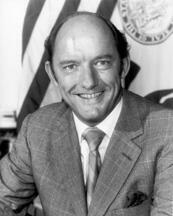
Here you will find contact information for Senator Malcolm Wallop, including email address, phone number, and mailing address.
| Name | Malcolm Wallop |
| Position | Senator |
| State | Wyoming |
| Party | Republican |
| Status | Former Representative |
| Term Start | January 4, 1977 |
| Term End | January 3, 1995 |
| Terms Served | 3 |
| Born | February 27, 1933 |
| Gender | Male |
| Bioguide ID | W000092 |
About Senator Malcolm Wallop
Malcolm Wallop (February 27, 1933 – September 14, 2011) was an American rancher and Republican politician who represented Wyoming in the United States Senate from 1977 to 1995. Born at Doctors Hospital in Manhattan, New York City, he was the second son of Jean Moore Wallop and the Hon. Oliver Malcolm Wallop. His paternal grandfather, Oliver Henry Wallop, a Wyoming cattle rancher who immigrated from England in the late nineteenth century, later inherited the Earldom of Portsmouth, linking the family to the British peerage. On his mother’s side, his great-grandfather was William Henry Moore, a prominent American lawyer, jurist, financier, and industrialist. Wallop’s family background thus combined Western ranching traditions with transatlantic aristocratic and financial connections.
Wallop was raised primarily in Wyoming and attended public schools in Big Horn. He later enrolled at the Cate School in Carpinteria, California, graduating from the school, which is located near Santa Barbara. He then attended Yale University, where he was a member of the St. Anthony Hall fraternity. He received a Bachelor of Arts degree from Yale in 1954. Following his graduation, Wallop served in the United States Army from 1955 to 1957, attaining the rank of first lieutenant. After completing his military service, he returned to Wyoming and began a career as a cattle rancher, continuing the family’s longstanding involvement in Western ranching.
Wallop entered elective politics in Wyoming in the late 1960s. In 1969 he won election to the Wyoming House of Representatives, where he served two terms from 1969 to 1972. He then served one term in the Wyoming State Senate from 1973 to 1976. In 1974, he sought the Republican nomination for governor of Wyoming but was defeated in the primary. Despite this setback, he remained a prominent figure in state Republican politics and positioned himself for a bid for federal office.
In 1976, Wallop ran for the United States Senate and successfully unseated three-term Democratic incumbent Gale W. McGee, winning approximately 55 percent of the vote. He had pledged during the campaign to serve only two terms, but ultimately served three terms in the Senate, from January 3, 1977, to January 3, 1995. His service in Congress occurred during a significant period in American history, spanning the Carter, Reagan, Bush, and early Clinton administrations, and he became identified with the ascendant conservative movement of the late 1970s and 1980s. A member of the Republican Party, he supported strong national security policies, tax reform, and other elements of what came to be known as Reagan conservatism.
During his Senate tenure, Wallop served on several key committees, including the Senate Judiciary Committee, the Committee on Energy and Natural Resources, and the Senate Select Committee on Intelligence. From 1981 to 1983, he was chairman of the Senate Select Committee on Ethics. Early in his first term, he authored the legislation establishing the Congressional Award program, which recognizes outstanding volunteerism and achievement among American youth. In 1977, he sponsored what became known as the Wallop Amendment to the Surface Mining Control Act, which required the federal government to compensate property owners whose ability to mine was restricted by federal regulation; the measure was hailed by property-rights advocates. Three years later, he successfully amended the Clean Water Act to strengthen protections for states’ interests in water regulation. Also in 1977, he was one of nine senators to vote against the adoption of a stringent new Senate code of ethics intended to help restore public confidence in Congress.
Wallop played a notable role in federal tax policy. In 1981, his bill to reduce inheritance and gift taxes became a key component of President Ronald Reagan’s tax reform package and was remembered as one of the most substantive tax policy changes of that decade. He had earlier been involved in efforts that contributed to the phasing out of President Jimmy Carter’s windfall profits tax on domestic oil production. Wallop was reelected to the Senate in 1982 by a 14-point margin over Democratic state legislator Rodger McDaniel. During his second term, he was an early and vocal supporter of the Strategic Defense Initiative, announced in 1983, which proposed a missile defense system to protect the United States from nuclear intercontinental and submarine-launched ballistic missiles.
In 1988, Wallop narrowly won a third term, defeating Democratic state senator John Vinich by just 1,322 votes. His final term in the Senate was marked by extensive involvement in foreign policy, arms control, and international trade debates at the end of the Cold War and in the early post-Soviet period. He served as a member of the Commission on Security and Cooperation in Europe (the Helsinki Commission) and traveled widely in Eastern Europe and the former Soviet Union as part of arms control discussions and negotiations. He was a strong advocate of the General Agreement on Tariffs and Trade (GATT) and supported U.S. participation in the emerging World Trade Organization. From 1990 to 1994, he was the ranking Republican member of the Senate Energy and Natural Resources Committee and played a key role in the passage of the Energy Policy Act of 1992, a far-reaching measure addressing energy efficiency, conservation, and market reforms. Choosing not to seek a fourth term, he retired from the Senate in 1995 and was succeeded by Republican Craig Thomas. Upon his retirement, The Economist noted that although his detractors had grown in number, even Democrats often acknowledged his candor and his willingness to be “stupendously politically incorrect.”
After leaving Congress in January 1995, Wallop remained active in public policy and conservative causes. He founded the Frontiers of Freedom Institute, a Virginia-based nonprofit organization dedicated to advocating constitutionally limited government, free markets, and a strong national defense. In the 1996 presidential election cycle, he served as general chairman and executive director of businessman Steve Forbes’s Republican presidential campaign, which achieved primary victories in Delaware and Arizona. Wallop also wrote and co-wrote works on public policy, including the chapter “The Environment: Air, Water & Public Lands” in the volume A Changing America: Conservatives View the 80s from the United States Senate (1980), and, with Angelo Codevilla, the book The Arms Control Delusion (1987), reflecting his skepticism about traditional arms control approaches.
Wallop maintained close ties to Wyoming and to higher education in the state. In 2010, the University of Wyoming established the Malcolm Wallop Fund for Conversations on Democracy to support speakers and workshops for students on democratic governance and civic life. The university’s American Heritage Center houses his papers, preserving documentation of his legislative work, political activities, and public policy interests. His career and legacy are also reflected in various archival and media collections, including recordings of his appearances on C-SPAN and other public forums, as well as a memorial service held in his honor.
Wallop’s personal life was marked by four marriages and a large family. He married Vail Stebbins in 1956; they had three sons and one daughter before divorcing in 1965. In 1967, he married Judith Warren; they divorced in 1981. His third marriage, to French Carter Gamble Goodwyn, took place in 1984; the couple divorced in 2001. In 2005, he married Isabel Brooke Thomasson Ferguson. Wallop’s family connections extended into the British aristocracy: his sister, Jean Wallop, married Henry Herbert, 7th Earl of Carnarvon, in 1956. Lord Carnarvon, a childhood friend of Queen Elizabeth II, was appointed her horse racing manager in 1969. During the Queen’s 1984 visit to the United States, she and Lord and Lady Carnarvon were house guests of Wallop at Canyon Ranch in Big Horn, Wyoming. Wallop’s nephew, George Herbert, 8th Earl of Carnarvon, later became widely known as the owner of Highclere Castle, the family seat in England and the primary filming location for the television series “Downton Abbey.”
Malcolm Wallop died at his home near Big Horn, Wyoming, on September 14, 2011, at the age of 78. His long career as a rancher, state legislator, United States senator, and public policy advocate left a lasting imprint on Wyoming politics, national conservative thought, and federal legislation in areas ranging from energy and environmental regulation to tax policy, national defense, and international trade.