Representative Manuel Luján
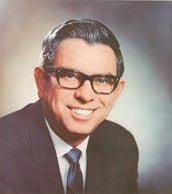
Here you will find contact information for Representative Manuel Luján, including email address, phone number, and mailing address.
| Name | Manuel Luján |
| Position | Representative |
| State | New Mexico |
| District | 1 |
| Party | Republican |
| Status | Former Representative |
| Term Start | January 3, 1969 |
| Term End | January 3, 1989 |
| Terms Served | 10 |
| Born | May 12, 1928 |
| Gender | Male |
| Bioguide ID | L000506 |
About Representative Manuel Luján
Manuel Archibald Lujan Jr. (May 12, 1928 – April 25, 2019) was an American politician from New Mexico who served ten terms as a Republican member of the U.S. House of Representatives from 1969 to 1989 and later as United States Secretary of the Interior from 1989 to 1993. Over the course of two decades in Congress and four years in the Cabinet of President George H. W. Bush, he played a prominent role in federal policy affecting public lands, Indian affairs, and science and technology, and was one of the most visible Hispanic Republicans of his generation.
Lujan was born on May 12, 1928, in San Ildefonso Pueblo, New Mexico, into a politically active family. He was the son of Manuel A. Lujan Sr. and Lorenzita (née Romero) Lujan. His father served as mayor of Santa Fe and was an unsuccessful candidate for both governor of New Mexico and the U.S. Congress, providing an early model of public service and political engagement. Raised in a Catholic household, Lujan attended Catholic schools in Santa Fe and went on to study at Saint Mary’s College of California in 1946. He later returned to New Mexico and graduated from St. Michael’s College in Santa Fe in 1950, completing the formal education that preceded his entry into business and politics.
After college, Lujan joined the family insurance business, the Manuel Lujan Agencies, which his father had founded in 1925. Based in Albuquerque, the firm grew into a leading risk management and insurance company in the state and, by 2002, was ranked as the most profitable of New Mexico’s Hispanic-owned businesses. While building his business career, Lujan also followed his father into politics. His first attempt at elected office came in 1964, when he ran unsuccessfully for the New Mexico State Senate. That defeat proved to be his last electoral setback. In 1967, he helped to found the Republican National Hispanic Assembly, reflecting his interest in expanding Hispanic participation in the Republican Party and in national politics.
Lujan won election to Congress in 1968 by defeating incumbent Democrat Thomas G. Morris and took his seat in the U.S. House of Representatives in January 1969. He served continuously until January 1989, representing New Mexico for ten consecutive terms. During his early years in the House, he was a colleague of George H. W. Bush, who also served in the chamber from 1967 to 1971. Throughout the 1970s, Lujan developed a reputation as a low-key, personable backbencher whose legislative priorities reflected the concerns of the western states. He focused on Indian affairs, the expansion of nuclear power, and the opening of federal lands to commerce and recreation. In 1978, he became the first Hispanic Republican to join the recently formed Congressional Hispanic Caucus, underscoring his role as a bridge between Hispanic constituencies and the Republican Party.
The 1980s brought Lujan greater prominence and new political challenges. In 1980, he narrowly survived a strong challenge from Democrat Bill Richardson, who would later serve in Congress, as U.S. ambassador to the United Nations, and as governor of New Mexico. Following the 1980 census, New Mexico gained a third congressional district, and the boundaries of Lujan’s district were significantly redrawn. The old 1st District had been largely rural and included the northeastern portion of the state along with most of Albuquerque, while the new 1st District became a more compact, urban district encompassing roughly three-quarters of Albuquerque. In response to the changing demographics and political dynamics of his constituency, Lujan stepped down as ranking Republican on the House Interior and Insular Affairs Committee and became the ranking Republican on the House Science, Space, and Technology Committee, where he helped shape policy on scientific research and space exploration. In addition to his congressional duties, he represented New Mexico as a delegate to every Republican National Convention from 1972 to 2004, and in 1980 he was a featured speaker on the night delegates met to nominate a vice-presidential candidate.
Lujan’s long-standing interest in public lands and western issues led to recurring speculation that he might be appointed Secretary of the Interior. Beginning with Ronald Reagan’s inauguration in 1981, his name was frequently mentioned as a potential nominee for the post, and he was considered, along with Dick Cheney, as a leading contender to replace Interior Secretary James G. Watt after Watt’s resignation, although the position ultimately went to William Clark. When President-elect George H. W. Bush’s transition team approached Lujan about the Interior portfolio in late 1988, he initially declined but changed his mind after a personal appeal from Bush. In 1989, President Bush named Lujan to his Cabinet, and he was unanimously confirmed by the Senate in February 1989. At the time of his confirmation, he was widely regarded as a moderate in comparison to his immediate predecessors James Watt and Donald Hodel, although environmental groups criticized his congressional voting record; the League of Conservation Voters gave him a 23 percent career rating.
As Secretary of the Interior from 1989 to 1993, Lujan oversaw federal management of public lands, natural resources, and many aspects of Indian affairs, but his tenure was often contentious. Within months of taking office, he drew criticism from conservationists and the media for what was perceived as a hands-off management style and for several public misstatements. In one widely quoted incident, he incorrectly told a reporter that the federal government received royalty payments for certain mineral rights and later admitted, “I didn’t know what I was talking about.” As chairman of a White House task force on offshore oil drilling, he strongly supported drilling off the California coast, prompting 19 members of the California congressional delegation—all Democrats—and Republican Governor Pete Wilson to call for his removal from the study group on grounds that he was biased, a request he declined. In the aftermath of the Exxon Valdez oil spill in April 1989, Lujan opposed Democratic efforts to halt offshore drilling, reinforcing his image as an advocate of resource development.
Despite early public relations difficulties, Lujan gained greater respect over the course of his term, though he remained a focal point for environmentalist criticism. In a 1990 interview, he described the Endangered Species Act as “too tough” and suggested it might not be necessary to “save every subspecies,” remarks from which the Bush administration quickly distanced itself. His tenure was marked by high-profile debates over the protection of the northern spotted owl in the Pacific Northwest, the proposed construction of an NFL stadium for the Washington franchise (now the Washington Commanders) on federal land in Washington, D.C., and the federal government’s increasing regulation of Indian gaming operations. While environmental groups often opposed his policies, he generally received praise for his handling of Indian affairs, an area in which he had been active throughout his congressional career. Reflecting on his time at Interior after leaving office, Lujan characterized the job as one of constant tension between competing interests, stating in a May 9, 1993, Associated Press interview that “no one is satisfied” and that he had sought to “bring a balance between the use of resources on public lands and environmental concerns.”
In the final months of the Bush administration, Lujan was frequently mentioned as a potential candidate for governor of New Mexico in 1994, but he publicly dismissed the speculation, saying he was “through running.” After leaving the Interior Department in January 1993, he worked as a lobbyist and public speaker, remaining active in conservative and Hispanic political circles. In 2004, he founded the Hispanic Alliance for Progress Institute, a conservative think tank devoted to economic and “family values” issues from a Hispanic perspective. His contributions to the Department of the Interior were later commemorated through the establishment of the “Manuel Lujan Jr. Champion Award,” presented annually to Interior Department employees who demonstrate outstanding work in carrying out the department’s mission. The department and the Bureau of Indian Affairs also honored him by dedicating the BIA’s administrative building in Albuquerque in his name. His family remained influential in New Mexico politics and culture; his brother Edward Lujan, born in 1931, served for many years as chairman of the New Mexico Republican Party and played a major role in the development of the National Hispanic Cultural Center.
Manuel Lujan died of heart failure on April 25, 2019, in Albuquerque, New Mexico. His career spanned local business, state and national politics, and service at the highest levels of the federal government, and he is remembered as one of the prominent Hispanic and Latino members of the United States Congress and a key Republican figure in New Mexico’s modern political history.