Representative Marc Lincoln Marks
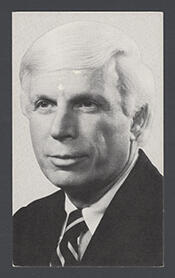
Here you will find contact information for Representative Marc Lincoln Marks, including email address, phone number, and mailing address.
| Name | Marc Lincoln Marks |
| Position | Representative |
| State | Pennsylvania |
| District | 24 |
| Party | Republican |
| Status | Former Representative |
| Term Start | January 4, 1977 |
| Term End | January 3, 1983 |
| Terms Served | 3 |
| Born | February 12, 1927 |
| Gender | Male |
| Bioguide ID | M000136 |
About Representative Marc Lincoln Marks
Marc Lincoln Marks (February 12, 1927 – February 28, 2018) was an American lawyer and Republican politician who represented Pennsylvania in the United States House of Representatives from 1977 to 1983. Over three terms in Congress, he participated actively in the legislative process during a period of significant political and economic change in the United States, representing the interests of his constituents while at times taking independent positions within his party.
Marks served in the United States Army Air Corps from 1945 to 1946, entering military service near the end of World War II. After his discharge, he pursued higher education, enrolling at the University of Alabama, where he graduated in 1951. He continued his studies at the University of Virginia in Charlottesville, Virginia, earning his degree there in 1954. Trained as a lawyer, he embarked on a legal career in Pennsylvania that would form the foundation for his later public service.
Returning to Pennsylvania, Marks established himself in legal practice and local public affairs. He served as Mercer County Solicitor, the county’s chief legal officer and district attorney, from 1960 to 1966. In that role he was responsible for representing the county in legal matters and overseeing criminal prosecutions, gaining experience in public law, administration, and the workings of local government. His tenure as solicitor helped build his reputation as a capable attorney and public servant within the region he would later represent in Congress.
Marks entered national politics in the 1976 United States House of Representatives elections. Running as a Republican in a district long held by Democrats, he defeated six-term Democratic incumbent Joseph Vigorito of Pennsylvania by an 11 percent margin, one of only eight Democratic House members unseated nationwide that year. He took office in January 1977. In the 1978 election, he secured reelection by again defeating Vigorito, this time by a 26 percent margin, demonstrating growing electoral strength. In 1980, amid a closely contested race, he was reelected to a third term by a margin of 120 votes over state Representative David C. DiCarlo.
During his service in the House of Representatives, Marks aligned with the Republican Party but did not hesitate to express reservations about aspects of its national agenda. His congressional tenure coincided with the Carter and Reagan administrations, a period marked by debates over economic policy, defense spending, and social programs. A serious back ailment led him to decide not to seek reelection for a fourth term in 1982. In March 1982, before House Speaker Thomas P. “Tip” O’Neill Jr., he delivered a notable speech on the House floor in which he questioned his own support for certain Reagan-era policies. He argued that what he termed “Reaganite” policies placed undue emphasis on military spending and caused distress to those he defined as “disadvantaged,” reflecting his concern for the impact of federal policy on vulnerable populations. Prior to his departure from Congress, former Texas Governor John B. Connally spoke with Marks and considered him as a potential running mate during Connally’s unsuccessful 1980 presidential campaign, an indication of Marks’s standing within national Republican circles.
Marks also engaged in prominent policy and oversight disputes while in Congress. In a letter to Time magazine, he publicly defended his vote in favor of contempt proceedings against Secretary of the Interior James G. Watt, underscoring his willingness to hold executive branch officials accountable. In another public intervention, he wrote to The New York Times criticizing what he viewed as the newspaper’s editorial board’s irresponsibility in its treatment of public officials and its apparent lack of understanding of the plight of unemployed citizens. These exchanges highlighted his interest in both environmental and economic issues, as well as his sensitivity to media portrayals of government and the challenges facing working Americans.
After leaving elective office in 1983, Marks continued his involvement in public affairs. In 1994, President Bill Clinton nominated him to serve as a Commissioner of the Federal Mine Safety and Health Review Commission, a quasi-judicial body that adjudicates disputes arising under federal mine safety and health laws. His appointment by a Democratic president reflected a measure of bipartisan respect for his experience and judgment, particularly in matters affecting labor, industry, and workplace safety—issues of special importance in Pennsylvania’s industrial and mining regions.
Marc Lincoln Marks died on February 28, 2018, at the age of 91. His career encompassed military service, legal practice, county office, three terms in the U.S. House of Representatives, and later federal commission service, marking him as a figure who participated in and helped shape public policy at multiple levels of government over several decades.