Representative Marge Roukema
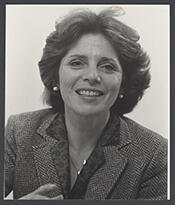
Here you will find contact information for Representative Marge Roukema, including email address, phone number, and mailing address.
| Name | Marge Roukema |
| Position | Representative |
| State | New Jersey |
| District | 5 |
| Party | Republican |
| Status | Former Representative |
| Term Start | January 5, 1981 |
| Term End | January 3, 2003 |
| Terms Served | 11 |
| Born | September 19, 1929 |
| Gender | Female |
| Bioguide ID | R000465 |
About Representative Marge Roukema
Margaret “Marge” Ellen Roukema (née Scafati; September 19, 1929 – November 12, 2014) was an American Republican Party politician who represented New Jersey in the United States House of Representatives from 1981 to 2003. Over the course of 11 consecutive terms in Congress, she contributed to the legislative process during a significant period in American history, participating in the democratic process and representing the interests of her New Jersey constituents. At the time of her retirement, she was the longest-tenured female member of the House of Representatives.
Roukema was born Margaret Ellen Scafati on September 19, 1929, in Newark, New Jersey, the daughter of Claude and Margaret Scafati. She was raised in nearby West Orange, New Jersey, where she attended local public schools and graduated from West Orange High School in 1947. Her early life in northern New Jersey, in communities that would later form part of her political base, helped shape her understanding of suburban issues, public education, and local governance, themes that would recur throughout her public career.
Following high school, Roukema pursued higher education at Montclair State College (now Montclair State University), where she earned a Bachelor of Arts degree in history and political science in 1951. She undertook graduate work at Montclair State, further deepening her grounding in the social sciences, and also completed graduate courses in city and regional planning at Rutgers University. This combination of historical, political, and planning studies provided her with a substantive academic foundation for her later work on education, housing, and community development issues in Congress.
Roukema began her professional career as a high school American history teacher in Ridgewood, New Jersey, a community in Bergen County that would become central to her political identity. Her work in the classroom and her engagement with local families and students led naturally to broader involvement in educational policy. From 1970 to 1973, she served as a member of the board of education of the Ridgewood Public Schools. In that role, she gained experience in budgeting, curriculum oversight, and school governance, and she developed a reputation as a pragmatic and engaged local official, which helped launch her into elective politics at the federal level.
Roukema first sought a seat in the U.S. House of Representatives in 1978, when she ran as a Republican candidate against incumbent Democratic Congressman Andrew Maguire. Although she lost that race by approximately 9,000 votes, the campaign raised her profile and laid the groundwork for a rematch. In 1980, she again challenged Maguire and this time prevailed, aided in part by the strong performance of Republican presidential candidate Ronald Reagan at the top of the ticket. She took office in January 1981, beginning a congressional career that would span more than two decades. During her tenure, she represented New Jersey’s 7th and later the 5th congressional districts, reflecting changes in district boundaries over time.
Throughout her 11 terms in the House of Representatives, Roukema was known as a moderate Republican who often focused on family, education, and financial issues. She was particularly noted for her staunch support of the Family and Medical Leave Act (FMLA), which became a landmark federal law guaranteeing eligible workers unpaid, job-protected leave for certain family and medical reasons. Her advocacy for FMLA reflected her broader interest in policies that balanced economic growth with protections for working families. She was repeatedly re-elected without facing serious Democratic opposition, a testament to her electoral strength in a district that, while generally Republican-leaning, included a substantial number of moderate and independent voters.
Roukema’s moderation within the Republican Party occasionally drew challenges from more conservative elements within her own party. In 1992, she faced a primary challenge from three other Republicans and prevailed. In 1998, State Assemblyman Scott Garrett, a considerably more conservative Republican, challenged her in the Republican primary; she defeated him, and did so again in a 2000 primary rematch. However, with the prospect of a third consecutive primary challenge from Garrett in 2002, and following redistricting that made her district more conservative on paper, Roukema chose not to seek a 12th term. Her decision was also influenced by the impending loss of her subcommittee chairmanships due to Republican caucus term-limit rules. The Ridgewood Republican retired from politics at the end of her term in January 2003. In the 2002 Republican primary to succeed her, she endorsed State Senator Gerald Cardinale, who lost to Garrett. Despite Roukema’s refusal to endorse him in the general election, Garrett was elected as her successor.
In her personal life, Roukema was married to Dr. Richard W. Roukema, a psychiatrist. The couple made their home in Ridgewood and had three children: Greg, Todd, and Meg. The family suffered a personal tragedy when their son Todd died of leukemia in October 1976, an experience that deepened her interest in health care and family issues. After leaving Congress, Roukema largely withdrew from public life, spending her later years in northern New Jersey. She died on November 12, 2014, in Wyckoff, New Jersey, at the age of 85. At the time of her death, she had been living with Alzheimer’s disease, closing the life of a long-serving legislator whose career spanned a transformative era in late twentieth-century American politics.