Representative Marguerite Stitt Church
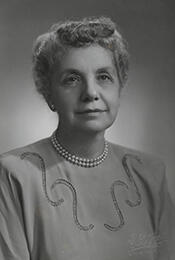
Here you will find contact information for Representative Marguerite Stitt Church, including email address, phone number, and mailing address.
| Name | Marguerite Stitt Church |
| Position | Representative |
| State | Illinois |
| District | 13 |
| Party | Republican |
| Status | Former Representative |
| Term Start | January 3, 1951 |
| Term End | January 3, 1963 |
| Terms Served | 6 |
| Born | September 13, 1892 |
| Gender | Female |
| Bioguide ID | C000389 |
About Representative Marguerite Stitt Church
Marguerite Stitt Church (September 13, 1892 – May 26, 1990) was an American psychologist and Republican politician who represented Illinois’ 13th congressional district in the United States House of Representatives from 1951 to 1963. Over the course of six consecutive terms in Congress, she contributed to the legislative process during a significant period in American history, participating in the democratic process and representing the interests of her constituents in suburban Chicago.
Church was born on September 13, 1892, to William J. and Adelaide Stitt (née Forsythe). She grew up in the New York City metropolitan area, where she attended St. Agatha School. Her family traveled abroad each summer, experiences that helped cultivate her early and enduring interest in foreign countries and international affairs. These formative years in and around New York, combined with her exposure to other cultures, laid the groundwork for her later engagement with national and international policy issues.
Pursuing higher education at a time when relatively few women did so, Church enrolled at Wellesley College and graduated in 1914 with a Bachelor of Arts degree in psychology, with a minor in economics and sociology. She continued her studies at Columbia University, where she earned a master’s degree in 1917. Her academic training in psychology and the social sciences informed both her early professional work and her later approach to public service, giving her a grounding in human behavior, social welfare, and economic issues that would prove relevant in her political career.
After completing her graduate studies, Church worked as a consulting psychologist for the State Charities Aid Association of New York City for one year. In this role she applied her academic background to practical problems in social welfare and public assistance, gaining firsthand insight into the needs of vulnerable populations and the operation of charitable and governmental institutions. This early professional experience contributed to her understanding of public policy and the social dimensions of government action.
On December 21, 1918, she married Ralph E. Church. The couple settled in Evanston, Illinois, a community just north of Chicago, where they raised three children: Ralph Jr., William, and Marjory. Ralph E. Church entered politics and was elected as a U.S. Representative in 1934. Marguerite Stitt Church became closely involved with her husband’s congressional work, gaining practical experience with legislative procedures, constituent relations, and the workings of the federal government. Her proximity to his career deepened her familiarity with national issues and the responsibilities of a member of Congress.
In March 1950, Ralph E. Church died of heart failure during a House committee hearing in Washington, D.C., leaving his congressional seat vacant. Later that year, Marguerite Stitt Church ran as a Republican candidate to succeed her late husband. In the November 1950 election she was elected to the U.S. House of Representatives from Illinois’ 13th congressional district by what was reported as the highest majority ever achieved by a candidate from Evanston. She took office in January 1951 and served six terms, remaining in Congress until 1963. As a member of the House of Representatives during the early Cold War and the emerging civil rights era, she participated in debates over domestic policy, foreign affairs, and social change, and was part of the growing cohort of women serving in the United States House of Representatives.
During her congressional service, Church aligned with key civil rights initiatives of the period. She voted in favor of the Civil Rights Act of 1957, the first federal civil rights legislation since Reconstruction, and supported the Civil Rights Act of 1960, which sought to strengthen protections for voting rights. She also voted for the 24th Amendment to the U.S. Constitution, which prohibited the use of poll taxes in federal elections. Through these votes, she supported efforts to expand and protect the franchise and to address longstanding racial discrimination in voting. Her legislative record reflected both her party affiliation and her personal engagement with major national issues of the mid-twentieth century.
After leaving Congress in 1963, Church retired from elective office but remained a notable figure in Evanston and in Illinois political history as one of the early women to serve in the U.S. House of Representatives. She lived in Evanston for the remainder of her life. Marguerite Stitt Church died there on May 26, 1990, at the age of 97. She is buried in Memorial Park in Skokie, Illinois, closing a long life that spanned nearly a century of American political and social transformation.