Representative Marion Tinsley Bennett
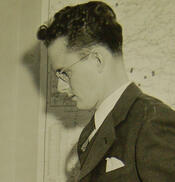
Here you will find contact information for Representative Marion Tinsley Bennett, including email address, phone number, and mailing address.
| Name | Marion Tinsley Bennett |
| Position | Representative |
| State | Missouri |
| District | 6 |
| Party | Republican |
| Status | Former Representative |
| Term Start | January 6, 1943 |
| Term End | January 3, 1949 |
| Terms Served | 3 |
| Born | June 6, 1914 |
| Gender | Male |
| Bioguide ID | B000379 |
About Representative Marion Tinsley Bennett
Marion Tinsley Bennett (June 6, 1914 – September 6, 2000) was an American lawyer, legislator, and federal judge who served as a Republican Representative from Missouri in the United States Congress from 1943 to 1949, as a judge of the United States Court of Claims, and as a United States circuit judge of the United States Court of Appeals for the Federal Circuit. He was born in Buffalo, Dallas County, Missouri, on June 6, 1914, to Philip Allen Bennett, a future member of Congress, and Mary Bertha (Tinsley) Bennett. Raised in southwest Missouri, he grew up in a family active in public affairs, an environment that would shape his later career in law, politics, and the federal judiciary.
Bennett attended public schools in Missouri and went on to study at Southwest Missouri State College (now Missouri State University) in Springfield, where he received an Artium Baccalaureus degree in 1935. He then enrolled at Washington University School of Law in St. Louis, earning a Juris Doctor in 1938. After his admission to the bar, he entered private legal practice in Missouri. While practicing law, he became active in Republican Party politics, serving on the Greene County, Missouri, Republican Central Committee and managing his father Philip Allen Bennett’s two congressional election campaigns. In 1941 he married June Young of Hurley, Missouri; the couple had two children, Ann and William, and later four grandchildren. In addition to his legal and political work, Bennett began a long association with the military as a United States Air Force Reserve officer, ultimately becoming a colonel in 1950, a status he retained until 1974.
Bennett’s congressional career began under solemn circumstances. His father, Representative Philip Allen Bennett, died in office on December 7, 1942. In the special election held to fill the vacancy in Missouri’s 6th Congressional District, Marion Tinsley Bennett was chosen to complete his father’s term in the Seventy-eighth Congress. Only 28 years old at the time, he took his seat in 1943. A member of the Republican Party, he won reelection twice and served three consecutive terms in the House of Representatives, encompassing the Seventy-eighth, Seventy-ninth, and Eightieth Congresses, from 1943 to 1949. During this significant period in American history, spanning the final years of World War II and the immediate postwar era, Bennett participated in the legislative process and represented the interests of his Missouri constituents in debates over wartime policy, demobilization, and the emerging contours of the early Cold War.
In 1945 Bennett was selected as part of an official ten-member congressional delegation invited by General Dwight D. Eisenhower to follow the United States Third Army into the Buchenwald concentration camp near Weimar, Germany. The delegation inspected the camp shortly after its liberation and witnessed firsthand the conditions and atrocities perpetrated there. Following their return to the United States, the members of the delegation toured the country, speaking publicly and reporting on what they had seen in order to inform the American public of the horrors of Nazi concentration camps. Bennett’s reaction, widely quoted at the time, was reported in The New York Times on May 6, 1945, where he stated, “I left Buchenwald convinced that every German must be killed,” a remark reflecting the profound shock and revulsion he experienced in the aftermath of his visit.
After the conclusion of his congressional service in 1949, Bennett transitioned from elective office to a long career in the federal judiciary. That year he was appointed a trial judge (then titled commissioner) of the United States Court of Claims in Washington, D.C. He served in that capacity from 1949 to 1972, adjudicating claims against the federal government and developing a deep expertise in government contracts, takings, and other areas of public law. From 1964 to 1972 he served as Chief of the Trial Division of the Court of Claims, supervising the court’s trial work and helping to shape its procedures and jurisprudence during a period of expanding federal activity and increasingly complex litigation.
Bennett’s judicial career advanced further when President Richard Nixon nominated him on May 22, 1972, to a judgeship on the United States Court of Claims, filling the seat vacated by Judge Linton McGee Collins. The United States Senate confirmed his nomination on June 28, 1972, and he received his commission the same day. He served as an appellate judge on the Court of Claims during a decade of significant change in the federal court system. On October 1, 1982, as part of a congressionally mandated reorganization of the federal courts, he was reassigned by operation of law to the newly created United States Court of Appeals for the Federal Circuit, to a new seat authorized by 96 Stat. 25. On that court, which consolidated much of the nationwide jurisdiction over federal claims, government contracts, patents, and other specialized areas, Bennett continued his work as a United States circuit judge, contributing to the development of a coherent body of federal law in those fields.
Bennett assumed senior status on the Federal Circuit on March 1, 1986, reducing his caseload but remaining available for judicial service. In 1997 he took inactive senior status, effectively retiring from the bench while retaining his judicial title. Over the course of his judicial career he also wrote extensively on legal and historical subjects related to his work. His publications included “American Immigration Policies: A History” (Washington: Public Affairs Press, c. 1963), “Private Claims Act and Congressional References” (Washington: U.S. Government Printing Office, 1968), and the two-volume study “The United States Court of Claims: A History,” Part 1, “The Judges, 1855–1976,” authored by Bennett, and Part 2, “Origin, Development, Jurisdiction, 1855–1978,” co-authored with W. Cowen and P. Nichols, published in Washington, D.C., by the Committee on the Bicentennial of Independence and the Constitution of the Judicial Conference of the United States in 1976–1978. These works reflected his longstanding interest in the institutional history and jurisdiction of the Court of Claims and in the broader evolution of federal adjudication.
Marion Tinsley Bennett died in Alexandria, Virginia, on September 6, 2000. His service as a member of Congress, as a judge of the United States Court of Claims, and as a circuit judge of the United States Court of Appeals for the Federal Circuit formally ended with his death. He was buried at Hazelwood Cemetery in Springfield, Missouri, returning in death to the region where he had been raised and where his public career had first taken shape.