Representative Mark Spencer Brewer
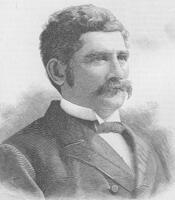
Here you will find contact information for Representative Mark Spencer Brewer, including email address, phone number, and mailing address.
| Name | Mark Spencer Brewer |
| Position | Representative |
| State | Michigan |
| District | 6 |
| Party | Republican |
| Status | Former Representative |
| Term Start | October 15, 1877 |
| Term End | March 3, 1891 |
| Terms Served | 4 |
| Born | October 22, 1837 |
| Gender | Male |
| Bioguide ID | B000811 |
About Representative Mark Spencer Brewer
Mark Spencer Brewer (October 22, 1837 – March 18, 1901) was an American lawyer and Republican politician from the state of Michigan who served four terms in the United States House of Representatives over two separate periods between 1877 and 1891. Over the course of his public career, he held local, state, national, and diplomatic offices and participated actively in the legislative and administrative life of the late nineteenth-century United States.
Brewer was born on October 22, 1837, in Addison Township, Oakland County, Michigan. He was educated in the rural schools of the area and later attended Romeo and Oxford Academies, institutions that provided him with a classical and preparatory education typical of aspiring professionals of the period. After completing his academic studies, he read law, following the customary apprenticeship route into the legal profession before the widespread establishment of formal law schools.
In 1864 Brewer was admitted to the bar and commenced the practice of law in Pontiac, Michigan, which became his professional and political base. He quickly entered public service at the local and county levels. Brewer served as city attorney of Pontiac in 1866 and 1867, and at the same time held the position of circuit court commissioner for Oakland County from 1866 to 1869, handling judicial and administrative responsibilities within the county court system. Building on this experience, he advanced to state office as a member of the Michigan State Senate from the 20th District, serving in the 1873–1874 legislative term.
Brewer’s state-level prominence led to his election to the United States House of Representatives as a Republican from Michigan’s 6th Congressional District. He was first elected to the Forty-fifth Congress and was reelected to the Forty-sixth Congress, serving from March 4, 1877, to March 3, 1881. During these initial two terms, he contributed to the legislative process in the post–Civil War and Reconstruction-era Congress, representing the interests of his Michigan constituents and participating in the broader democratic process at a time of significant economic and political change in the United States.
After his first period in Congress, Brewer entered diplomatic service. On June 30, 1881, President James A. Garfield appointed him consul general of the United States to Berlin, in the German Empire. He assumed his duties on August 29, 1881, and served in that capacity until June 7, 1885. As consul general, Brewer was responsible for protecting American commercial and consular interests, facilitating trade, and assisting U.S. citizens abroad in one of Europe’s major capitals during a period of growing American engagement in international affairs.
Upon returning from Berlin, Brewer reentered national politics. He was again elected as a Republican to the U.S. House of Representatives from Michigan’s 6th District, this time to the Fiftieth and Fifty-first Congresses, serving from March 4, 1887, to March 3, 1891. Over these additional two terms, he continued his legislative work during a period marked by debates over tariffs, civil service reform, and economic policy. In total, Brewer served four terms in Congress between 1877 and 1891. He declined to be a candidate for renomination in 1890 and, after leaving office, resumed the practice of law in Pontiac.
In his later years, Brewer remained active in national Republican politics and federal administration. He was a delegate to the 1896 Republican National Convention, participating in the party deliberations that led to the nomination of William McKinley for the presidency. On January 18, 1898, President McKinley appointed him a member of the United States Civil Service Commission, where he served until his death. In this role, Brewer was involved in overseeing and advancing the merit-based federal civil service system that had been established in the wake of the Pendleton Act, reflecting his continued engagement with governmental reform and public administration.
Mark Spencer Brewer died in Washington, D.C., on March 18, 1901, while still serving on the United States Civil Service Commission. His remains were returned to Michigan, and he was interred in Oak Hill Cemetery in Pontiac, Oakland County, Michigan, the community where he had built his legal career and from which he had launched his long tenure in public service.