Representative Martin Maginnis
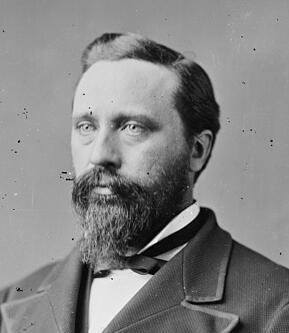
Here you will find contact information for Representative Martin Maginnis, including email address, phone number, and mailing address.
| Name | Martin Maginnis |
| Position | Representative |
| State | Montana |
| District | -1 |
| Party | Democratic |
| Status | Former Representative |
| Term Start | December 1, 1873 |
| Term End | March 3, 1885 |
| Terms Served | 6 |
| Born | October 27, 1841 |
| Gender | Male |
| Bioguide ID | M000050 |
About Representative Martin Maginnis
Martin Maginnis (October 27, 1841 – March 27, 1919) was a nineteenth-century politician, soldier, publisher, editor, miner, and long-serving territorial delegate to the United States Congress from the Montana Territory. He was born on his family’s farm near Pultneyville, Wayne County, New York, to Patrick and Winnifred Devine Maginnis, Irish immigrants who had met and married in Liverpool, England before coming to the United States in 1838. His father, from County Clare, and his mother, from Galway, initially settled in Wayne County, New York, where Patrick worked as a contractor on the New York Central Railway. In 1851 the family moved west to LaSalle, Illinois, where Patrick worked on the Illinois Central Railroad, and in 1853 they relocated again to Goodhue Township near Red Wing, Minnesota, continuing the family’s pattern of following emerging opportunities in the developing American interior.
Maginnis was educated in the public schools and pursued further study in Minnesota at Hamline University. Although he did not complete a degree, his time there coincided with his growing interest in politics and journalism. In Red Wing he became closely associated with William Wallace Phelps, a lawyer and part owner of the Red Wing Sentinel newspaper, and with William J. Colvill, the paper’s first editor. Colvill mentored the young Maginnis, sharing his library and fostering Maginnis’s intellectual development, while the two also enjoyed the abundant hunting and fishing of the region. Maginnis left Hamline University early to take charge of a Democratic newspaper, and by early 1861 he had become the owner of the Red Wing Sentinel, with Phelps serving as editor. This early experience in Democratic Party journalism helped shape his political identity and public voice.
With the outbreak of the American Civil War, Maginnis enlisted as a private in the 1st Minnesota Volunteer Infantry Regiment in 1861, aligning his fortunes with the Union cause. He advanced steadily through the ranks, being promoted to first lieutenant in 1862 and to captain in 1863, reflecting both his leadership abilities and his active service. In 1864 he was commissioned major of the 11th Minnesota Volunteer Infantry Regiment. Ordered to join the Army of the Cumberland, he served under General George H. Thomas until he was mustered out with his regiment in 1865. His wartime service, culminating in the rank of major, established his credentials as a veteran and leader at a formative moment in national history.
After the Civil War, in 1866 Maginnis moved with his brothers to Helena, in what would become the Montana Territory, where he initially engaged in mining. As the region developed, he returned to his earlier vocation in journalism, becoming involved in publishing and editing the Helena Daily Gazette. His work as a publisher and editor in Helena placed him at the center of territorial political life and public discourse, and it reinforced his standing as a committed Democrat in a rapidly changing frontier society. These pursuits in mining and journalism laid the groundwork for his subsequent political career and deepened his ties to the territory and its residents.
Maginnis was elected as a Democrat to the United States House of Representatives in 1872, serving as the non-voting territorial delegate from the Montana Territory from March 4, 1873, to March 3, 1885. Over the course of six consecutive terms, he represented the interests of his constituents in Congress during a significant period in American history marked by Reconstruction’s aftermath, western expansion, and the consolidation of federal authority in the territories. Although, as a territorial delegate, he did not possess a formal vote on the House floor, he participated actively in the legislative process, served on committees, and advocated for measures affecting Montana’s development, including issues related to land, resources, and infrastructure. As a member of the Democratic Party, he contributed to debates over national policy while working to secure recognition and support for the needs of the Montana Territory.
After leaving Congress in 1885, Maginnis remained engaged in public affairs. He sought to return to the House of Representatives in 1890 but was unsuccessful in that bid. Nonetheless, he continued to play a role in Montana’s governmental and economic life, serving as Commissioner of Mineral Land of Montana from 1890 to 1893, a position that drew on both his mining experience and his legislative background. In 1900 he presented his credentials as a Senator-designate from Montana to fill a vacancy in the United States Senate, but he was not seated. These later political efforts underscore his continued prominence in Montana politics and his enduring ambition to influence public policy at both the territorial and state levels.
In his final years, Maginnis’s health declined, and in 1915 he moved to Los Angeles, California, seeking a more favorable climate. He died there on March 27, 1919, from gangrene of the foot. His body was returned to Montana, where he was interred in Resurrection Cemetery in Helena, symbolically closing a life that had been closely intertwined with the growth and political maturation of the Montana Territory and later the state. His papers, including correspondence and other documents dating from 1864 to 1912, are preserved in collections such as the Martin Maginnis Papers at the Montana Historical Society Research Center and the Martin Maginnis Incoming Correspondence Transcriptions at the Merrill G. Burlingame Special Collections Library at Montana State University, providing valuable primary sources for understanding his career and the broader history of the American West.