Representative Martin Boswell McKneally
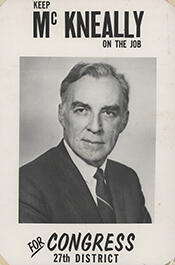
Here you will find contact information for Representative Martin Boswell McKneally, including email address, phone number, and mailing address.
| Name | Martin Boswell McKneally |
| Position | Representative |
| State | New York |
| District | 27 |
| Party | Republican |
| Status | Former Representative |
| Term Start | January 3, 1969 |
| Term End | January 3, 1971 |
| Terms Served | 1 |
| Born | December 31, 1914 |
| Gender | Male |
| Bioguide ID | M000530 |
About Representative Martin Boswell McKneally
Martin Boswell McKneally (December 31, 1914 – June 14, 1992) was a Republican member of the United States House of Representatives from New York who served one term in Congress from January 3, 1969, to January 3, 1971. A lifelong New Yorker, he was also a prominent veterans’ leader and served as National Commander of The American Legion from 1959 to 1960, playing a notable role in mid‑twentieth‑century veterans’ affairs and civic life.
McKneally was born in Newburgh, New York, the son of George F. and Ellen (née Lahey) McKneally. He attended the public schools of Newburgh and graduated from Newburgh Free Academy. He went on to the College of the Holy Cross, from which he graduated in 1936, and then studied law at Fordham University School of Law, receiving his degree in 1940. After being admitted to the bar, he practiced law in both Newburgh and New York City, establishing himself as an attorney before the United States entered the Second World War.
In 1941, McKneally was drafted into the United States Army. He attended The Judge Advocate General’s School, then located at the University of Michigan, and received a commission as a second lieutenant in the Army Judge Advocate General’s Corps. During his military service he taught military law at Grinnell College and was later deployed to the Pacific theater. In the Pacific he served on the staff of Lieutenant General Robert C. Richardson, commander of the Central Pacific Area. He was released from active duty in 1946 with the rank of major, returning to New York to resume his legal career and deepen his involvement in veterans’ organizations and public affairs.
McKneally’s postwar public life was closely tied to The American Legion. He rose through the organization’s ranks, serving as New York State American Legion commander from 1957 to 1958 and then as National Commander from 1959 until 1960. His national administration was particularly notable for his decision to disaffiliate the 40 and 8 Society from the Legion because of that organization’s racially discriminatory membership requirements, a move that underscored his willingness to confront segregation within veterans’ circles. At the same time, he remained active in local government in Newburgh, serving as president of the Newburgh school board, and he continued to practice law.
In addition to his veterans’ leadership, McKneally held several important advisory and legal positions in New York state government and civic enterprises. He served as special counsel to Lieutenant Governor Malcolm Wilson from 1960 to 1968, providing legal and policy advice during a period of significant growth and change in New York. He was also counsel to the 1964 New York World’s Fair from 1961 to 1965, contributing to the legal and organizational framework of that major international exposition. These roles, combined with his American Legion prominence, helped establish his reputation as a public figure and paved the way for his entry into electoral politics.
In 1968, McKneally was elected as a Republican to the United States House of Representatives from New York, defeating Democratic incumbent John G. Dow. He took his seat in the Ninety‑first Congress on January 3, 1969, and served until January 3, 1971. His term in the House of Representatives coincided with a significant period in American history marked by the Vietnam War, social unrest, and evolving domestic policy debates. As a member of the House, Martin Boswell McKneally participated in the legislative process, represented the interests of his New York constituents, and contributed to the broader democratic deliberations of the era during his single term in office.
McKneally sought reelection in 1970, but his congressional career was cut short by a tax controversy that emerged late in the campaign. During the final month of the 1970 race, it was revealed that he had not paid federal income taxes for many years. He contended that the Internal Revenue Service had over‑withheld his taxes, but the explanation failed to persuade many voters. In the ensuing election he was defeated by John G. Dow, who reclaimed the seat with 52 percent of the vote to McKneally’s 48 percent. McKneally was later found guilty of tax evasion and was sentenced to one year of probation and fined, placing him among the American federal politicians convicted of crimes arising from their public careers.
In his personal life, McKneally never married and had no children. His family remained active in Newburgh’s civic affairs; his brother George McKneally served as mayor of Newburgh. After leaving Congress, Martin Boswell McKneally returned to private life in New York. He died on June 14, 1992, at the Veterans Administration facility in Castle Point, New York. He was interred at Cedar Hill Cemetery and Mausoleum in Newburgh, the community where he had been born, educated, and spent much of his professional and public life.