President Martin Van Buren
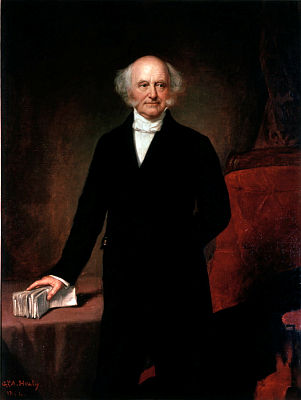
Here you will find contact information for President Martin Van Buren, including email address, phone number, and mailing address.
| Name | Martin Van Buren |
| Position | President |
| State | United States |
| Party | |
| Status | Former Representative |
| Term Start | March 4, 1837 |
| Term End | March 4, 1841 |
| Terms Served | 1 |
| Born | December 5, 1782 |
| Gender | Male |
| Website | Official Website |
About President Martin Van Buren
Martin Van Buren was born in the rural town of Kinderhook, New York, on December 5, 1782. His father, Abraham, owned a successful inn and small farm. The Van Buren tavern served as a hub of social activity for the town, and the constant coming and goings of travelers between New York City and the state capital of Albany brought young Martin into contact with all sorts of people–both free and enslaved. In 1807, Martin married Hannah Hoes and the two had five children, but Hannah tragically died in 1819, long before Van Buren ascended to the presidency.
Van Buren studied law and quickly became immersed in New York politics. He rose rapidly through the ranks of the Democratic-Republican Party and became the leader of the Bucktail faction. In 1821, the state legislature elected Van Buren to represent New York in the United States Senate, where he served until he resigned to become the Governor of New York. He held this office briefly before accepting the position of Secretary of State for President Andrew Jackson.
Van Buren’s political ascent continued when he sided with President Jackson, Secretary of War John Eaton, and Eaton’s wife Margaret during the scandalous Petticoat affair. As the president’s relationship with Vice President John C. Calhoun deteriorated, Jackson asked Van Buren to serve as the U.S. Minister to the United Kingdom. During Van Buren’s confirmation hearing in the Senate, Vice President Calhoun delivered the decisive nay vote, confident that it would destroy Van Buren’s career and sabotage his political ambitions. Instead, the episode brought Van Buren closer to Jackson and elevated his reputation among Democrats. President Jackson asked him to join the 1832 ticket as his vice president, and after Jackson’s re-election, Van Buren became one of the president’s closest advisors and confidantes. When Jackson decided not to run for a third term, Vice President Van Buren was the natural choice to succeed him.
Van Buren’s strong support of Jackson’s agenda–along with his northern roots–gave him broader appeal to the electorate, and he defeated a crowded field of candidates in 1836. He became the first president to use the term “slavery” in an inaugural address, affirming his support for the institution. As president, Van Buren continued many of his predecessor’s policies–including the forcible removal of thousands of Native Americans from their lands. His administration’s involvement in the United States v. Amistad case on behalf of the Spanish government was viewed as a defense of slavery, though it lost the case at the United States Supreme Court. He did draw a sharp contrast to Jackson on the issue of Texas, as Van Buren believed annexation of a territory that permitted slavery would incite political discord and likely instigate a war with Mexico.
During his time in the White House, President Van Buren relied upon free and enslaved African Americans to operate and maintain the President’s House. This mix of staff was not unusual, as many of his predecessors had done the same; and Van Buren himself had previously used both free and enslaved labor at Decatur House while he served as secretary of state. However, more attention was paid to his household expenditures rather than who was working in his house. The Panic of 1837 was one of the worst economic depressions in the young country’s history. As a result, critics accused the president of living lavishly while ordinary Americans struggled to make ends meet. This perception–and the running of a popular war hero in William Henry Harrison–contributed to Van Buren’s defeat in his reelection campaign. Click to learn more about the enslaved households of President Martin Van Buren.
In 1844, Van Buren was poised to reclaim leadership of the Democratic Party, but his opposition to the annexation of Texas ultimately hurt him with southern delegates and those that favored westward expansion. Van Buren made one more attempt to return to the White House in 1848 as the presidential candidate for the Free Soil Party–a party that was formed to oppose the expansion of slavery into the western territories. Major General Zachary Taylor ultimately won the 1848 election, and Van Buren never ran for political office again. The former president lived out the rest of his life at Lindenwald, where he died on July 24, 1862.