Representative Martin Welker
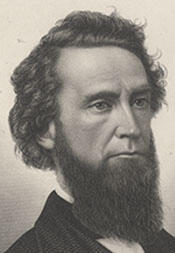
Here you will find contact information for Representative Martin Welker, including email address, phone number, and mailing address.
| Name | Martin Welker |
| Position | Representative |
| State | Ohio |
| District | 14 |
| Party | Republican |
| Status | Former Representative |
| Term Start | December 4, 1865 |
| Term End | March 3, 1871 |
| Terms Served | 3 |
| Born | April 25, 1819 |
| Gender | Male |
| Bioguide ID | W000270 |
About Representative Martin Welker
Martin Welker (April 25, 1819 – March 15, 1902) was an American politician, soldier, and judge who served as a Republican U.S. Representative from Ohio for three terms from 1865 to 1871 and later as a district judge of the United States District Court for the Northern District of Ohio from 1873 to 1889. His congressional service occurred during the critical years of the American Civil War’s aftermath and Reconstruction, and he subsequently played a significant role in the federal judiciary and in civic and educational life in Ohio.
Welker was born on April 25, 1819, in Knox County, Ohio. His father was an immigrant from the German Confederation and one of the early European pioneers in Ohio. Raised on a family farm, Welker left home at the age of fourteen to work as a clerk in a store in Millersburg, Ohio. He attended the common schools and then read law, beginning in 1840. That same year he was admitted to the bar and commenced private practice in Millersburg, where he practiced law from 1840 to 1846. On March 4, 1841, he married Maria Armour of Millersburg, establishing the family base that would anchor his early professional and political life.
Welker’s public career began in local judicial administration. He served as clerk of the Holmes County Court of Common Pleas from 1846 to 1851. A member of the Whig Party in the 1840s, he was the Whig nominee for the Thirty‑first United States Congress in 1848, but was defeated in what was then a largely Democratic district. In 1850 he was again offered the congressional nomination but declined and returned to private practice in Millersburg from 1851 to 1852. He ran unsuccessfully for election to the Thirty‑third Congress in 1852. That same year, however, he was elected judge of the Ohio Court of Common Pleas for the Sixth Judicial District, serving from 1852 to 1857. After leaving the bench, he resumed private practice in Wooster, Ohio, in 1857. By this time aligned with the emerging Republican Party, he was elected the fourth lieutenant governor of Ohio and president of the Ohio Senate in the Fifty‑third General Assembly, serving from 1857 to 1858 on the ticket headed by Governor Salmon P. Chase.
With the outbreak of the American Civil War, Welker entered military and administrative service for the Union. On May 14, 1861, he was appointed judge‑advocate of the Second Brigade of the Ohio Volunteer Militia with the rank of major and served with General Jacob Dolson Cox. On August 10, 1861, he was appointed aide‑de‑camp to the Governor of Ohio with the rank of colonel. He then served as Judge Advocate General of the State of Ohio for the remainder of 1861 and became superintendent of drafting under Governor David Tod beginning August 15, 1862. During 1862 he also served as assistant adjutant general. Although he had already held high staff rank, Welker formally enlisted in the Union Army on February 16, 1865, as a private in Company I, 188th Ohio Volunteer Infantry, and was mustered out on September 21, 1865. He was an unsuccessful Republican candidate for election to the Thirty‑eighth Congress in 1862, but his continued prominence in law, politics, and wartime service sustained his standing in Ohio public life.
Welker was elected as a Republican from Ohio’s 14th congressional district to the United States House of Representatives for the Thirty‑ninth, Fortieth, and Forty‑first Congresses, serving from March 4, 1865, to March 3, 1871. His three consecutive terms in the House coincided with the closing months of the Civil War and the early Reconstruction era, a significant period in American history. As a member of the House of Representatives, he participated in the legislative process during these transformative years and represented the interests of his Ohio constituents within the broader national debates over reunion, civil rights, and postwar policy. He was not a candidate for renomination to the Forty‑second Congress in 1870, bringing his six years of continuous congressional service to a close.
After leaving Congress, Welker entered the federal judiciary. On November 25, 1873, President Ulysses S. Grant gave him a recess appointment as judge of the United States District Court for the Northern District of Ohio, filling the vacancy created by the departure of Judge Charles Taylor Sherman. Grant formally nominated him to the same position on December 2, 1873; the United States Senate confirmed the nomination on December 8, 1873, and Welker received his commission that day. He served as a United States district judge until June 1, 1889, when his service terminated due to retirement. His sixteen years on the federal bench extended his influence from the legislative to the judicial branch during a period of industrial expansion and legal change in the postwar Midwest.
Concurrent with his federal judicial service, Welker was active in education, finance, and veterans’ affairs. Beginning in 1873, he served as a professor of political science and international law at the College of Wooster, a position he held until 1890. He also became president of the Wooster National Bank, reflecting his prominence in local financial circles, and served as vice president of the Wayne County Fair Board, contributing to the civic and agricultural life of his community. As a veteran of the Union cause, he was a member of the Grand Army of the Republic, maintaining ties with fellow soldiers and participating in veterans’ organizations. After the death of his first wife, Maria Armour, he married Flora Uhl of Cleveland, Ohio, on January 16, 1896.
Martin Welker died on March 15, 1902, in Wooster, Ohio. He was interred in Wooster Cemetery, closing a career that had spanned local and state office, military and administrative service in the Civil War, three terms in the United States Congress, and more than a decade and a half on the federal bench, along with substantial contributions to education and civic life in northern Ohio.