Representative Maurice Edgar Crumpacker
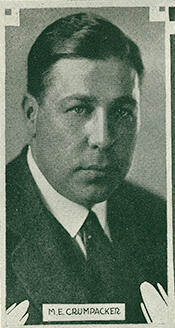
Here you will find contact information for Representative Maurice Edgar Crumpacker, including email address, phone number, and mailing address.
| Name | Maurice Edgar Crumpacker |
| Position | Representative |
| State | Oregon |
| District | -1 |
| Party | Republican |
| Status | Former Representative |
| Term Start | December 7, 1925 |
| Term End | March 3, 1929 |
| Terms Served | 2 |
| Born | December 19, 1886 |
| Gender | Male |
| Bioguide ID | C000959 |
About Representative Maurice Edgar Crumpacker
Maurice Edgar Crumpacker (December 19, 1886 – July 24, 1927) was a Republican U.S. congressman from Oregon who served in the United States House of Representatives during a significant period in American history. Born in Valparaiso, Indiana, he was the son of Edgar D. Crumpacker, who himself served in the U.S. House of Representatives from Indiana. When Maurice was ten years old, his father was elected to Congress, and the family’s relocation to the nation’s capital exposed him early to national politics and public life. He attended public schools in Valparaiso and then in Washington, D.C., completing his primary education in the capital. His family was part of a broader political lineage; a cousin, Shepard J. Crumpacker, Jr., would later serve in the House of Representatives representing Indiana.
After his early schooling in Washington, D.C., Crumpacker returned to Indiana and enrolled at Culver Military Academy, from which he graduated in 1905. He then attended the University of Michigan, where he distinguished himself both academically and athletically. At Michigan he played football under the renowned coach Fielding H. Yost and was a starting right tackle on the 1908 Michigan Wolverines football team in his senior year. He graduated from the University of Michigan in 1909 and subsequently pursued legal studies at Harvard Law School. Upon completion of his legal education, he was admitted to the bar in 1912, marking the formal beginning of his professional career.
In 1912, Crumpacker moved to the Pacific Northwest and established a law practice in Portland, Oregon. As his legal career developed, the United States moved toward participation in World War I, and Crumpacker entered military service. He was commissioned as a first lieutenant in the Aviation Section of the U.S. Army Signal Corps. In 1917 he was placed in charge of the Loyal Legion of Loggers and Lumbermen, a company union organized for the Army’s Spruce Production Division, which was responsible for supplying critical lumber for military aircraft and ships. His leadership in this wartime industrial effort led to his promotion to captain in the division. He was honorably discharged from the Army in 1918 and returned to Portland, where he resumed his legal and civic activities.
Crumpacker’s growing prominence in Oregon’s legal community led to his appointment in 1921 as special deputy district attorney for Multnomah County. Seeking to extend his public service to the national level, he ran for the Republican nomination for the U.S. House of Representatives in 1922, though this initial effort was unsuccessful. Undeterred, he sought the nomination again in 1924, this time securing it and winning election as the representative for Oregon’s 3rd congressional district. A member of the Republican Party, he took his seat in the Sixty-ninth Congress in 1925 and was re-elected for the Seventieth Congress, contributing to the legislative process during two terms in office. His service in Congress occurred during a significant period in American history, and as a member of the House of Representatives he participated in the democratic process and represented the interests of his Oregon constituents in national affairs.
Crumpacker’s congressional career was cut short by his sudden and tragic death in 1927 while still in office. In July of that year, he was invited by Speaker of the House Nicholas Longworth to travel down the West Coast from Seattle in a special train car as the guest of a director of the Northern Pacific Railroad. Crumpacker, who stood 6 feet 2 inches tall and weighed about 200 pounds (1.88 m, 91 kg), was reportedly uncomfortable in the intense heat of California’s Central Valley during the journey. The train reached San Francisco on July 22, with plans for the party to continue on to Salinas and then to the ranch of California Senator James D. Phelan the following day. When the time came to depart, however, Crumpacker could not be located, and the group proceeded without him.
Later that day, Crumpacker was found sitting on a curb in San Francisco, behaving erratically and claiming that he had been poisoned. Authorities eventually subdued and handcuffed him and took him to a hospital, where a physician observed that he appeared to be under great nervous strain and exhibited symptoms described at the time as those of a paranoiac. By the next morning, Crumpacker had persuaded hospital officials to release him. News of his disturbed condition reached Thomas Smart, a Seattle newspaperman who was vacationing in the area, and Smart agreed to accompany Crumpacker back to Portland that night. While the two men were walking along the shore of San Francisco Bay, Crumpacker suddenly broke away, ran, and leapt into the water. Though Smart and others quickly pulled him from the Bay, efforts to revive him were unsuccessful, and he was pronounced dead on July 24, 1927. Several notes left by Crumpacker indicated that he believed he had been murdered by his friends, adding a further element of mystery and distress to the circumstances of his death.
Following his death, Crumpacker’s body was returned to Portland, where he was honored with extensive public tributes for his military service, legal career, and work in Congress. He was interred at River View Cemetery in Portland, Oregon. He was survived by his wife, Cully Cook Crumpacker, and three sons, James, Edgar, and Peter. His Portland residence, known as the Maurice Crumpacker House and designed by noted Portland architect Wade Hampton Pipes, later gained recognition for its architectural and historical significance and was added to the National Register of Historic Places in 1992. Crumpacker’s death in office places him among the members of the United States Congress who died while still serving between 1900 and 1949, and his career reflects both a family tradition of public service and the political life of Oregon and the nation in the 1920s.