Representative Max Schwabe
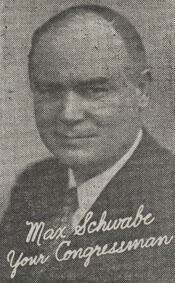
Here you will find contact information for Representative Max Schwabe, including email address, phone number, and mailing address.
| Name | Max Schwabe |
| Position | Representative |
| State | Missouri |
| District | 2 |
| Party | Republican |
| Status | Former Representative |
| Term Start | January 6, 1943 |
| Term End | January 3, 1949 |
| Terms Served | 3 |
| Born | December 6, 1905 |
| Gender | Male |
| Bioguide ID | S000156 |
About Representative Max Schwabe
Max Schwabe (December 6, 1905 – July 31, 1983) was a United States Representative from Missouri and a member of the Republican Party who served three consecutive terms in Congress from 1943 to 1949. He was the brother of George B. Schwabe, who also served in the U.S. House of Representatives, representing Oklahoma. Over the course of his public career, Max Schwabe combined experience in agriculture, business, and federal administration with his legislative service during a pivotal era in American history.
Schwabe was born on December 6, 1905, in Columbia, Boone County, Missouri. Raised in central Missouri, he came of age in a region where farming and small business were central to the local economy, influences that would later shape his professional pursuits and political interests. He attended the University of Missouri in Columbia, pursuing higher education in his home state. Although detailed records of his course of study are limited, his time at the university placed him in one of Missouri’s principal centers of learning and public life.
Before entering elective office, Schwabe worked as both an insurance agent and a farmer. This combination of occupations reflected the economic realities of mid-20th-century Missouri, where many individuals balanced agricultural work with business or professional endeavors. His experience in farming provided him with firsthand knowledge of rural concerns, while his work in insurance acquainted him with issues of risk, finance, and personal security. These dual roles helped prepare him for later responsibilities in both Congress and the federal executive branch, particularly in matters affecting rural communities and agricultural development.
Schwabe was elected as a Republican to the Seventy-eighth and the two succeeding Congresses, serving from January 3, 1943, to January 3, 1949. His tenure in the U.S. House of Representatives coincided with World War II and the early postwar period, years in which Congress addressed issues of wartime mobilization, veterans’ readjustment, economic reconversion, and the emerging international order. As a member of the House, Schwabe participated in the legislative process and represented the interests of his Missouri constituents during this significant period in American history. He contributed to debates and votes on measures affecting both the home front and the broader national economy, reflecting the concerns of a state with substantial agricultural and rural populations.
After three terms in office, Schwabe sought reelection in 1948 but was an unsuccessful candidate for the Eighty-first Congress. His defeat ended his service in the House on January 3, 1949, but did not conclude his involvement in public affairs. Drawing on his agricultural background and legislative experience, he later assumed a key administrative role in the federal government.
From 1953 to 1961, Schwabe served as the Missouri state director of the Farmers Home Administration in the United States Department of Agriculture. In this capacity, he oversaw federal programs designed to assist farmers and rural residents, including efforts to improve farm credit, housing, and rural infrastructure. His leadership in the Farmers Home Administration extended his long-standing engagement with agricultural issues and allowed him to influence rural development policy at the state level during the postwar expansion of federal support for farming communities.
Max Schwabe died on July 31, 1983. He was interred in Columbia Cemetery in Columbia, Missouri, returning in death to the city of his birth and early education. His career encompassed service as a farmer, insurance agent, member of Congress, and federal administrator, reflecting a lifelong connection to Missouri and to the agricultural and rural interests he represented.