Senator Mel Martinez
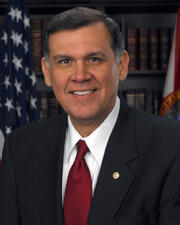
Here you will find contact information for Senator Mel Martinez, including email address, phone number, and mailing address.
| Name | Mel Martinez |
| Position | Senator |
| State | Florida |
| Party | Republican |
| Status | Former Representative |
| Term Start | January 4, 2005 |
| Term End | September 9, 2009 |
| Terms Served | 1 |
| Born | October 23, 1946 |
| Gender | Male |
| Bioguide ID | M001162 |
About Senator Mel Martinez
Melquíades Rafael Ruiz Martínez (born October 23, 1946) is a Cuban-American lobbyist and former public official who served as a United States senator from Florida from January 3, 2005, to September 9, 2009. A member of the Republican Party, he was the first Cuban-American elected to the U.S. Senate and also served as general chairman of the Republican National Committee from November 2006 until October 19, 2007. Before his Senate service, Martínez was a local elected official in Florida and a member of the Cabinet of President George W. Bush, serving as the 12th secretary of housing and urban development from 2001 to 2004.
Martínez was born in Sagua La Grande, Cuba, and came to the United States as a teenager in the early 1960s as part of Operation Peter Pan, a program that brought unaccompanied Cuban children to the United States following the Cuban Revolution. He initially lived with foster families and in youth facilities before being reunited with his parents, who later emigrated from Cuba. Settling in Florida, he became a naturalized U.S. citizen and pursued his education while working to support himself and his family, experiences that shaped his later political emphasis on opportunity, immigration, and the rule of law.
Martínez attended Florida State University, where he earned a bachelor’s degree and subsequently a Juris Doctor from the Florida State University College of Law. After law school, he established a legal career in Orlando, Florida, focusing on civil litigation and business law. Over time he became a prominent attorney and community leader in Central Florida, gaining visibility in civic affairs and within Republican Party circles. His legal and civic work laid the foundation for his entry into electoral politics and statewide party activities.
In 1994, Martínez made his first bid for statewide office when he ran for lieutenant governor of Florida on a Republican ticket headed by pro-life activist Ken Connor, who would later serve as president of the Family Research Council. The Connor–Martínez ticket was defeated in the Republican primary, finishing fifth with 83,945 votes, or 9.31 percent of the vote. Four years later, on November 3, 1998, Martínez was elected Orange County Chairman (a position commonly referred to as county mayor), defeating Republican State Senator John Ostalkiewicz. As Orange County Chairman, he served through the end of 2000 and became known for implementing what became known as the “Martínez doctrine,” a growth-management policy that prohibited new development from taking place unless adequate public infrastructure—particularly school capacity—was in place to support it. The doctrine was challenged in court, but its legality was upheld when the Florida Supreme Court declined to hear an appeal from a lower court ruling that sustained the policy.
Martínez’s rising profile in Florida Republican politics led to a prominent role in national campaigns. He served as co-chairman of then–Texas Governor George W. Bush’s 2000 presidential election campaign in Florida and was a leading fundraiser for the Bush campaign. Following the disputed 2000 election, he was one of the 25 presidential electors from Florida who cast their Electoral College votes for Bush. In recognition of his political support and his background in local government and housing issues, President Bush nominated Martínez to be secretary of housing and urban development. Confirmed by the Senate, he served as HUD secretary from 2001 to 2004, during which time he was an ex officio member of the President’s Advisory Commission on Educational Excellence for Hispanic Americans. In that role, he worked on housing policy, homeownership initiatives, and urban development programs, with particular attention to minority and low-income communities.
On August 12, 2004, Martínez resigned his Cabinet post to run for the open U.S. Senate seat in Florida being vacated by retiring Democratic Senator Bob Graham. He secured the Republican nomination and in the general election narrowly defeated the Democratic nominee, former Florida Education Commissioner Betty Castor. His victory made him the first Cuban-American to serve in the United States Senate. Sworn in on January 3, 2005, Martínez represented Florida during a period marked by the ongoing conflicts in Iraq and Afghanistan, debates over immigration reform, and the aftermath of major hurricanes affecting his state. As a senator, he participated in the legislative process and represented the interests of his Florida constituents, aligning generally with Republican positions on national security, tax policy, and judicial nominations, while also taking a visible role in issues affecting Hispanic and immigrant communities.
During his Senate tenure, Martínez also assumed a national party leadership role. In November 2006 he was selected as general chairman of the Republican National Committee, a position he held until October 19, 2007. In that capacity he was involved in party strategy, fundraising, and outreach in the run-up to the 2008 election cycle, while continuing to serve in the Senate. On December 2, 2008, Martínez announced that he would not seek re-election to the Senate in 2010, signaling an intention to return to private life after completing his term. However, on August 7, 2009, CNN and the Orlando Sentinel reported that he would resign his Senate seat before the end of his term. He formally left the Senate on September 9, 2009, and later that month Florida Governor Charlie Crist announced that he would appoint George LeMieux to serve as Martínez’s successor for the remaining year and a half of the Senate term.
Martínez’s Senate service also intersected with sensitive foreign policy and human rights issues. Three months into President Barack Obama’s term, in April 2009, the administration asked Senator Martínez to deliver a private message to Spanish government officials concerning a potential Spanish investigation into former Bush administration officials over alleged rendition and torture of Guantánamo Bay detainees. According to reporting by journalist Carol Rosenberg, Spanish human rights advocates had compiled a detailed dossier seeking to hold several former U.S. legal and defense officials—among them former Attorney General Alberto Gonzales; David Addington, former chief of staff and legal adviser to the Vice President; William Haynes, former Department of Defense general counsel; Douglas Feith, former under secretary of defense for policy; Jay Bybee, former head of the Department of Justice Office of Legal Counsel; and John Yoo, a former OLC staff member—accountable under Spain’s universal jurisdiction laws. On April 15, 2009, Martínez met with Acting Foreign Minister Ángel Losada at the Spanish foreign ministry, warning that prosecutions would not be understood or accepted in the United States and would have an “enormous impact” on the bilateral relationship. Losada responded that Spain’s judiciary was independent and that the executive branch could not close any judicial investigation, urging that the case not be allowed to damage broader U.S.–Spanish relations. Following this outreach, Spanish Attorney General Cándido Conde-Pumpido’s office indicated that prosecutors would make a recommendation to the National Court, where Judge Baltasar Garzón—an outspoken critic of the Guantánamo Bay detention facility who had publicly suggested that former President George W. Bush should be tried for war crimes—would decide whether to proceed. In April 2010, on Conde-Pumpido’s advice that an American tribunal should address the matter before any Spanish court became involved, prosecutors recommended that Judge Garzón drop the investigation, with the attorney general warning that the case risked turning the court “into a toy in the hands of people who are trying to do a political action.”
After leaving the Senate, Martínez moved into the private sector as a lobbyist and financial executive. Two weeks after his resignation, The Hill reported that he would become a lobbyist and partner at the international law and lobbying firm DLA Piper. He left DLA Piper in August 2010 to become chairman of Chase Bank Florida and to oversee its operations in Mexico, Central America, and the Caribbean. He later assumed a broader role at JPMorgan Chase & Co., serving as chairman of the Southeast and Latin America, where he has been involved in regional strategy, client relations, and business development. In addition to his corporate responsibilities, Martínez has remained active in public policy circles, serving as a co-chair of the Housing Commission at the Bipartisan Policy Center, where he contributes to national discussions on housing finance, affordability, and community development.
Martínez and his wife, Kitty, have three children and five grandchildren. He is the brother of Rafael E. Martínez and resides in Orlando, Florida. Throughout his career in local government, the federal Cabinet, the United States Senate, and the private sector, he has remained a prominent figure in Florida and national politics, particularly as a representative of the Cuban-American community and as a participant in debates over housing, immigration, and U.S. relations with Latin America and Europe.