Representative Mel Reynolds
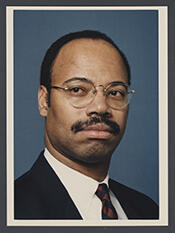
Here you will find contact information for Representative Mel Reynolds, including email address, phone number, and mailing address.
| Name | Mel Reynolds |
| Position | Representative |
| State | Illinois |
| District | 2 |
| Party | Democratic |
| Status | Former Representative |
| Term Start | January 5, 1993 |
| Term End | October 1, 1995 |
| Terms Served | 2 |
| Born | January 8, 1952 |
| Gender | Male |
| Bioguide ID | R000178 |
About Representative Mel Reynolds
Melvin Reynolds, commonly known as Mel Reynolds, was born on January 8, 1952, in Mound Bayou, Bolivar County, Mississippi. He is one of twin sons of Reverend J. J. Reynolds and Essie Mae Prather; his twin brother is Marvin Jerry Reynolds. During his childhood, Reynolds moved with his family to Chicago, Illinois, where he was raised. His early life in Chicago, combined with his family’s religious and community-oriented background, helped shape his later interest in public service, civil rights, and economic development in urban communities.
Reynolds pursued higher education through a series of academic achievements. He first earned an Associate of Arts degree from one of the City Colleges of Chicago. He then attended the University of Illinois at Urbana–Champaign, from which he graduated, and went on to Harvard University, where he received a Master of Public Administration (M.P.A.). Demonstrating notable academic distinction, Reynolds was awarded a Rhodes Scholarship to the University of Oxford. At Oxford he attended Lincoln College and obtained an LL.B. degree. This combination of American and British higher education, particularly in public administration and law, provided him with a strong foundation for a career in politics and public policy.
Before entering elective politics, Reynolds worked in academia and community development. He served as an assistant professor of political science at Roosevelt University in Chicago, Illinois, where he taught and conducted work related to government and public affairs. In addition to his academic role, he founded the Community Economic Development and Education Foundation, an organization focused on promoting economic opportunity and educational advancement in underserved communities. These early professional activities underscored his interest in economic development, education, and civic engagement on Chicago’s South Side and in surrounding areas.
Reynolds’s political career began with a series of campaigns for Congress in Illinois’s 2nd Congressional District. Between 1988 and 1992, he ran three times in Democratic Party primaries against incumbent Representative Gus Savage, who had become known for racially incendiary and anti-Semitic remarks that drew criticism from both Republicans and Democrats. In the 1988 primary, Reynolds finished third in a multi-candidate field, receiving about 14 percent of the vote. In 1990, he ran again and lost, but the race was closer, coming after Savage had been criticized by the House Ethics Committee in connection with a sex scandal. Following redistricting in 1992, the 2nd District was pushed further into Chicago’s suburbs, a change widely viewed as favorable to Reynolds. The New York Times reported that the new district configuration was “seen as a benefit to the 40-year-old Mr. Reynolds, whose appeals for accountability and racial unity sit well with middle-class black moderates embarrassed by Mr. Savage and whites frightened by his often combative, racially charged speech.” Shortly before the 1992 primary, Reynolds was lightly injured when unknown assailants fired shotguns at his vehicle as he waited at an intersection. He was given police protection for the remainder of the campaign. Supporters of Savage accused Reynolds of staging the incident to gain sympathy and cast suspicion on Savage, but Reynolds did not directly accuse Savage of involvement.
On March 17, 1992, Reynolds defeated Savage in the Democratic primary, and he went on to win the general election in November, securing a seat in the U.S. House of Representatives from Illinois. A member of the Democratic Party, he began serving in the 103rd Congress on January 3, 1993, representing Illinois’s 2nd Congressional District. Although his tenure in Congress lasted from 1993 to 1995, he is sometimes described as having served two terms in office because he was re-elected in 1994; however, his second term was cut short by his resignation. During his time in the House of Representatives, Reynolds participated in the legislative process during a significant period in American political and economic history and represented the interests of his constituents from Chicago and its suburbs. He achieved unusual prominence as a freshman when he was granted a seat on the powerful Committee on Ways and Means, becoming the first freshman in 14 years to serve on that committee. In Congress, he supported major trade legislation, voting in favor of the North American Free Trade Agreement (NAFTA), and he introduced legislation related to gun control, reflecting his concern with crime and public safety in urban communities.
Reynolds’s congressional service was overshadowed and ultimately ended by criminal charges and convictions. In August 1994, he was indicted in Illinois state court on charges of criminal sexual assault and criminal sexual abuse for engaging in a sexual relationship with a 16-year-old campaign volunteer that began during his 1992 campaign. He also faced charges of child pornography for asking the underage campaign worker to obtain “lewd photographs of another girl who was age 15,” as well as obstruction of justice for attempting to persuade one of the girls involved to lie to authorities. Despite these serious allegations, Reynolds continued his 1994 re-election campaign and was returned to Congress in November without opposition. He initially denied the charges and asserted that they were racially motivated. On August 22, 1995, Reynolds was convicted on 12 counts, including criminal sexual assault, sexual abuse, obstruction of justice, and solicitation of child pornography. In light of the conviction, and under longstanding House rules that would have severely limited his ability to participate in floor votes and committee work as a convicted felon, Reynolds resigned his seat effective October 1, 1995. He was sentenced to five years in prison and was expected to be released in 1998.
While still entangled in the consequences of his first conviction, Reynolds faced additional federal charges. In April 1997, he was convicted on 16 counts related to financial misconduct, including bank fraud, wire fraud, misuse of campaign funds for personal expenses, and making false statements to investigators from the Federal Election Commission (FEC). Specifically, the convictions encompassed one count of bank fraud, two counts of wire fraud, eight counts of making false statements on loan applications, one count of conspiracy to defraud the FEC, and four counts of making false statements to the FEC. These offenses resulted in an additional sentence of 78 months in federal prison, ordered to run consecutively to his earlier sentence. Reynolds served the entirety of his initial five-year sentence and 42 months of the later sentence before President Bill Clinton commuted the remainder of his bank fraud sentence. Following the commutation, Reynolds was released from prison and completed the balance of his term in a halfway house.
After his release, Reynolds sought to reestablish himself in public life and politics, though with limited success. In January 2001, he was hired by Jesse Jackson’s Rainbow/PUSH Coalition to work on initiatives aimed at reducing the number of young African Americans entering the criminal justice system. He later attempted a political comeback by seeking to reclaim his former congressional seat. In 2004, he ran in the Democratic primary for Illinois’s 2nd District but was overwhelmingly defeated by the incumbent, Jesse Jackson Jr., who had succeeded him in Congress; Jackson received approximately 88 percent of the vote. Nearly a decade later, Reynolds again sought the same seat in the 2013 special election called after Jackson’s resignation. In that contest, Reynolds finished seventh in the Democratic primary, demonstrating the enduring impact of his criminal record on his political viability.
Reynolds’s later life has been marked by further legal and personal controversies, including international incidents and additional federal charges. On February 18, 2014, he was arrested in Zimbabwe for overstaying his visa. Authorities there alleged that he possessed pornographic videos he had filmed with several women at the hotel where he was staying, in a country where possession of pornography is a crime. He had also reportedly accumulated more than $24,000 in unpaid hotel charges. The pornography charges were subsequently dropped, but Reynolds pleaded guilty to violating Zimbabwean immigration laws and was deported to South Africa. In early March 2014, he claimed to be hiding in South Africa from Zimbabwean “death squads,” asserting that he was being targeted because he possessed information about American companies from Chicago allegedly doing business illegally in Zimbabwe.
Reynolds’s legal difficulties continued in the United States. On June 26, 2015, he was indicted by a federal grand jury for failure to file federal income tax returns for the 2009 through 2012 tax years on more than $400,000 in income. The following month, he missed his scheduled arraignment, stating that he could not return to the United States due to issues involving his daughter’s health. His exact whereabouts were unclear, although he had previously been reported as hiding in South Africa out of fear for his safety. In April 2016, Reynolds was sentenced to two months in prison for two bond violations in his tax case, and his trial on the tax charges was scheduled for September of that year. Choosing to represent himself in court, Reynolds argued that most of the income at issue had been provided by Chicago businessman Elzie Higginbottom, the government’s key witness, to finance travel to South Africa to explore opportunities in real estate and the diamond industry. On September 28, 2017, Judge Robert Gettleman found Reynolds guilty on all four counts of failing to file a federal income tax return for four consecutive years. On May 10, 2018, Reynolds was sentenced to six months in prison, which he began serving on August 1, 2018, at the Metropolitan Correctional Center in Chicago. After sentencing, he publicly stated that he planned to move to South Africa with his daughter upon his release.
Reynolds was released to a halfway house in November 2018 and continued to pursue legal actions related to his experiences abroad. He filed a lawsuit against deposed Zimbabwean president Robert Mugabe and a Chicago-area businessman, alleging that he had suffered “physical and psychological torture” during his 2014 detention in Zimbabwe. A U.S. court granted him permission to travel to Africa while on supervised release. Nonetheless, as of August 2019, public reports indicated that Reynolds was still residing in the Chicago area. Throughout his career and subsequent legal troubles, Melvin Reynolds has remained a notable, if controversial, figure in Illinois and national political history, as an African-American former United States representative whose congressional service and later life have been deeply intertwined with issues of law, ethics, and public accountability.